
Published: March 2020 | Last Updated:November 2025
© Copyright 2026, Reddog Consulting Group.

Every major retailer owes its success to a solid retail strategy. Harvard research shows companies that invest in strategy outperform competitors by up to 30 percent. You might think it’s all about flashy marketing and sales, but that’s only half the story. The real power comes from a smart plan that connects business goals with what customers actually want. Surprised? Wait until you see how these strategies reshape entire markets.
| Takeaway | Explanation |
|---|---|
| Define your target market precisely | Identify the customer segments most likely to buy your products or services for effective engagement. |
| Continuously refine your retail strategy | Stay agile by regularly analyzing market trends, customer behaviors, and competition for sustained relevance. |
| Create a unique competitive advantage | Differentiate your business by developing distinct positioning that sets you apart from competitors. |
| Leverage psychological triggers in marketing | Use emotional resonance, perceived value, and social validation to influence consumer purchasing decisions. |
| Integrate operational and customer strategies | Balance efficiency with a customer-centered approach to enhance overall business performance and customer satisfaction. |
A retail strategy represents a comprehensive blueprint that guides retailers in effectively targeting customers, positioning their brand, and achieving sustainable competitive advantages. At its core, a retail strategy is a structured approach that transforms business goals into actionable plans, enabling organizations to navigate complex market dynamics and create meaningful connections with their target audience.
Retail strategy encompasses several critical elements that work together to create a cohesive business approach. Penn State University’s research on retail strategic planning highlights three fundamental components:
These components are interconnected and require strategic alignment to generate meaningful business outcomes.
The following table summarizes the three fundamental components of a retail strategy and provides a concise explanation of each, making it easier to understand their interconnected roles.
| Component | Explanation |
|---|---|
| Target Market Identification | Defining specific customer segments most likely to engage with your products or services |
| Retail Format Selection | Determining the optimal method of delivering products and experiences to your chosen market |
| Competitive Advantage Development | Creating a unique positioning that differentiates your business from competitors |
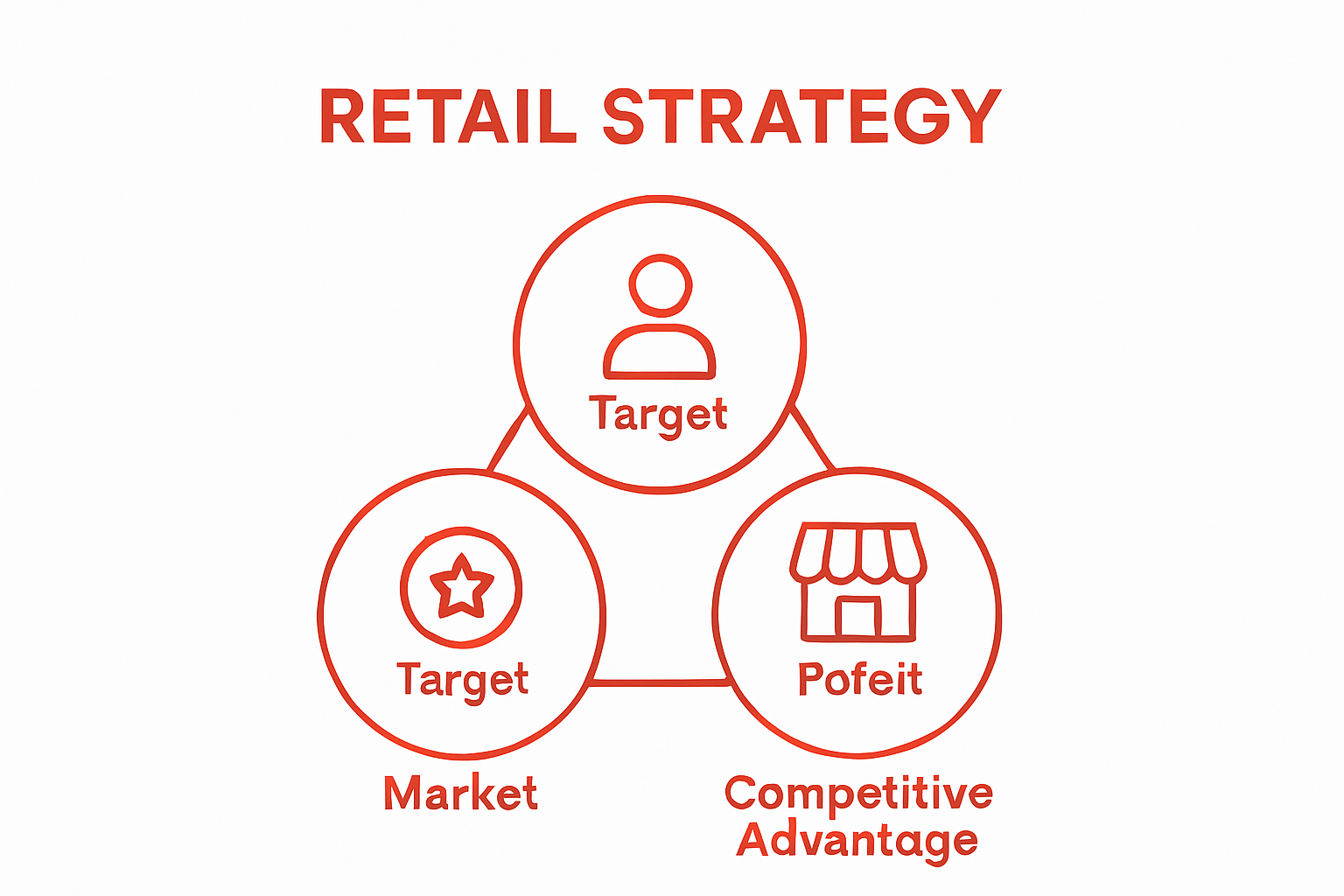 Successful retailers understand that a robust retail strategy goes beyond simple sales tactics and involves deep market understanding, customer insights, and adaptive planning.
Strategic planning in retail is not a one-time event but a continuous process of analysis, adaptation, and refinement. Retailers must consistently evaluate market trends, consumer behaviors, and competitive landscapes to maintain relevance. This dynamic approach requires businesses to remain agile and responsive to changing market conditions.
Key strategic considerations include understanding customer preferences, analyzing competitive positioning, and developing innovative approaches to meet evolving market demands. By read more about comprehensive retail strategy practices, businesses can create frameworks that support sustainable growth and long-term success.
A well-crafted retail strategy transforms abstract business goals into concrete operational plans, providing clear direction for merchandising, marketing, customer engagement, and overall business development. It serves as a roadmap that guides decision-making processes and helps organizations allocate resources effectively, ultimately driving profitability and market competitiveness.
Retail strategy plays a pivotal role in driving business growth by providing a structured framework that enables organizations to navigate complex market landscapes, optimize resource allocation, and create sustainable competitive advantages. Far beyond simple sales planning, a well-developed retail strategy serves as a comprehensive roadmap for transforming business potential into tangible market success.
Research from American Military University highlights emerging trends that underscore the critical importance of strategic planning in retail. The most successful businesses recognize that growth requires more than reactive approaches strategic thinking must be proactive, anticipatory, and deeply connected to evolving market dynamics.
Key areas where retail strategy drives business growth include:
A robust retail strategy serves multiple critical functions beyond revenue generation. It provides a systematic approach to understanding market complexities, managing operational risks, and creating resilient business models. By developing clear strategic frameworks, businesses can:
Businesses seeking comprehensive insights can explore our omnichannel strategy guide to understand advanced strategic planning techniques. Strategic planning transforms potential challenges into opportunities for growth, enabling organizations to move from reactive survival modes to proactive market leadership.
Ultimately, retail strategy is not just about immediate sales but about building sustainable, adaptable businesses capable of thriving in increasingly complex and competitive market environments. By investing in strategic planning, organizations create powerful mechanisms for continuous learning, innovation, and strategic transformation.
Retail strategy serves as a powerful mechanism for understanding, predicting, and ultimately shaping consumer behavior through sophisticated psychological and strategic approaches. By carefully designing marketing messages, product positioning, and customer experience frameworks, businesses can significantly influence consumer decision-making processes and purchasing patterns.
According to Johnson & Wales University Online, consumer behavior is fundamentally driven by complex psychological mechanisms that retailers can strategically leverage. These psychological triggers include:
Successful retail strategies recognize that consumers do not make purchasing decisions based solely on rational considerations. Instead, they are influenced by a complex interplay of emotional, social, and personal factors that can be strategically addressed through thoughtful marketing approaches.
Retail strategies shape consumer perception through carefully crafted communication channels. This involves developing consistent brand messaging, creating compelling visual narratives, and establishing trust through transparent and authentic interactions. Retailers who understand these nuanced communication dynamics can create powerful connections that transcend traditional transactional relationships.
By exploring advanced omnichannel strategy techniques, businesses can develop more sophisticated approaches to understanding and influencing consumer behavior. The most effective strategies move beyond simple persuasion tactics, focusing instead on creating genuine value and meaningful experiences that naturally attract and retain consumers.
Ultimately, retail strategy represents a sophisticated dialogue between businesses and consumers a dynamic process of understanding, anticipating, and responding to evolving market needs and individual preferences. By developing deep insights into consumer psychology and consistently delivering value, retailers can transform traditional transactional interactions into long-term, mutually beneficial relationships.
Effective retail strategies are multifaceted frameworks that integrate numerous interconnected elements to create comprehensive, dynamic business approaches. These strategies go beyond simple sales tactics, representing holistic systems designed to optimize organizational performance, customer engagement, and competitive positioning.
Harvard Business School research highlights critical components that form the backbone of successful retail strategies. These foundational elements include:
Successful retailers understand that these components are not standalone tactics but interconnected systems requiring continuous refinement and strategic alignment. The most effective strategies create synergies between different organizational capabilities, transforming potential challenges into opportunities for growth and innovation.
Retail strategies must balance operational efficiency with customer-centric approaches. This involves developing robust supply chain management, implementing data-driven decision-making processes, and creating flexible operational models that can quickly adapt to changing market conditions.
By exploring advanced omnichannel strategy techniques, businesses can develop more sophisticated, integrated approaches to retail strategy. The most successful organizations view their strategy not as a static document but as a dynamic, evolving framework that continuously responds to market shifts and emerging consumer trends.
Ultimately, effective retail strategies represent sophisticated ecosystems that balance technical precision with creative innovation. They require a holistic understanding of market dynamics, organizational capabilities, and the complex interplay between technological infrastructure, human behavior, and strategic vision.

Successful retail strategies demonstrate how innovative approaches can transform market challenges into powerful competitive advantages. By examining real-world examples, businesses can uncover valuable insights into strategic implementation, customer engagement, and sustainable growth models that transcend traditional retail paradigms.
Research by Wharton marketing professor Barbara Kahn reveals distinctive strategic approaches adopted by leading retailers. These examples showcase how different organizations create unique value propositions:
Each of these retailers has identified a specific strategic dimension that differentiates them from competitors, demonstrating that successful retail strategy is not about universal approaches but about finding unique market positioning.
Here is a comparison table highlighting the distinctive strategic value dimensions adopted by successful retailers as mentioned in the article.
| Retailer | Strategic Value Focus | Notable Approach |
|---|---|---|
| Amazon | Convenience | Prioritizes seamless digital experiences |
| Walmart | Low-Cost | Consistently focuses on offering low-price products |
| Warby Parker | Brand Experience | Creates a curated experience targeting millennial consumers |
| Sephora | In-Store Engagement | Delivers superior customer service and personalization |
Successful retailers understand that strategy is a dynamic process requiring continuous adaptation. They invest in understanding evolving customer preferences, technological shifts, and emerging market trends. This approach allows them to create flexible frameworks that can quickly respond to changing consumer behaviors.
By exploring advanced omnichannel strategy techniques, businesses can learn how top-performing retailers integrate digital and physical experiences. The most successful strategies blur traditional boundaries between online and offline channels, creating seamless, integrated customer journeys.
Ultimately, these real-world examples reveal that effective retail strategies are not about copying successful models but about understanding fundamental principles of value creation, customer engagement, and strategic flexibility. The most successful retailers view their strategy as a living, breathing ecosystem that continuously evolves to meet changing market demands.
You have just learned how a strong retail strategy drives business growth, customer engagement, and long-term success. But understanding these core principles is only the first step. The real challenge is putting these strategies into action, especially when you are facing complex market changes, struggling to connect with the right audience, or juggling multiple sales channels without clear direction. If you want to move from insights to measurable results, you need a partner who can bridge strategy with execution.
Reddog Group has helped over 50 brands unlock growth by transforming ideas into winning omnichannel strategies. You can see how our omnichannel strategy guide and omnichannel process insights identify new opportunities for brand expansion and sharpen your competitive edge. Do not let uncertainty hold your business back. Discover practical solutions and expert support that supercharge your marketplace management, digital marketing, and integrated retail strategies at Reddog Group. Take the next step now to secure sustainable growth for your brand.
A retail strategy typically comprises three core components: target market identification, retail format selection, and competitive advantage development. These elements work together to create a cohesive approach for retailers to connect with their customers and differentiate themselves in the market.
Strategic planning is crucial in retail as it allows businesses to remain agile and responsive to market changes. By continuously evaluating trends, customer preferences, and competitive dynamics, retailers can adapt their approaches to drive growth and maintain relevance in the marketplace.
Retail strategy influences consumer behavior through tailored marketing messages, effective product positioning, and engaging customer experiences. By understanding psychological triggers and consumer preferences, retailers can shape purchasing decisions and foster longer-term relationships with customers.
Innovation is vital in retail strategy as it enables businesses to continuously improve and adapt to changing consumer needs and market conditions. Retailers that embrace innovation can develop new products, enhance customer experiences, and implement more efficient operational processes, all of which contribute to sustainable growth.
Leave a comment: