
Published: March 2020 | Last Updated:February 2026
© Copyright 2026, Reddog Consulting Group.

Balancing growth with operational efficiency is a constant challenge for Texas Consumer Packaged Goods brands as competition intensifies across retail and online channels. Automation in CPG marketing lets founders and sales leaders reduce manual workloads, sharpen customer targeting, and drive better decisions at scale. By adopting advanced marketing automation technologies, Texas brands tap into intelligent systems that update campaigns, track performance, and amplify margins without sacrificing creativity or agility.
| Point | Details |
|---|---|
| Automation Enhances Efficiency | Automation in CPG marketing streamlines repetitive tasks, optimizing customer interactions and reducing operational costs. |
| Advanced Tools Enable Personalization | Using AI-driven tools, brands can create targeted marketing campaigns and improve consumer engagement. |
| Margin Improvement through Data | Automation supports precision marketing and demand forecasting, ultimately enhancing profit margins for CPG brands. |
| Mitigating Implementation Risks | Successful automation requires aligning technology with existing systems and continuous training for staff to avoid common pitfalls. |
Automation in Consumer Packaged Goods (CPG) marketing represents a strategic technological approach that transforms how brands manage repetitive tasks, optimize customer interactions, and drive operational efficiency. Advanced marketing automation technologies are fundamentally reshaping how CPG companies approach customer engagement and operational strategy.
At its core, automation in CPG marketing encompasses several critical capabilities:
The technological landscape of marketing automation goes beyond simple task replacement. It represents a sophisticated ecosystem where artificial intelligence and machine learning intersect to create intelligent, adaptive marketing systems. These technologies can analyze complex consumer behavior patterns, predict purchasing trends, and dynamically adjust marketing strategies in real-time.
Automation is not about replacing human creativity, but amplifying marketing teams’ strategic capabilities through intelligent technological support.
By leveraging advanced automation tools, CPG brands can achieve significant operational improvements. These include reduced manual labor costs, more precise customer targeting, faster campaign deployment, and enhanced data-driven decision-making processes.

Pro tip: Start by mapping your current marketing workflows to identify repetitive tasks most suitable for initial automation efforts.
Marketing automation tools in the Consumer Packaged Goods (CPG) sector have evolved into sophisticated platforms designed to streamline complex marketing processes. AI-driven marketing capabilities represent a transformative approach to managing customer interactions, campaign strategies, and data analytics.
The primary categories of marketing automation tools include:
These tools leverage advanced technologies to transform traditional marketing approaches. Artificial intelligence and machine learning enable sophisticated data processing, allowing CPG brands to move beyond generic marketing strategies toward highly personalized, data-driven customer engagement.
Marketing automation is not just about efficiency, but about creating more intelligent, responsive marketing ecosystems.
Unique capabilities of these tools include real-time customer segmentation, dynamic content generation, and automated performance tracking. By integrating multiple data sources, these platforms provide CPG marketers with unprecedented insights into consumer behavior, enabling more strategic decision-making and precise targeting.
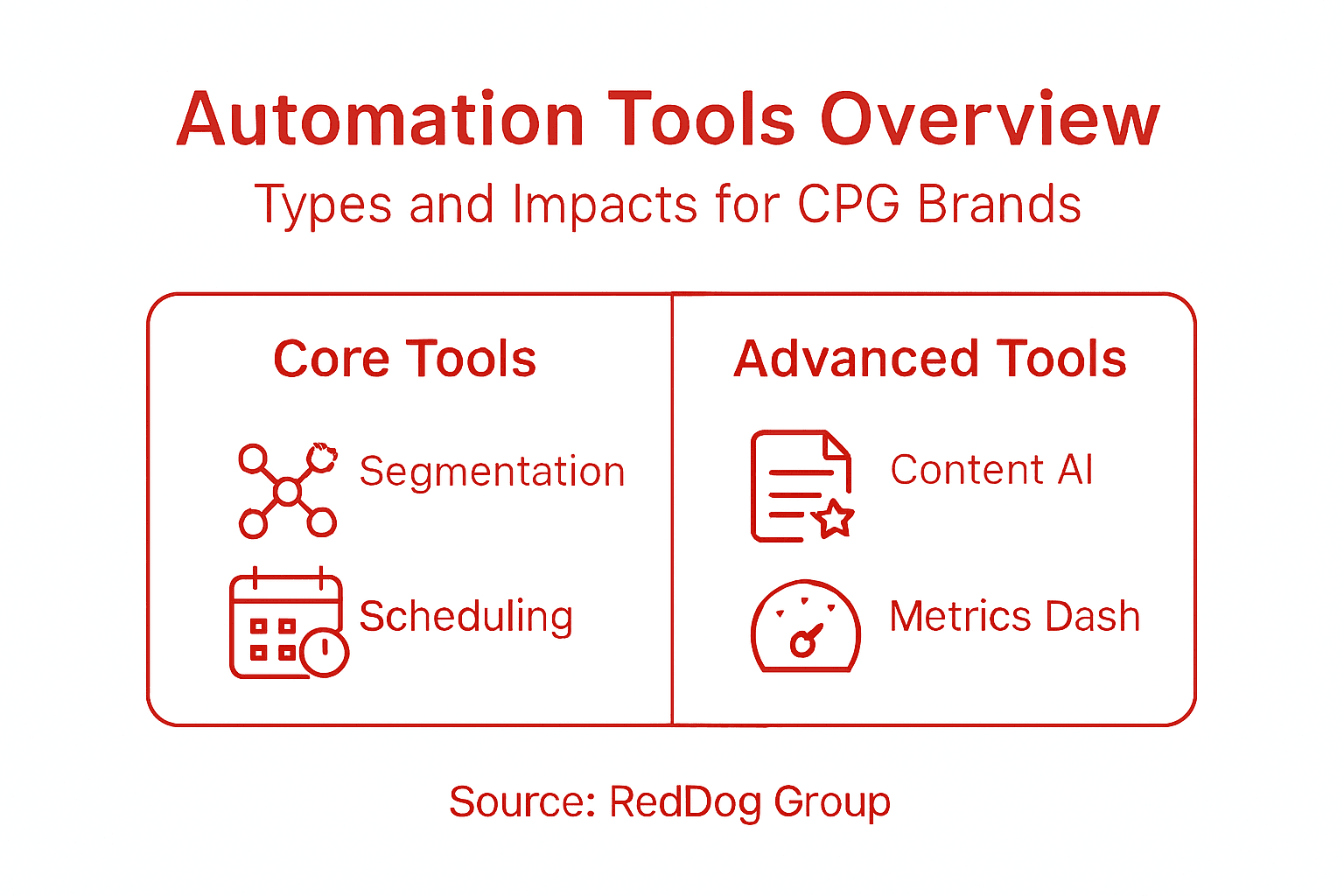
Here’s a quick reference comparing major types of marketing automation tools and their impact on CPG brands:
| Tool Type | Primary Function | Typical Business Impact |
|---|---|---|
| Customer Data Platforms | Unifies consumer information | Enables targeting and analytics |
| Campaign Management | Automates campaign tasks | Faster launches, better tracking |
| Personalization Engines | Tailors content to individuals | Improves engagement and loyalty |
| Programmatic Advertising | Places ads automatically | Higher ROI, optimized spend |
| Predictive Analytics | Forecasts customer behavior | Reduces risk, improves decisions |
Pro tip: Evaluate your marketing automation tools based on integration capabilities, data processing speed, and alignment with specific brand objectives.
Automation represents a strategic approach for Consumer Packaged Goods (CPG) brands to systematically improve profit margins across multiple business functions. Margin optimization through digital transformation has become a critical competitive advantage for modern CPG organizations.
Key margin improvement strategies enabled by automation include:
By leveraging advanced AI and machine learning technologies, CPG brands can transform traditionally manual and inefficient processes. These automation systems analyze complex datasets in real-time, enabling more intelligent decision-making that directly impacts bottom-line performance.
Automation is not just about reducing costs, but about creating more agile, responsive business ecosystems.
The financial impact of automation extends beyond simple cost-cutting. Sophisticated platforms enable granular performance tracking, allowing brands to understand precise contribution margins across different channels and product lines. This level of insight helps leadership make data-driven strategic decisions that incrementally improve overall profitability.
Pro tip: Prioritize automation tools that provide clear, measurable metrics on cost reduction and revenue enhancement.
Texas-based Consumer Packaged Goods (CPG) brands are pioneering innovative automation strategies that demonstrate remarkable performance improvements across multiple business functions. AI-driven marketing transformation is reshaping how local companies approach competitive market challenges.
Successful automation implementations by Texas brands include:
These local success stories illustrate how strategic technology adoption can transform traditional business models. Automation technologies enable Texas brands to compete more effectively by providing unprecedented operational insights and efficiency gains.
Technology adoption is not about replacing human expertise, but amplifying strategic capabilities through intelligent systems.
The competitive advantage stems from automation’s ability to process complex datasets rapidly, enabling more nuanced decision-making. By leveraging AI and machine learning, Texas CPG brands can create more responsive, data-driven business strategies that directly impact bottom-line performance.
Pro tip: Conduct a comprehensive audit of your current workflows to identify the most impactful automation opportunities.
Adopting marketing automation technologies requires strategic planning and nuanced understanding of potential challenges. Automation implementation risks can derail digital transformation efforts if not carefully managed and strategically approached.
Critical risks and potential pitfalls for CPG brands include:
Understanding these potential challenges is crucial for successful technology adoption. Many CPG brands rush into automation without comprehensive change management strategies, leading to underwhelming results and wasted investments.
Successful automation is not about replacing human expertise, but augmenting strategic capabilities through intelligent technological integration.
The most common mistake is treating automation as a purely technological solution rather than a holistic business transformation. Brands must develop cross-functional teams, invest in continuous learning, and maintain flexibility in their technological approach to mitigate implementation risks.
This summary highlights common mistakes versus best practices to ensure successful automation in CPG marketing:
| Common Mistake | Best Practice Solution |
|---|---|
| Poor tool integration | Assess compatibility before rollout |
| Inadequate staff skills | Provide specialized automation training |
| Inaccurate data sources | Conduct regular data quality audits |
| Neglecting ROI measures | Set clear performance benchmarks |
| Over-automation | Maintain key human decision points |
Pro tip: Develop a phased automation strategy with clear pilot programs and measurable benchmarks before full-scale implementation.
The article highlights the challenges CPG brands face when adopting automation to boost profit margins through precision marketing, demand forecasting, and supply chain optimization. If you are struggling with navigating the complex landscape of marketplace economics, inventory velocity, or margin compression, you are not alone. Automation offers great potential but without clear operational clarity and a contribution-margin-first strategy, brands often miss key margin leaks and risk over-automation.
At RedDog Group, we specialize in helping Texas-based and national CPG brands scale profitably by blending advanced automation concepts with practical retail growth solutions. Our expertise in channel-level margin analysis, Amazon and Walmart marketplace strategy, and wholesale distribution ensures your automation investments translate into real, measurable increases in profitability. We understand the complex factors impacting your bottom line like 3PL storage costs and cash flow timing.
Ready to stop guessing and start growing with confidence? Explore how our CPG Retail Growth Offer aligns with automation-driven margin improvement.
Take control of your retail complexity and uncover hidden margin opportunities today. Connect with our Houston-based team at RedDog Group to build a data-driven, scalable growth plan tailored to your brand’s specific needs. Visit RedDog Group now to learn how to boost your CPG margins with smart automation and expert marketplace guidance.
Automation in CPG marketing involves using technology to streamline repetitive tasks, optimize customer interactions, and improve operational efficiency. It encompasses capabilities like workflow optimization, customer segmentation, performance tracking, and data integration.
Automation enhances CPG profit margins by enabling precision marketing, better inventory management, accurate demand forecasting, targeted customer segmentation, and improved supply chain operations, ultimately leading to reduced costs and increased revenue.
CPG brands can utilize various marketing automation tools, including customer data platforms, campaign management systems, personalization engines, programmatic advertising tools, and predictive analytics software, each designed to optimize different aspects of marketing and customer engagement.
Common challenges include technology misalignment, skill gaps among staff, data quality issues, over-automation leading to lack of human judgment, and miscalculating ROI. Brands must address these risks through thorough planning and strategy.
Leave a comment: