
Published: March 2020 | Last Updated:March 2026
© Copyright 2026, Reddog Consulting Group.

Most emerging CPG founders believe that adding more SaaS tools automatically scales operations. Yet 89% of omnichannel shoppers return because of integrated tech stacks, not tool sprawl. For Texas brands expanding beyond DTC into Amazon, Walmart, and wholesale, your tech stack determines whether channel growth builds profit or bleeds margin. This guide shows you how to architect platforms that optimize contribution margin across every sales channel.
| Point | Details | |-------|---------|| | Platform architecture defines scalability | Monolithic, headless, and composable options each impact customization costs and vendor lock-in differently for CPG brands. | | Marketplace fees demand margin-aware tech | Amazon and Walmart fees consume up to 30% of gross revenue, requiring integrated analytics to track true channel profitability. | | AI automation reduces operational costs | Demand forecasting tools cut holding costs by 20% and improve order accuracy for multichannel inventory management. | | Five-layer framework guides implementation | Core platform, integrations, frontend, data infrastructure, and optimization layers create scalable stacks focused on contribution margin. |
Your eCommerce tech stack is the collection of platforms, integrations, and tools powering every transaction, inventory update, and customer interaction across sales channels. For Texas CPG brands managing Amazon FBA, Walmart WFS, DTC sites, and wholesale accounts simultaneously, this infrastructure directly impacts operational clarity and profit per order. The right stack surfaces exactly which channels contribute to margin and where costs drain capital.
Emerging brands often face these specific challenges:
A margin-focused tech stack solves these problems by connecting order management, inventory tracking, financial reporting, and customer data into one operational view. You stop guessing at profitability and start making decisions backed by real channel economics. This foundation becomes critical when scaling from $500K to $5M+ revenue, where operational inefficiency compounds quickly.
For Texas CPG founders, your tech decisions today determine whether multichannel expansion builds sustainable profit or creates complexity that eats margin faster than revenue grows.
Choosing your core eCommerce platform starts with understanding three architectures: monolithic, headless, and composable. Each affects customization ability, scaling costs, and how tightly you’re locked into vendor ecosystems. Shopify and Shopify Plus dominate recommendations for CPG brands because of rapid deployment, reliable hosting, and extensive app integrations that handle marketplace connections without custom development.
Monolithic platforms like standard Shopify bundle frontend, backend, payment processing, and hosting into one package. You get fast setup and lower technical overhead, perfect for brands under $2M revenue. The tradeoff comes in customization limits and transaction fees that compound as volume scales. WooCommerce offers more flexibility on WordPress but requires hosting management and security updates, adding operational burden.
Headless commerce separates your storefront presentation from backend commerce logic, giving you complete control over customer experience while maintaining robust order processing. Platforms like Medusa.js and commercetools enable unlimited frontend experimentation. You pay with increased development costs and complexity managing API connections between systems. Composable architectures take this further, letting you swap individual components like payment processors or inventory systems independently.

Here’s how platforms compare for Texas CPG brands:
| Platform | Architecture | Monthly Cost | Customization | Transaction Fees | Best For |
|---|---|---|---|---|---|
| Shopify | Monolithic | $29-$2,000 | Moderate | 0.5%-2.9% | Brands under $5M revenue |
| Shopify Plus | Monolithic | $2,000+ | High | Negotiable | Enterprise CPG brands |
| WooCommerce | Monolithic | $20-$200 | Very High | Payment gateway only | Tech-savvy small brands |
| Medusa.js | Headless | $0-$500 | Complete | 0% | Developer-resourced brands |
| commercetools | Composable | $3,000+ | Complete | 0% | Brands over $10M revenue |
Pro Tip: Match architecture to current revenue stage. Under $1M, monolithic platforms minimize technical overhead. Between $1M-$5M, evaluate headless if customization drives conversion. Above $5M, composable stacks optimize margin across complex channel mixes.
Vendor lock-in matters more than founders realize. Switching platforms after building custom workflows costs $50K-$200K in migration expenses and lost sales during transition. Choose platforms that offer API access and data export flexibility from day one.
Every sales channel introduces unique technical requirements that affect your stack decisions. Amazon FBA and Walmart WFS fees consume up to 30% of gross revenue on some products, making margin visibility through your tech stack essential for profitability. Your platform must integrate financial data from marketplace seller portals, 3PL systems, and payment processors to calculate true contribution margin by channel.
Amazon requires real-time inventory updates through Seller Central APIs or you risk suspended listings. Walmart WFS demands EDI integration for wholesale orders while WFS operates through different technical protocols. DTC sites need fraud prevention that doesn’t kill conversion rates, while wholesale accounts require invoice generation and net payment term tracking that marketplaces handle automatically. Each channel creates technical debt if you solve problems with manual processes instead of integrated systems.
Margin-focused tech stacks need these channel-specific features:
Omnichannel integration improves customer retention by 89% by connecting purchase history across channels. When someone buys on Amazon then visits your DTC site, your stack should recognize them and personalize the experience. This requires customer data platforms that unify marketplace orders, website analytics, and email engagement into single profiles.
For marketplace optimization, your tech stack determines how quickly you can test pricing changes, launch new products, and respond to competitor moves. Brands managing this manually lose 15-20% potential margin to delayed reactions and pricing errors.
Texas CPG brands often start DTC-only then add marketplaces, discovering their original platform can’t handle multi-channel complexity. Building with omnichannel capabilities from the start prevents expensive platform migrations when you scale.
Emerging CPG brands often overestimate headless commerce complexity while underestimating how vendor lock-in with monolithic platforms compounds migration costs. You don’t need a $500K custom build to get flexibility. Modern headless platforms like Medusa.js offer open-source options that developers can implement for under $50K total.
Another myth: more plugins equal more capability. Every Shopify app adds monthly costs, potential conflicts, and page load time that kills conversion. Brands averaging 40+ apps often see checkout abandonment rates 25% higher than streamlined competitors. The goal is integrated tools that communicate through APIs, not disconnected point solutions requiring manual data entry.
Vendor lock-in creeps in through proprietary checkout flows, closed API ecosystems, and data formats that don’t export cleanly. Platforms advertising “no-code” solutions often trap you in their walled garden, making migration extremely painful when you outgrow their capabilities. Evaluate exit costs before committing to any platform.
Use this five-step framework to select your tech stack:
This framework prevents overbuying enterprise solutions before you need them while avoiding platforms you’ll outgrow in 18 months. For scaling eCommerce across channels, your tech decisions today determine operational leverage when revenue hits $5M+.
Most emerging brands choose monolithic platforms initially, then evaluate headless options around $3M revenue when customization needs justify the development investment. This staged approach balances speed to market against long-term flexibility.
AI and automation tools transform inventory management from reactive firefighting to predictive optimization. Demand forecasting powered by AI reduces holding costs by 20% while improving order accuracy by 15% for multichannel CPG brands. These tools analyze historical sales patterns, seasonal trends, and external factors like weather or events to predict SKU-level demand across channels.
For Texas brands managing physical retail alongside eCommerce, AI-powered inventory allocation prevents stockouts in high-velocity locations while reducing slow-moving inventory in underperforming channels. This precision directly improves contribution margin by minimizing 3PL storage fees and reducing capital tied up in excess stock.
Automation benefits specific to CPG multichannel operations:
Pro Tip: Select AI tools that integrate directly with your core platform through native APIs, not screen scraping or CSV exports. Real-time data access enables margin-focused decisions, while delayed data creates blind spots where profitability leaks.
For increasing eCommerce sales, automation removes manual bottlenecks that slow testing velocity. Brands using automated A/B testing tools iterate twice as fast on product pages, pricing strategies, and promotional campaigns. This speed compounds into significant margin advantages over competitors making decisions based on intuition rather than data.
The key is balancing automation with operational oversight. Tools should surface exceptions and anomalies for human review rather than making fully autonomous decisions that could damage brand reputation or violate marketplace policies. Start with rules-based automation for repetitive tasks, then layer in machine learning as data volume and complexity justify the investment.
Build your tech stack using this five-layer framework that separates concerns while enabling seamless integration:
This separation lets you upgrade individual components without rebuilding everything. For example, switching from Stripe to a lower-fee payment processor touches only the integration layer if properly architected.
Common failure points and fixes for Texas CPG brands:
Here’s how each framework layer impacts margins and scalability:
| Layer | Margin Impact | Scalability Impact | Optimization Priority |
|---|---|---|---|
| Core Platform | Medium | High | Choose flexible architecture early |
| Integrations | High | Medium | Automate financial reconciliation first |
| Frontend | Medium | Medium | Optimize for mobile conversion |
| Data Infrastructure | High | High | Unify customer profiles across channels |
| Optimization | Very High | Low | A/B test pricing and promotions continuously |
Balance customization against complexity by asking whether each tool directly impacts contribution margin or customer retention. If the answer is no, you probably don’t need it yet. For scaling eCommerce profitably, operational simplicity often beats feature richness.
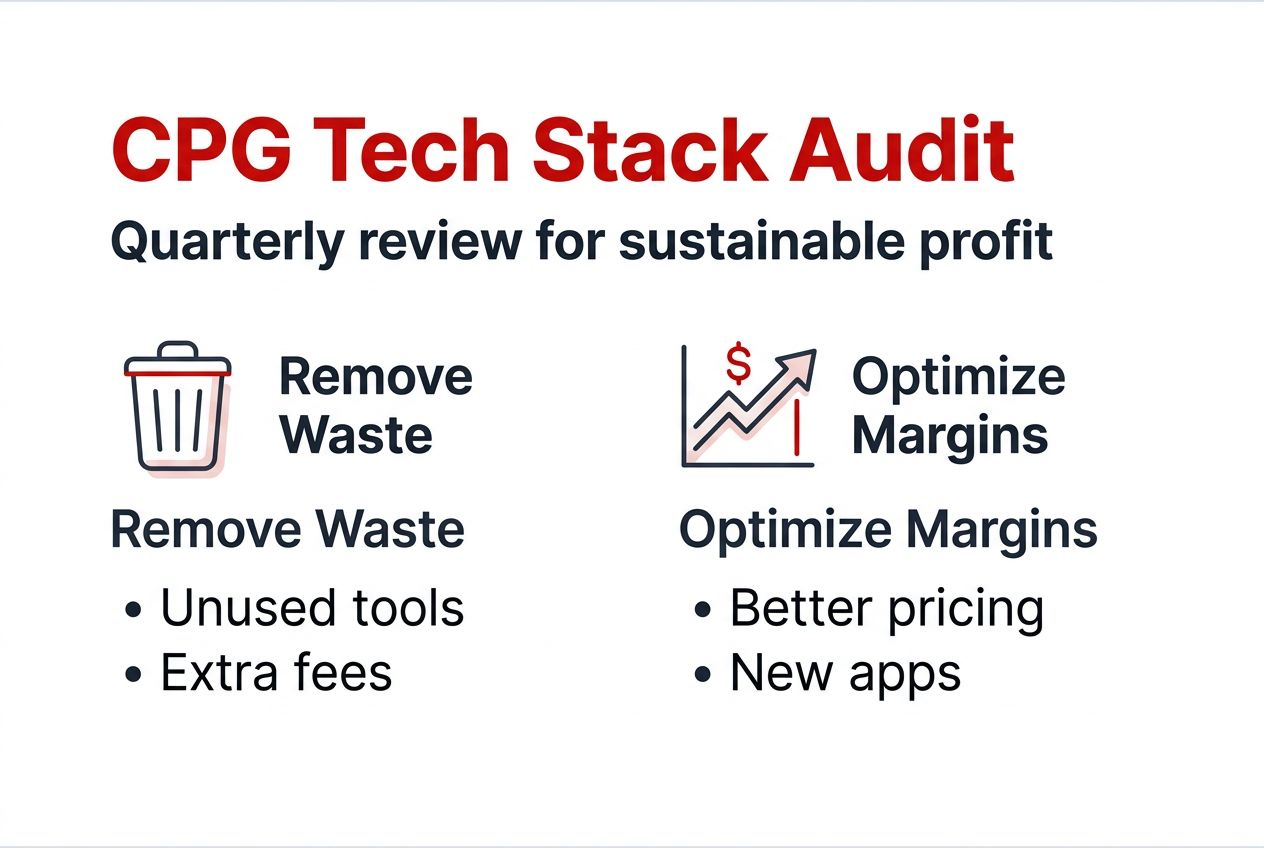
Plan quarterly tech stack audits to remove underused tools, renegotiate pricing on volume-based services, and evaluate new solutions that address emerging bottlenecks. Your stack should evolve with your channel mix and revenue scale. What works at $1M creates operational drag at $10M if you don’t continuously optimize.
For detailed implementation guidance, explore this 2026 eCommerce tech development resource covering architecture patterns and vendor selection criteria. The key is treating your tech stack as operational infrastructure requiring regular maintenance, not a one-time implementation project.
RedDog Group helps Texas CPG brands build margin-focused tech stacks that scale profitably across Amazon, Walmart, DTC, and wholesale channels. We cut through vendor marketing to identify tools that actually improve contribution margin and operational clarity.
Our approach combines marketplace expertise with technical platform knowledge to solve real challenges like inventory syncing, margin analytics, and omnichannel customer data. Whether you’re launching your first DTC site or optimizing a complex multichannel operation, we provide structured frameworks that prevent expensive mistakes.
Explore our CPG conversion optimization guide for specific tactics that improve site performance and increase average order value. Our marketplace optimization resource covers channel-specific strategies for Amazon and Walmart success. Ready to build a tech stack that supports profitable growth? Let’s talk about your specific challenges and goals.
An eCommerce tech stack is the collection of software platforms, integrations, and tools powering your online sales operations across channels. For CPG brands, this includes your core eCommerce platform, marketplace integrations, inventory management systems, payment processing, customer data platforms, and analytics tools. The stack determines how efficiently you manage multichannel operations and track profitability by channel.
Platform architecture affects customization flexibility, scaling costs, and vendor lock-in risks. Monolithic platforms offer fast deployment but limited customization, while headless and composable architectures provide complete control at higher development costs. Your choice impacts how easily you can add sales channels, integrate specialized tools, and migrate to new platforms as you grow. Choosing the wrong architecture creates expensive technical debt.
Margin-focused tech stacks integrate financial data from marketplaces, 3PLs, and payment processors to calculate true profitability by channel after all fees and fulfillment costs. This visibility lets you identify which channels actually contribute to profit versus just driving top-line revenue. Automated tools reduce operational costs through better inventory allocation, repricing optimization, and order routing that minimizes fulfillment expenses.
Basic monolithic platform setup takes 4-8 weeks including product migration, payment configuration, and initial integrations. Adding marketplace connections and inventory syncing adds another 2-4 weeks. Headless or composable implementations require 3-6 months for custom development and testing. Plan 20% longer for brands managing wholesale accounts alongside eCommerce due to EDI integration complexity. Ongoing optimization is continuous, not a one-time project.
Headless makes sense if customization directly impacts conversion rates and you have developer resources or budget for ongoing maintenance. Brands under $2M revenue typically see better ROI from monolithic platforms like Shopify that minimize technical overhead. Between $2M-$5M, evaluate headless if your growth is constrained by platform limitations. Above $5M, headless or composable stacks often justify their cost through improved operational efficiency and margin optimization.
Unified tech stacks that recognize customers across Amazon purchases, DTC orders, and retail interactions enable personalized experiences that improve retention rates. When your system knows someone’s full purchase history regardless of channel, you can tailor recommendations, prevent redundant promotions, and provide seamless support. This recognition drives the 89% retention improvement seen with integrated omnichannel strategies compared to siloed channel operations.
Leave a comment: