
Published: March 2020 | Last Updated:April 2026
© Copyright 2026, Reddog Consulting Group.

TL;DR:
- Reviews with at least five ratings significantly increase purchase likelihood and trust.
- A review score between 4.0 and 4.7 stars maximizes credibility and conversions.
- Active review management and syndication across channels boost omnichannel sales and retail success.
Five customer reviews. That’s all it takes to change a buyer’s decision. Products with just 5 reviews show 270% higher purchase likelihood than those with none, which means reviews are not a vanity metric or a “nice-to-have” add-on. For emerging CPG brands competing on crowded shelves and packed marketplaces, reviews are a core sales driver. This article breaks down why reviews matter so much, how they directly lift revenue, what mistakes to avoid, and the exact strategies you can use to build a review engine that works across every channel you sell through.
| Point | Details |
|---|---|
| Even a few reviews matter | Just 5 reviews can boost purchase likelihood by 270% for CPG products. |
| Aim for trust, not perfection | Ratings between 4.0–4.7 stars convert better than perfect 5.0 averages. |
| Reviews drive omnichannel sales | Reviews influence both online and offline buying decisions across all CPG categories. |
| Strategic display lifts conversions | Displaying reviews at key touchpoints can raise conversion rates by 90% or more. |
| Actively manage your review strategy | Seed, automate, and amplify reviews for ongoing sales growth and market advantage. |
If you’re running a CPG brand in the $500K to $20M range, you already know that getting a product onto a shelf or a product detail page is only half the battle. The other half is convincing a stranger to pick it up. Reviews are doing more of that convincing than most founders realize.
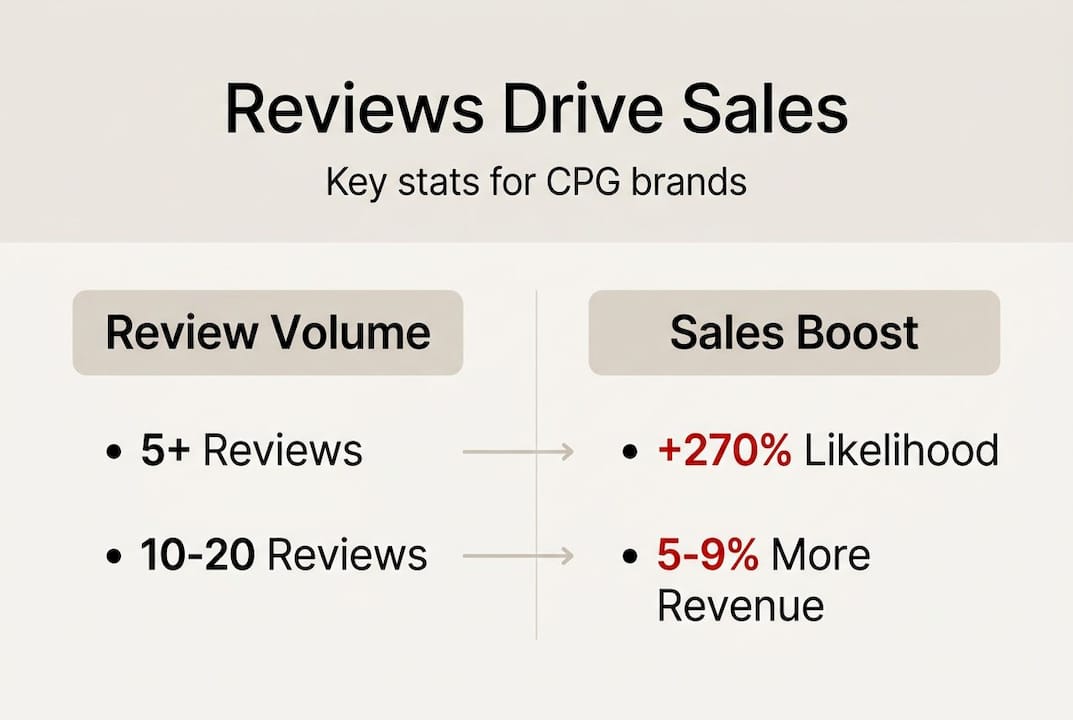
The data is clear. Products with 5+ reviews show up to 270% greater purchase likelihood compared to products with zero reviews. But here’s the part that surprises most brand operators: the effect doesn’t stop at the digital shelf. 66% of in-store shoppers check online reviews before making a purchase, even when they’re standing in the aisle. That means your Amazon or DTC review count is influencing decisions at Walmart, HEB, and your regional grocery partner too.
This is why a siloed approach to reviews fails. Brands that treat reviews as an Amazon-only problem miss the broader omnichannel reality. A strong review presence online lifts both digital and physical retail performance simultaneously.
Here’s what the research tells us about the review sweet spot:
“Social proof is no longer a differentiator. It’s table stakes. If your product has fewer than 5 reviews, you’re not in the consideration set for a large share of buyers.”
For brands trying to improve ecommerce conversion rates, reviews are often the highest-leverage, lowest-cost lever available. And for brands building a profitable omnichannel retail strategy, reviews are the connective tissue that makes every channel work harder.
The expectation has shifted. Buyers now assume reviews exist. When they don’t, the absence itself becomes a red flag. Your job as a founder is not just to have reviews but to have the right reviews, in the right places, at the right volume.
Let’s get specific about the revenue impact. A one-star rating increase can produce a 5 to 9% revenue boost across industries, including CPG. For a brand doing $2M in annual revenue, that’s $100K to $180K in incremental sales from a single improvement in review quality. That’s not a rounding error. That’s a meaningful business outcome.

The pre-launch phase is where most emerging brands leave money on the table. Seeding 10 to 20 reviews before a retail launch leads to faster sell-through and stronger retail buyer confidence. Buyers at regional chains and national retailers look at review counts as a signal of market validation. Walking into a buyer meeting with 15 verified reviews tells a different story than walking in with zero.
Here’s a breakdown of how review volume maps to sales outcomes:
| Review count | Estimated conversion lift | Retail buyer signal |
|---|---|---|
| 0 reviews | Baseline | Weak: unproven product |
| 1 to 4 reviews | Modest lift | Neutral: early stage |
| 5 to 10 reviews | Up to 270% lift | Positive: gaining traction |
| 11 to 50 reviews | Strong sustained lift | Strong: validated demand |
| 50+ reviews | Incremental gains | Very strong: category contender |
Visual reviews and user-generated content (UGC) amplify this effect further. A photo of a real customer using your protein bar or hot sauce in their kitchen does something a product description never can: it makes the product feel real and accessible. Displayed at high-intent moments, like on the product detail page or in a retargeting ad, UGC can dramatically shift purchase decisions.
For brands operating across omnichannel retail platforms, the compounding effect is significant. Reviews generated on Amazon can be syndicated to your DTC site. Reviews from your DTC site can be referenced in wholesale pitch decks. The asset works across every channel if you build the system intentionally.
Pro Tip: Don’t wait until launch to think about reviews. Build your review seeding plan 60 days before you go live on any new channel. Send product to loyal customers, beta users, or micro-influencers in your category and ask for honest feedback. Even 10 reviews at launch changes the trajectory.
For a deeper look at how review volume connects to revenue, the sales conversion rate guide walks through the mechanics across different CPG categories.
Not all reviews are equal, and not all review strategies are smart. This is where a lot of emerging brands make costly mistakes that either suppress conversions or, worse, get them penalized on major marketplaces.
The optimal rating range is 4.0 to 4.7 stars. A perfect 5.0 triggers skepticism, not confidence. Buyers have been trained by years of fake review scandals to distrust perfection. A 4.3 with 47 reviews reads as more credible than a 5.0 with 12. Authenticity beats perfection every time.
Here’s a comparison of review strategies that work versus those that backfire:
| Strategy | Impact |
|---|---|
| Verified purchase reviews | High trust, strong conversion lift |
| Photo and video reviews | Highest engagement and click-through |
| Responding to negative reviews | Builds brand credibility and often recovers the sale |
| Gating reviews (blocking negatives) | Violates platform policies, destroys trust if discovered |
| Incentivized reviews without disclosure | FTC violation risk, platform removal risk |
| Generic 5-star reviews with no detail | Low trust signal, minimal conversion impact |
Responding to negative reviews is one of the most underused trust-building tools in CPG. When a founder or brand rep responds thoughtfully to a complaint, it signals that real humans are behind the product and that quality matters. Many buyers read the negative reviews first. A well-crafted response can convert a skeptic into a buyer.
Here’s the right order of operations for building a trustworthy review profile:
Pro Tip: Use negative reviews as a product development tool. If three buyers mention the same packaging flaw or flavor issue, that’s free market research. Fix it, then mention the improvement in your response to those reviews. It shows buyers you listen.
Understanding what omnichannel commerce actually means for review strategy helps you see why consistency across platforms matters. A brand with strong Amazon reviews but zero presence on its DTC site or Google Shopping creates trust gaps that cost conversions.
Knowing reviews matter is one thing. Building a system that generates, displays, and amplifies them consistently is another. Here’s the playbook that works for CPG brands at your stage.
Automate your review request sequence. The optimal window for a post-purchase review request is Day 10 to 14. By then, the customer has used the product enough to form an opinion but hasn’t moved on entirely. Set this up in your email platform or CRM and let it run. Don’t rely on hoping customers leave reviews organically.
Seed reviews before every new channel launch. Whether you’re going live on Walmart.com, launching a new SKU, or entering a regional retail chain, have at least 10 reviews ready. This is non-negotiable if you want retail buyers to take you seriously.
Repurpose reviews across every touchpoint. A great review doesn’t belong only on your product page. Use it in:
Syndicate reviews to retailer sites. If you’re generating reviews on your DTC site, push them to Walmart.com and other retail partners through syndication tools. Strategic review display can lift conversions by up to 90% when reviews appear at high-intent moments in the purchase journey.
Monitor reviews weekly. Set up alerts for new reviews across every platform. Track sentiment trends, flag recurring complaints, and identify your most enthusiastic customers. These are the people you recruit for UGC campaigns and loyalty programs.
Building this system is how you boost omnichannel sales without increasing ad spend. Reviews work around the clock on every channel, compounding over time.
Here’s the uncomfortable truth: most emerging CPG brands treat reviews like a checkbox. They set up an automated email, collect a few dozen reviews in year one, and then move on. That’s not a strategy. That’s passive hope dressed up as a system.
The brands that actually use reviews to win in retail treat them as a living sales asset. They monitor them weekly, respond within 48 hours, syndicate them across every channel, and actively seed new ones before every major retail push. They also use review data to inform product iterations, packaging decisions, and positioning.
The other mistake we see constantly is ignoring the placement side. You can have 200 reviews and still lose the conversion if those reviews aren’t visible at the moment a buyer is deciding. Review positioning on your product detail page, in your ads, and on retail partner sites matters as much as the reviews themselves.
Brands that build review equity also gain negotiating power. Walking into a retail buyer conversation with 500 verified reviews and a 4.4-star average is a fundamentally different conversation than walking in with a great label and a sales deck. Reviews reduce the perceived risk for buyers, distributors, and retail partners alike. Exploring top omnichannel platforms that support review syndication is a smart first step toward making this work at scale.
Reviews are one of the highest-ROI assets a CPG brand can build, but only if the strategy behind them is intentional, channel-specific, and consistently executed. Most brands leave significant revenue on the table by treating reviews as an afterthought rather than a core part of their retail growth engine.
At RedDog Group, we help emerging CPG brands build review strategies that actually move the needle across Amazon, Walmart, DTC, and physical retail. From pre-launch seeding to syndication and placement optimization, our omnichannel growth services are built around contribution margin and measurable sales outcomes. If you’re ready to stop guessing and start scaling with a system that works, explore our CPG retail growth offer and connect with our team today.
As few as 5 reviews can raise purchase likelihood by 270%, though returns begin to diminish after the first 10 reviews, making early volume your top priority.
A rating between 4.0 and 4.7 stars drives the most trust and highest sales conversion because perfect 5-star averages often appear curated or fake to experienced buyers.
Absolutely. 66% of in-store shoppers check online reviews before buying, which means your digital review presence directly affects physical retail sell-through.
Automate review requests at Day 10 to 14 post-purchase, encourage photo submissions, respond to all feedback publicly, and syndicate your best reviews across retailer sites, ads, and packaging.
Leave a comment: