
Published: March 2020 | Last Updated:January 2026
© Copyright 2026, Reddog Consulting Group.

Ecommerce supply chain management isn't just a back-office task—it's the operational heartbeat of your online store. Think of it as the entire journey a product takes, from the supplier's factory floor all the way to a customer's front door, and even back again if a return is needed.
A poorly managed system creates a mess of stockouts and shipping delays. But when you get it right? It becomes one of your most powerful competitive advantages, driving measurable growth and customer loyalty.
For any brand selling on Shopify, Amazon, or Walmart, your supply chain is the central nervous system connecting every part of your operation. This isn't just about moving boxes and printing labels; it's a strategic function that directly impacts your profit margins, builds customer loyalty, and determines how fast you can scale.
When you nail your operations, every dollar you spend on marketing and product development pays off, culminating in a seamless customer experience that keeps people coming back.
An efficient ecommerce supply chain management system delivers real, measurable results across the entire business. You're essentially building a rock-solid operational Foundation, giving you the confidence to handle growth, whether you're launching on a new marketplace or managing a massive surge in demand from a viral ad campaign.
Your supply chain is the engine that powers your omnichannel growth. It dictates how well you can sync your online storefront with physical retail channels and meet customer expectations no matter where they buy. A strong supply chain lets your brand:
At the core of all this is the process of fulfillment. To truly grasp the bigger picture, it helps to dive deeper into what is ecommerce fulfillment and see how this critical piece fits in.
An optimized supply chain stops being a cost center and starts becoming a strategic asset. It’s the difference between a brand that’s always struggling to keep up and one that’s built for consistent, profitable expansion.
This guide will walk you through building that advantage. We'll start with the foundational setup, move to data-driven Optimization, and finally get to the Amplification stage where your operations become the fuel for unstoppable growth. Let’s get started.
An optimized ecommerce supply chain isn't a single, monolithic thing you set and forget. It’s a living network of interconnected functions all working in sync. Think of it like a high-performance engine—for the whole machine to run smoothly, every component has to be perfectly tuned.
These components are the seven pillars that hold up a modern, resilient, and scalable supply chain.
Getting these pillars right is the difference between just shipping boxes and building an operational machine that fuels your brand’s growth. Each one is a chance to find efficiencies, cut costs, and improve the customer experience across your DTC and marketplace channels.
This visual breaks down the core stages, showing how everything flows from sourcing products all the way to the customer's front door.
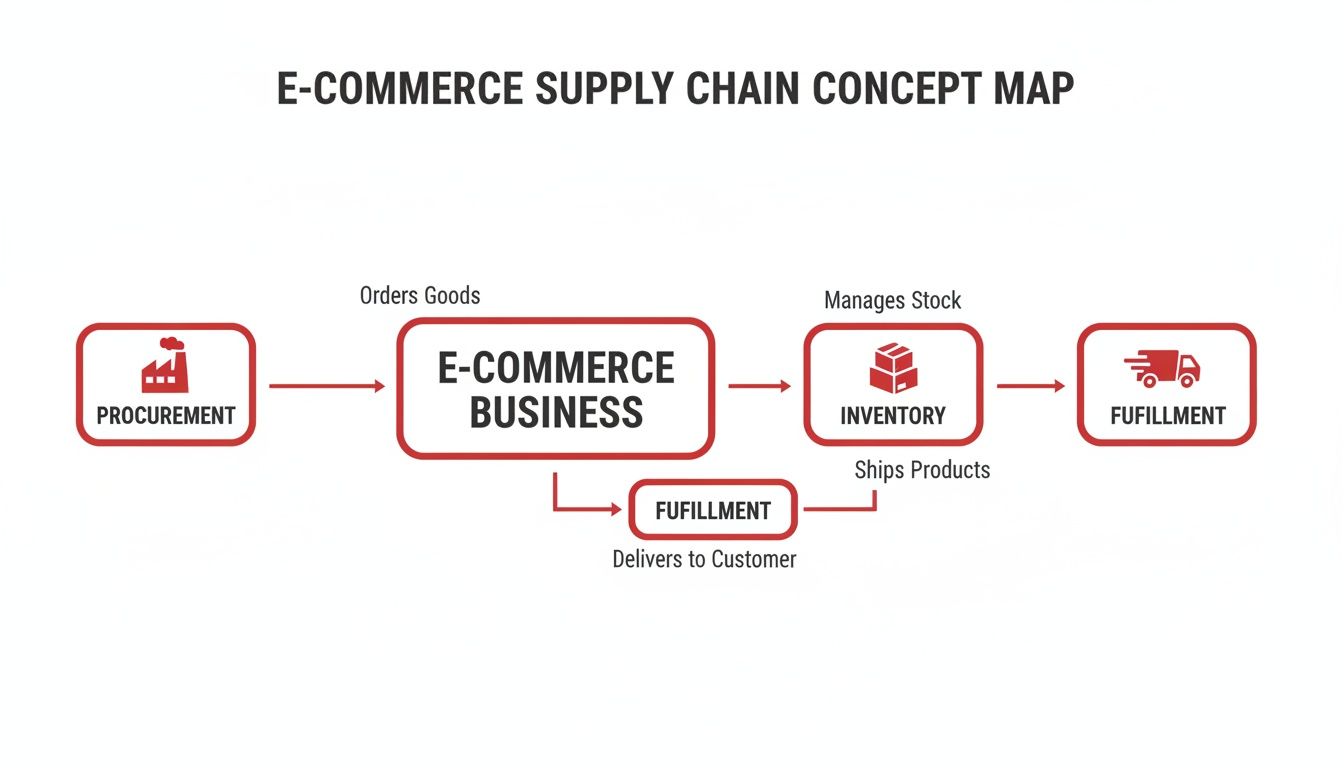
As you can see, procurement, inventory, and fulfillment aren't isolated tasks. They're sequential steps that must be woven together to create a seamless experience for your customer.
This is about predicting what your customers will want to buy, and when. It’s less like gazing into a crystal ball and more like being a detective, piecing together clues from past sales data, market trends, and seasonal shifts to make an educated guess.
A beverage brand, for example, would analyze last summer's sales data to predict the demand spike for their iced tea as temperatures climb. This lets them ramp up production just in time, avoiding stockouts during their peak season and capturing every possible sale.
Building directly on your forecast, inventory planning is where you decide how much product to order and when to order it. The goal is to walk a tightrope—holding just enough stock to meet demand without tying up cash in products that are just sitting on a shelf.
Good planning helps you dodge two massive profit killers:
Nailing this involves setting smart reorder points and calculating safety stock levels. To dive deeper into the tactics, check out our guide on inventory management best practices.
Simply put, procurement is how you get the goods you sell. This pillar covers everything from finding and vetting suppliers to negotiating contracts and managing those relationships. A solid procurement strategy ensures you get high-quality products, on time, and at a fair price.
For a startup selling handcrafted leather goods, this means finding reliable tanneries, negotiating better pricing on bulk materials, and setting crystal-clear quality standards. Get procurement right, and you build a resilient foundation for your entire operation.
Warehousing is more than just a building to store boxes. It's the strategic storage of your products, organized in a way that makes picking, packing, and shipping as efficient as possible. How you handle warehousing directly impacts your fulfillment speed and operational costs.
A growing apparel brand might start fulfilling orders from a spare room. But eventually, they'll face a decision: lease their own warehouse or partner with a Third-Party Logistics (3PL) provider? Each path has major implications for cost, control, and your ability to scale.
This is the engine room of your supply chain. It covers every step from the moment a customer clicks "buy" to the second the package leaves your facility. This includes picking the right items, packing them securely, and generating the shipping label.
Speed and accuracy are the name of the game in fulfillment. One wrong item or a day's delay can kill customer trust, while a consistently fast and flawless process builds die-hard brand loyalty.
This is where your online store and marketplace channels must connect perfectly. Whether an order comes from Shopify, Amazon, or a retail partner, the fulfillment process has to be completely seamless.
The last-mile is the final, and often most expensive, leg of the journey—getting the package from your warehouse to the customer's doorstep. This stage has a massive impact on how customers perceive your brand. A smooth delivery feels great, but a delay or a lost package can sour the entire experience.
Optimizing this pillar means choosing the right shipping carriers, offering different delivery options (like standard and expedited), and giving customers real-time tracking that keeps them in the loop.
Finally, there’s reverse logistics, better known as returns management. A clunky or expensive returns process can stop a customer from ever buying from you again. On the flip side, a simple, free return policy can be a powerful reason for them to buy in the first place.
This pillar involves receiving returned items, inspecting them, restocking or disposing of them, and processing refunds quickly. A streamlined reverse logistics flow protects your margins by recovering value from returns and solidifies customer trust by making the whole process painless.
You can't fix what you don't measure. Moving from ideas to results means getting laser-focused on the Key Performance Indicators (KPIs) that reveal the health of your ecommerce supply chain management. These numbers turn vague operational goals into productive conversations with your team or 3PL partner. They’re what guide your operations from just getting by to truly excelling.
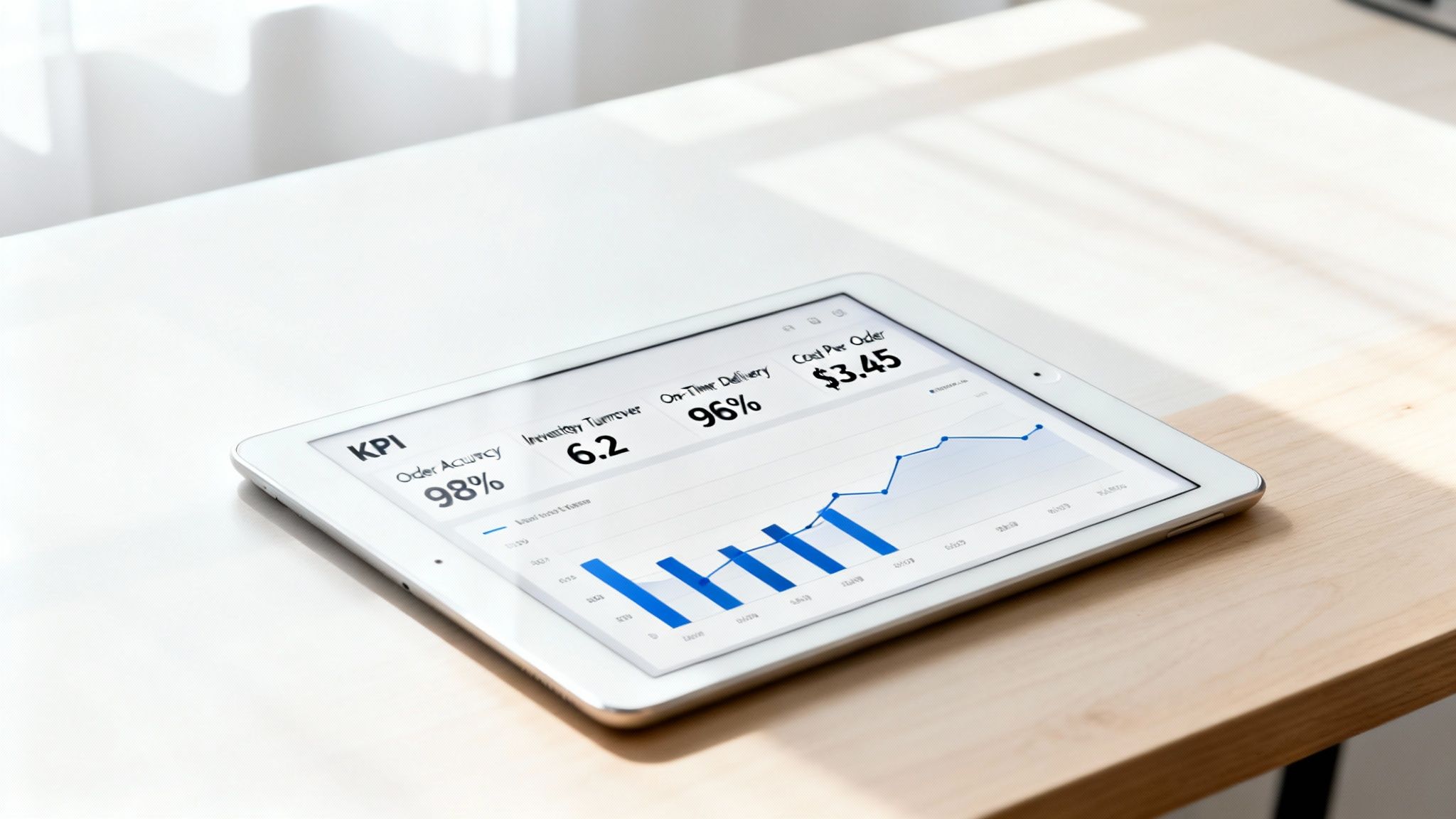
Tracking the right data is how you win the Optimization phase of our growth framework. It gives you a clear scoreboard for your performance across both DTC and marketplace channels, showing you exactly where you’re winning and where you’re falling short. Let’s break down the metrics every growing brand needs on their radar.
Two of the biggest metrics your customers notice are order accuracy and delivery speed. Get these right, and you build trust and loyalty. Get them wrong, and you’ll find yourself buried in negative reviews. They are fundamental to a positive omnichannel experience.
Order Accuracy Rate: This is the percentage of orders you ship without a single mistake—no wrong items, no incorrect quantities. A high rate, ideally 99.5% or better, tells you the pick-and-pack process in your warehouse is dialed in. You calculate it with: (Total Orders Shipped without Error / Total Orders Shipped) x 100.
On-Time Delivery Rate: This tracks how often your packages arrive by the promised delivery date. It’s a reflection of both your fulfillment team's speed and your shipping carriers' reliability. The formula is simple: (Total Orders Delivered On Time / Total Orders Shipped) x 100.
Operational performance has a direct line to your bank account. These financial KPIs help you understand just how cost-effective your supply chain is and where you can plug leaks to protect your profit margins. They’re what make sure your growth is actually profitable.
A supply chain that isn't measured for financial performance can easily become a drain on your business. Tracking cost per order and inventory turnover transforms your operations from a necessary expense into a strategic asset for growth.
Keep a close eye on these financial indicators:
Cost Per Order: This is your all-in number for getting an order out the door. It includes everything from warehousing and labor to boxes and shipping. A lower Cost Per Order means more profit on every single sale.
Inventory Turnover: This ratio shows how many times you sell through your entire stock in a given period. A healthy turnover rate (think 4-6 for many retail businesses) means your products are selling well and you aren't tying up precious capital in dust-collecting inventory.
Return Rate: This measures the percentage of orders customers send back. While it feels like a customer service issue, a high return rate—anything above 10-15% depending on your product category—can signal deeper supply chain problems like poor product descriptions, weak quality control, or shipping damage. Tracking this helps you find and fix expensive issues before they get out of hand.
Every growing brand eventually hits operational roadblocks. Scaling always introduces new complexities that can strain even the best-laid plans. A smart ecommerce supply chain management strategy isn't just about smooth sailing; it's about building a ship that can weather the inevitable storms.
These challenges aren't just minor headaches; they're profit killers. Stockouts lead to lost sales, fulfillment errors wreck your brand's reputation, and high shipping costs eat away at your margins. Tackling these pain points head-on is a crucial step in the Optimization phase of growth, turning reactive fire-fighting into proactive strength.
Modern supply chains are global webs. That makes them powerful, but also fragile. A factory shutdown halfway across the world, a jam at a major port, or a sudden tariff change can bring your entire operation to a grinding halt. The goal isn't to avoid disruptions entirely—that's impossible—but to build a system that can absorb the shock.
Smart moves include diversifying your supplier base so you aren't all-in on a single source and strategically holding safety stock for your most critical SKUs to create a buffer against unforeseen delays. In fact, recent data shows 78% of firms are now buffering inventory and diversifying suppliers to build this very resilience.
Few things are more damaging than telling a customer an item is in stock, only to find out your inventory count was wrong. These inaccuracies, often called "phantom inventory," lead directly to overselling, canceled orders, and a massive loss of customer trust. They usually happen when your sales channels (like Shopify and Amazon) are out of sync with what's actually on your warehouse shelves.
The solution is a single source of truth. Implementing a robust inventory management system that syncs in real time across all your channels is non-negotiable. This stops overselling in its tracks and gives you an accurate, unified view of your stock—the bedrock of smart purchasing and forecasting.
As your order volume climbs, shipping can quickly balloon into one of your biggest expenses. Many brands get squeezed by rising carrier costs, packaging materials, and labor, all of which shrink profitability. One of the most critical and expensive pieces for many is mastering last mile delivery, the final—and often most complex—leg of the journey to the customer.
To fight back against rising costs, you need to regularly audit and negotiate your carrier rates. Another powerful tactic is distributing your inventory across multiple fulfillment centers closer to your customers. This shrinks the average shipping zone and can dramatically lower costs while speeding up delivery times. For complex international shipments, especially to marketplaces, it's also vital to understand how to choose a freight forwarder for Amazon FBA to keep your process both cost-effective and compliant.
A common mistake is treating fulfillment as a fixed cost. In reality, it’s a highly variable expense that can be optimized through smart carrier selection, inventory placement, and efficient packing processes. Constant optimization is key to protecting your margins as you scale.
By systematically identifying and solving these common challenges, you fortify your operations, creating a more resilient and profitable business ready for whatever comes next.
An ecommerce supply chain management strategy that actually works doesn’t just fall into place. It’s built on purpose, piece by piece, with a clear plan that keeps your operations in sync with your biggest growth goals. At RedDog, we guide brands through a proven framework for omnichannel success: Foundation → Optimization → Amplification.
This approach turns your supply chain from a simple cost center into a genuine growth driver, making sure your backend can handle anything your marketing team dreams up.
The Foundation stage is all about nailing the fundamentals. For a brand just starting out, this means making smart, simple choices that pave the way for future growth without getting bogged down in complexity. You have to build a solid base before you can start adding the fancy stuff.
One of the first big calls you'll have to make is choosing between in-house fulfillment and partnering with a third-party logistics (3PL) provider. Going in-house gives you ultimate control, but it also means investing heavily in warehouse space, staff, and technology. A 3PL, on the other hand, brings instant expertise and infrastructure to the table, freeing you up to focus on your products and marketing.
To help you weigh the pros and cons, here’s a quick comparison:
Choosing between managing your own fulfillment and outsourcing is a critical decision that depends on your brand's current size, resources, and growth plans. This table breaks down the key factors to consider.
| Factor | In-House Fulfillment | Outsourcing to a 3PL |
|---|---|---|
| Control | Complete control over every step of the process, from receiving to shipping. | Less direct control; you rely on your partner's processes and standards. |
| Upfront Cost | High. Requires investment in warehouse space, staff, and technology (WMS). | Low. No need for capital investment in infrastructure or hiring a large team. |
| Expertise | Requires you to build or hire logistics expertise from scratch. | Instant access to a team of fulfillment experts and established processes. |
| Scalability | Difficult to scale quickly; requires more space and staff to handle growth. | Highly scalable. Easily handles seasonal peaks and long-term growth. |
| Brand Experience | Full control over custom packaging and unboxing experience. | May have limitations on custom packaging, though many 3PLs offer it. |
| Focus | Diverts time and resources from core business activities like marketing. | Allows you to focus on product development, marketing, and sales. |
Ultimately, the right choice depends on where you are today and where you want to be tomorrow. Early-stage brands often benefit from a 3PL's flexibility, while larger, more established brands might bring fulfillment in-house for greater control.
Another non-negotiable at this stage is getting basic inventory software in place. Even a simple system that tracks stock levels and sales velocity is a quantum leap from trying to manage everything in spreadsheets. The goal isn't perfection—it's about creating a single source of truth for your inventory so you can avoid stockouts and overselling. To help you get started, our expert comparison of the best inventory management software can point you in the right direction.
Once your foundation is locked in, the Optimization stage is where you start fine-tuning your processes. This is where technology helps you sharpen your competitive edge, turning your supply chain into an asset that boosts efficiency and makes customers happier. Think of it less as a total overhaul and more as a series of smart, data-driven tweaks.
This is often the time to integrate more powerful tools. A Warehouse Management System (WMS), for instance, can completely transform your pick-and-pack process, leading to huge gains in order accuracy and fulfillment speed. You might also start exploring AI-powered forecasting tools that analyze historical data and market trends with a level of precision that’s impossible to achieve manually.
Optimization is the bridge between a functional supply chain and a high-performance one. It’s where you stop just shipping orders and start strategically managing the flow of goods to protect margins and delight customers.
In the fast-moving world of ecommerce, the investment in digital tools is exploding. In fact, 82% of supply chain organizations are boosting their IT spend in 2025. This reflects a massive industry shift toward AI, automation, and real-time visibility tools that are changing how brands manage everything from inventory to final delivery. You can discover more insights about supply chain trends that are reshaping the industry today.
The Amplification stage is where all your hard work starts to pay dividends. With a well-oiled, optimized supply chain, you finally have the operational confidence to chase aggressive growth without worrying about the backend breaking under pressure. Your supply chain is no longer just keeping up; it's the stable platform you can use to launch major growth plays.
This is the point where you can confidently:
By moving through these three stages, you build a resilient, scalable operation that doesn’t just react to your brand's growth—it actively fuels it. This methodical approach ensures you're always building on solid ground, ready for what comes next.
Ready to build a supply chain that drives real growth? Let’s Talk Growth.
The next leap in ecommerce supply chain management isn't about small tweaks—it’s about a fundamental shift in how your operations run. We're moving past basic software and into an era where artificial intelligence (AI), machine learning, and advanced automation are no longer buzzwords. They're essential tools for building a real competitive edge.
These aren't some far-off ideas; they are practical solutions delivering measurable results for brands right now. Investing in this technology is the ultimate form of Amplification. It’s how you build a supply chain that doesn't just keep up with your growth but actively drives it, unlocking efficiencies that protect your margins and elevate the customer experience.
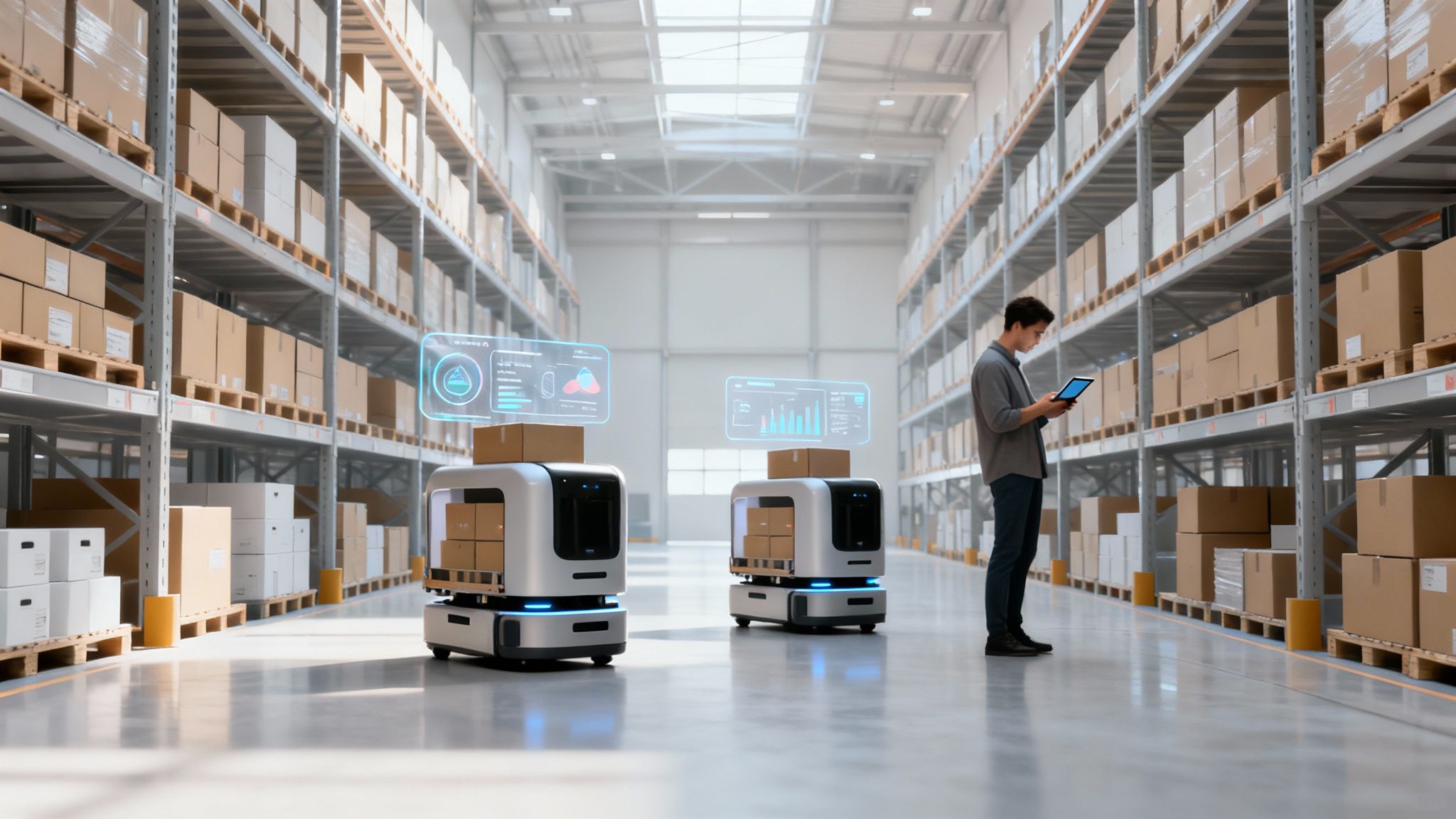
Picture a supply chain that sees problems coming before they happen. That’s the power of AI. Instead of just reacting to past sales data, AI-driven predictive forecasting sifts through thousands of variables—from market trends and competitor pricing to weather patterns—to predict demand with shocking accuracy. This lets brands get ahead of costly overstock and avoid frustrating stockouts, making sure every dollar of capital is working for you.
Brands adopting this early are seeing huge wins. AI is already slashing logistics costs by 15%, cutting inventory levels by 35%, and boosting service efficiency by 65% for early adopters. This technology is rapidly changing the game.
The future of the supply chain isn't just about being faster; it's about being smarter. Predictive technology turns your operations from a reactive cost center into a proactive growth engine, giving you a powerful advantage over slower competitors.
Inside the four walls of the warehouse, automation is turning fulfillment from a manual, labor-heavy process into a high-speed, precision-driven operation. Autonomous mobile robots (AMRs) zip across warehouse floors to retrieve inventory, dramatically cutting down the time it takes to pick and pack an order. This doesn't just mean faster fulfillment; it also drives up order accuracy, a massive factor in customer satisfaction.
For a growing brand, this means you can handle a huge surge in orders from a viral ad campaign or a holiday rush without your operations collapsing under the weight.
Finally, modern tech offers a level of transparency that was unthinkable just a few years ago. Real-time visibility tools use sensors and data integrations to track shipments from the moment they leave your supplier to the final drop-off at a customer’s door. This gives you a degree of control and insight over your entire network that was once impossible.
That transparency can be passed directly to your customers. Giving them accurate, up-to-the-minute tracking builds trust and massively cuts down on "where's my order?" support tickets. It's a clear win-win, turning the final mile from a point of anxiety into another chance to strengthen your brand.
We've walked through the strategy and the nuts and bolts of building a top-tier ecommerce supply chain management system. Now, let’s tackle some of the most common questions we hear from growing brands.
Think of these as the quick-fire answers you need to make smart decisions as you move from building your Foundation to Optimization and eventually Amplification.
At its core, the goal is simple: get the right product to the right customer, at the right time, and for the right cost. It's a constant balancing act between keeping customers happy with speed and accuracy while protecting your own profit margins. A great supply chain strategy doesn’t just move boxes—it delivers an experience that brings customers back for more.
This one trips people up, but it's pretty straightforward when you break it down.
In short, one is a service you outsource; the other is a tool you use to manage operations.
There’s no magic number, but you’ll feel it when you hit the ceiling. Key triggers are when your team can’t keep up with order volume without making mistakes, or when you find yourself spending more time taping boxes than you do on marketing and growing the business.
If operational headaches are putting a cap on your growth, it’s time to look at outsourcing. Making the switch frees up your time and capital, letting you focus on scaling up.
Ready to build a supply chain that actually fuels your growth instead of holding it back? The experts at RedDog Group can map out a strategy that connects your operations directly to your biggest goals. Let’s build your foundation for profitable, omnichannel success.
Leave a comment: