
Published: March 2020 | Last Updated:November 2025
© Copyright 2026, Reddog Consulting Group.

Before you list a single product on Walmart Marketplace, you need to build a solid foundation. This is the foundational work that separates brands approved in weeks from those stuck in application limbo for months.
Walmart is fiercely protective of its brand and, more importantly, its customers. They aren’t just opening the floodgates; they’re looking for established, professional businesses that can meet high customer expectations from day one. This process is less about filling out a form and more about proving you have the operational credibility to succeed on their platform.
Let’s walk through the non-negotiables. Getting these right upfront makes the entire process smoother and signals to Walmart that you're a serious, growth-oriented partner. This is the Foundation phase of your omnichannel strategy.
First, the paperwork. Walmart's team verifies every detail during your application, so precision is key.
The marketplace is more competitive than ever. The platform’s seller count exploded to 200,000 active sellers in mid-2025, a 25% year-over-year increase. With 44,000 new sellers joining in the first five months of 2025 alone, perfectly organized documentation is your first step to cutting through the noise.
This visual flow breaks down the three pillars of getting ready to sell: nailing your business docs, prepping your catalog, and having your logistics locked down.
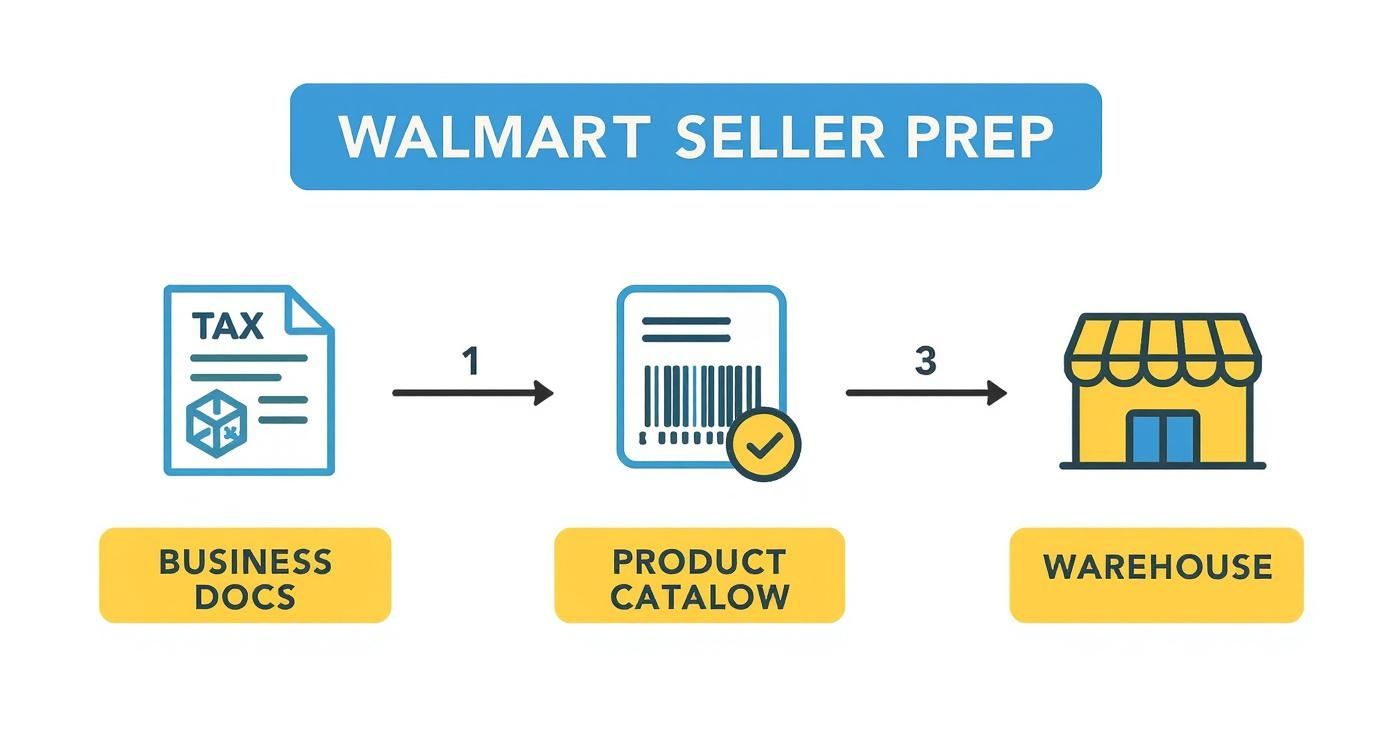
Get these three areas right—documentation, catalog, and warehouse logistics—and you're setting yourself up for a strong start.
Beyond legal documents, Walmart needs to see you can handle the physical side of selling at scale. This is where your operational setup is put to the test.
A US-based warehouse is a non-negotiable requirement. Whether you own it, lease it, or partner with a third-party logistics (3PL) provider, your fulfillment center must be located within the United States to guarantee the fast, reliable shipping that Walmart customers expect.
Your product catalog is your single greatest asset during onboarding. It's not just data; it's how you present your brand professionally and make it easy for Walmart's system to ingest your listings for maximum visibility.
Your product catalog must be ready before you apply. This means having high-quality images, compelling product descriptions, and—this is crucial—valid GS1-certified UPCs for every item. Using anything other than authentic UPCs will lead to immediate product rejection.
As you build this foundation, it's the perfect time to implement solid online brand protection strategies to safeguard your IP and brand reputation. This foundational work doesn't just get you approved; it sets the stage for measurable, sustainable growth. For a closer look, our guide on what branding for a small business covers these essentials in more detail.
Getting approved to sell on Walmart Marketplace is the starting line, not the finish. The real work begins with your product catalog—it’s the engine that drives visibility, clicks, and sales. This is the Optimization phase, where brands either set themselves up for success or get lost in the noise.
Let’s move past the basics and focus on what actually gets your products seen. Getting comfortable with the Walmart Seller Center is your first operational test, and how you manage your catalog from day one will define your growth trajectory.
Think of the Seller Center as your command hub. From listing new items to digging into performance data, mastering its tools is non-negotiable for winning on the platform.
Walmart offers several ways to list your products. The right choice depends on your catalog size and technical resources.
For most growing brands, mastering the Bulk CSV upload is the strategic sweet spot. It provides efficiency without requiring a developer on payroll.
Uploading products isn’t enough. You must optimize them for both Walmart’s search algorithm and human shoppers to build a competitive edge.
The competition is real. The marketplace opened to international sellers in March 2021, and by 2025, projections show 34% of active sellers will be based in China, with nearly 60% of all new sellers in 2025 coming from there. This influx means your listings can’t just be good—they must be exceptional.
A key metric to obsess over is your Listing Quality Score. Found in the Seller Center, this score is Walmart’s grade on how complete and compelling your listing is. A higher score means better visibility in search and a much stronger chance of winning the Buy Box.
Think of your Listing Quality Score as your product’s GPA on Walmart. A higher score directly translates to better search placement and more sales. For your most important products, aim for a score of 95% or higher.
To boost your score and drive measurable results, nail these core components:
Getting these elements right is foundational. For a deeper dive into these tactics, explore our guide on comprehensive listing optimization strategies. This is where you put theory into practice and turn a basic presence into a high-performing sales channel.
An optimized product catalog is a great first step, but it won’t drive sales without a sharp pricing and fulfillment strategy. This is where you convert visibility into revenue. It’s time to break down how to price your products to win the Buy Box—without eroding your margins—and choose a fulfillment model that scales with your brand.
This is where your operational capabilities meet the customer experience head-on. Getting this right is non-negotiable for any brand serious about winning on Walmart Marketplace.
Walmart built its retail empire on "Everyday Low Prices," and that philosophy is hardwired into the marketplace. To compete effectively, you must understand the two rules that govern pricing on the platform.
The key takeaway: your pricing must be competitive and consistent across all your sales channels. Violating these rules doesn't just cost you sales; it can damage your account health over time.
The Buy Box is where the vast majority of sales happen. While price is the biggest factor, it's not the only one. Walmart's algorithm also heavily weights in-stock availability and fast shipping options.
Your goal isn't just to be the cheapest; it's to have the most compelling offer. A slightly higher price with free two-day shipping through WFS will almost always beat a lower price with a one-week delivery estimate.
To increase sales velocity without simply slashing prices, use Walmart’s promotional tools strategically:
These promotions create a sense of urgency that attracts shoppers, drives immediate sales, and can improve your product's organic ranking over time.
How you get products to customers is one of the biggest decisions you'll make. This choice directly impacts your shipping speed, costs, customer satisfaction, and eligibility for programs that boost visibility. You have two main paths.
One option is self-fulfillment. This gives you total control over inventory, branded packaging, and customer service. The downside is that you are solely responsible for meeting Walmart’s strict performance standards for on-time shipping and delivery, which can be a massive operational burden.
The other path is Walmart Fulfillment Services (WFS). You ship your inventory to Walmart's fulfillment centers, and they handle storage, picking, packing, shipping, and customer service.
To help you decide, let's compare them side-by-side.
Choosing between Walmart Fulfillment Services and self-fulfillment is a strategic decision that shapes your brand's growth potential. This table breaks down the key differences to help you align your logistics model with your business goals.
| Feature | Walmart Fulfillment Services (WFS) | Self-Fulfillment |
|---|---|---|
| Buy Box Advantage | High. Products get the "Fulfilled by Walmart" tag and TwoDay delivery badge. | Low. It's extremely challenging to compete with WFS shipping speeds. |
| Operational Lift | Low. Walmart manages logistics, returns, and customer service. | High. You are responsible for everything from packing to tracking. |
| Cost Structure | Pay a fulfillment fee per order and monthly storage fees. | Costs vary based on your own warehouse, staff, and shipping rates. |
| Ideal For | Brands wanting to scale quickly, ensure fast shipping, and reduce complexity. | Brands with established logistics, custom packaging, or oversized items. |
For most brands aiming for aggressive growth, WFS is the clear winner. The boost in visibility and conversion from the TwoDay delivery tag is a game-changer. Plus, offloading logistics frees you to focus on what you do best—growing your brand.
No fulfillment strategy works without a tight grip on stock levels. You can learn more by checking out our essential inventory management checklist. A solid inventory system is the backbone of any successful fulfillment strategy, whether you handle it in-house or use WFS.
Once you have a solid foundation with optimized listings, it's time to shift from setup to scale. This is the Amplification stage, where you stop waiting for traffic and start actively driving it. The best tool for the job is Walmart Connect, the platform’s powerful advertising engine.
A smart ad strategy transforms your Walmart presence from a passive sales channel into an aggressive growth driver. This isn’t about throwing money at ads; it’s about making calculated investments to launch products, defend market share, and generate a measurable return.
Walmart’s value proposition is connecting with customers "at scale, where they shop." You’re tapping into a massive, built-in audience with high purchase intent.
Walmart Connect offers two main ad types. Knowing when to use each is the difference between hitting your goals and wasting your budget.
For example, a customer searching "organic baby food" is a perfect target for a Sponsored Brands ad showcasing your entire product line. A customer searching "organic sweet potato baby food pouch" is laser-focused, making them the ideal audience for a Sponsored Products ad that leads directly to that item.
A disorganized ad account is a money pit. A well-structured campaign allows you to control budgets, target the right shoppers, and clearly measure what’s working. A proven method is structuring campaigns by product category and then by strategic goal.
A brand selling kitchen gadgets might create separate campaigns for "blenders," "coffee makers," and "air fryers." Within each, you can create ad groups by keyword type (branded, generic, competitor) or product attribute (high-end vs. budget-friendly). This granularity enables smart, data-driven decisions.
Your ad strategy should be a direct reflection of your business goals. Launching a new product? Use Sponsored Products with aggressive keyword bidding to gain initial traction. Seeing a competitor eat into your sales? Deploy a defensive Sponsored Brands campaign on your own brand terms to protect your turf.
To ensure profitability, you must master keyword research within Walmart's ecosystem. The Seller Center's Growth Opportunities tool is a good starting point, but don’t stop there. Think like a customer and brainstorm long-tail keywords that signal high purchase intent. "12 cup programmable coffee maker with auto shut off" is infinitely more valuable than just "coffee maker."
To truly amplify your brand, you need to track the right metrics. Impressions are a vanity metric—they look good, but they don't impact your bottom line.
Focus on these two key performance indicators:
By closely monitoring ROAS and CVR, you can make smart optimizations—refining bids, pausing unprofitable keywords, and shifting budget to winning campaigns. This continuous cycle of testing and optimizing is the heart of a successful amplification strategy.
Getting your products live is just the beginning. Real, sustainable success comes from a continuous cycle of monitoring performance, learning from data, and making strategic moves to scale. Your Seller Center Performance Dashboard is the command center for your operation, helping you graduate from managing listings to building a healthy, growing business.
Understanding the data Walmart provides is non-negotiable. It’s about digging into the health metrics that directly control your visibility and your odds of winning the Buy Box. Mastering this unlocks a clear path to scalable growth.
Walmart simplifies your account health into a few key performance indicators (KPIs). These are not suggestions; they are standards you must meet. Two of the most critical are your Order Defect Rate (ODR) and your On-Time Shipment Rate.
Your ODR measures how many orders go wrong, including seller-initiated cancellations, returns for incorrect items, and customer complaints. Walmart requires you to keep your ODR below 2% over a 90-day period.
The On-Time Shipment Rate tracks how consistently you ship orders by the expected date. You must maintain a rate of 99% or higher. Letting these metrics slip can trigger listing suspensions or even account deactivation.
Think of your seller metrics as your brand's reputation with Walmart's algorithm. Strong performance signals that you're reliable, which Walmart rewards with better visibility and a higher chance of winning the Buy Box. Poor performance tells the system you're a risky bet for its customers.
Proactive monitoring is your best defense. Check your dashboard daily. The moment a metric dips, investigate. Was it a late carrier pickup? A batch of mislabeled inventory? Find the root cause and fix it before it becomes a pattern that puts your account at risk.
Even experienced sellers face challenges. The brands that thrive are those that can quickly troubleshoot common issues.
Your performance data isn’t just for troubleshooting; it’s a roadmap for scaling your brand. By analyzing your top-performing products, you can make smarter decisions across your entire Walmart operation.
Look at your best-sellers and ask why they're winning. Is it a specific color? A certain pack size? Use those insights to expand your catalog with similar variations. If a 3-pack of your flagship product sells twice as much as the single unit, that's a clear signal to create more multi-pack offerings.
This data also fuels your inventory strategy. During the holidays, Walmart often waives peak season storage fees for WFS users from October to December. Use your sales velocity data to stock up confidently, sending in more inventory to meet the surge in demand without incurring extra costs. This is how you shift from simply selling on Walmart to building a powerful, scalable brand.
Stepping into a new marketplace raises questions. When brands learn how to sell on Walmart, they often encounter the same hurdles. Let's break down the most common questions with clear, practical answers.
While both are retail giants, selling on Walmart is a different ballgame than Amazon. The experience, rules, and competitive landscape are distinct.
The core difference is philosophy. Amazon is an open, sprawling bazaar. Walmart is more like a curated shopping mall—they prioritize established brands that can reliably meet high standards for customer experience.
The timeline can vary, but a realistic expectation is two to four weeks if you have all your documentation in order.
This window covers the initial application review, business verification, and final onboarding. Any missing information, like an incorrect Tax ID or an unverified business address, will cause delays. Preparation is the key to a speedy approval.
How you handle service and returns is a huge factor in your account health, and the right approach depends on your fulfillment model.
If you fulfill orders yourself, you are 100% responsible for all customer inquiries, managing the returns process, and issuing refunds.
If you use Walmart Fulfillment Services (WFS), Walmart’s team manages customer service and processes returns for your WFS orders. This is a massive operational advantage, freeing up your team and ensuring customers receive the consistent service Walmart demands.
Yes, but with important requirements. While Walmart opened its marketplace to international sellers in 2021, the operational requirements remain US-centric.
Even if your business is headquartered overseas, you must have a US entity with a US Tax ID and a US-based return address. Critically, you also have to ship from a US warehouse, whether it's your own, a 3PL partner's, or via WFS.
In short, while your company can be foreign-owned, your operational footprint must be firmly based in the United States to meet customer expectations for shipping and returns.
Navigating the complexities of Walmart Marketplace is a crucial step in any omnichannel strategy. At RedDog Group, we specialize in turning these challenges into growth opportunities, using our Foundation → Optimization → Amplification framework to drive measurable results. If you’re ready to scale your brand the right way, let's talk. Let’s Talk Growth.
Article created using Outrank
Leave a comment: