
Published: March 2020 | Last Updated:December 2025
© Copyright 2026, Reddog Consulting Group.

In today’s unified commerce landscape, inventory isn’t just about having stock—it’s about having the right stock, in the right place, at the right time, for every single customer. Whether they’re browsing on Amazon, clicking 'buy' on your Shopify store, or walking into a brick-and-mortar location, a seamless experience depends on flawless inventory orchestration. Missteps lead to stockouts, lost sales, and frustrated customers. But getting it right? That’s where sustainable growth happens.
This isn't just about avoiding empty shelves; it's a strategic lever for profitability, customer loyalty, and brand resilience. Effective inventory control means moving beyond basic tracking to a proactive, data-driven approach that integrates your entire operation. While optimizing internal processes is key, understanding broader strategies for managing supply chain disruptions is also paramount. Strong internal systems provide the resilience needed to navigate external challenges effectively.
This guide breaks down 10 crucial inventory management best practices tailored for modern retail, translating complex theories into practical, actionable strategies. We'll explore everything from Just-In-Time (JIT) and ABC analysis to advanced forecasting, helping you build a robust Foundation, Optimize your processes for measurable results, and Amplify your growth across every channel. Let's get started.
Just-In-Time (JIT) is a lean inventory strategy where materials are ordered and received precisely when needed for production or to fulfill a customer order. Instead of holding large quantities of stock in a warehouse, JIT synchronizes inventory arrival with your operational schedule. The result? Drastically minimized storage costs, reduced waste, and improved cash flow because capital isn't tied up in unsold goods. It's a cornerstone of efficient inventory management.

Pioneered by Toyota, the JIT model has been successfully adapted by companies like Zara, which uses it to achieve rapid turnover for its fast-fashion collections. For omnichannel retailers, a modified JIT approach can be powerful, especially for high-value or customizable products where holding excess inventory is a significant financial risk. For instance, a direct-to-consumer furniture brand might order specific fabrics only after a custom sofa order is placed, eliminating the cost of storing unpopular materials.
Implementing JIT requires precision and strong foundational partnerships. It's not a strategy to take lightly, as a single supply chain disruption can lead directly to stockouts.
ABC analysis is a simple yet powerful method for categorizing your inventory. It applies the Pareto Principle (the 80/20 rule) to classify items into three groups based on their value to your business: A-items are your most valuable products that drive the most revenue, B-items are of moderate value, and C-items are the low-value products that make up the bulk of your inventory. This tiered approach allows you to allocate your time, money, and energy more effectively.

In practice, a retailer might find that 20% of their SKUs (A-items) generate 80% of their total sales. With ABC analysis, they can ensure these critical products are always in stock, stored in the most accessible warehouse locations, and monitored with frequent inventory counts. Meanwhile, the numerous C-items can be managed with less stringent controls, saving valuable resources without risking significant revenue. This strategic segmentation safeguards your most important income streams.
Successful ABC analysis moves beyond a simple classification exercise; it becomes the foundation for differentiated inventory policies, focusing your resources where they deliver the highest return.
Economic Order Quantity (EOQ) is a classic formula used to calculate the ideal order size to minimize total inventory costs—specifically, your ordering costs and your holding costs. By finding the sweet spot between placing frequent, small orders (high ordering costs) and holding large amounts of stock (high holding costs), EOQ helps protect your profit margins. It's a foundational, data-driven tool for smart replenishment.
Imagine an e-commerce brand selling a popular skincare product across its own site and on Amazon. Using EOQ, they can determine the most cost-effective number of units to order from their supplier in each batch. This data-driven approach removes guesswork, ensuring they don't overspend on storage for a massive order or waste money on constant, small reorders. This calculation is a key step in building a solid operational Foundation.
Successfully using the EOQ formula depends on accurate data and understanding its role as a strategic guide, not an inflexible rule.
First-In, First-Out (FIFO) is a fundamental inventory practice where the first products received into your warehouse are the first ones sold and shipped. This chronological approach ensures older stock is moved before newer stock, which is critical for preventing product spoilage, expiration, or becoming obsolete. It's an intuitive system that aligns inventory flow with natural product life cycles.
FIFO is non-negotiable for businesses dealing with perishable goods or items with a limited shelf life. Grocery stores use it to ensure milk and produce are sold before their expiration dates. For an omnichannel CPG brand selling food, supplements, or cosmetics, implementing FIFO is essential for maintaining product quality, ensuring customer satisfaction, and complying with industry regulations across all sales channels, from their DTC site to retail partners.
A successful FIFO system depends on disciplined warehouse processes and clear visibility. Without proper organization, you risk shipping newer products first, leading to costly waste from expired inventory.
Safety stock is a strategic buffer of extra inventory held to mitigate the risk of stockouts caused by unpredictable demand or supply chain delays. Think of it as an insurance policy. It ensures you can continue fulfilling orders even when a supplier's shipment is late or a marketing campaign generates a surprise surge in sales. It's a critical component for maintaining a consistent customer experience.
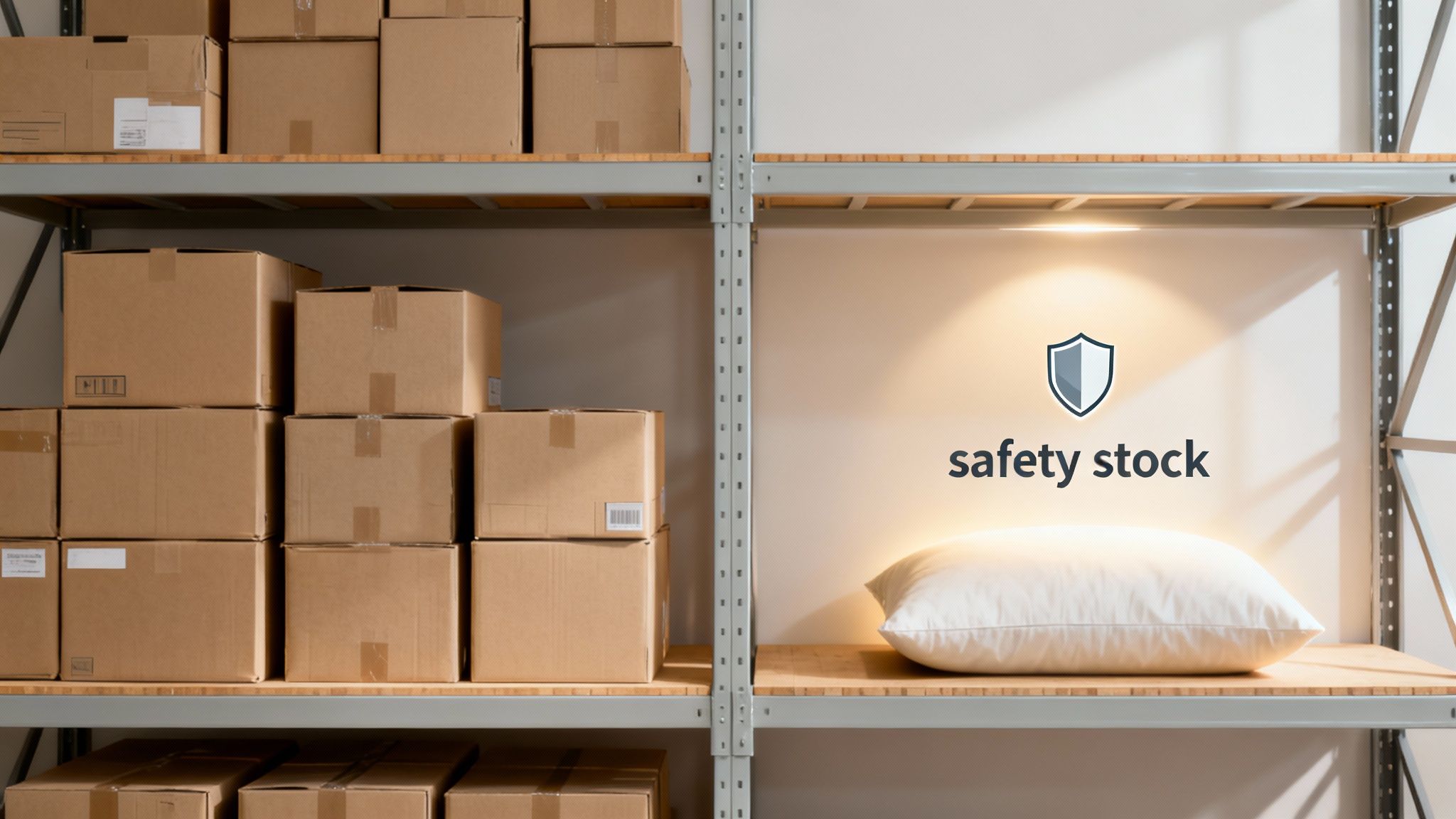
This practice is essential for omnichannel retailers who must maintain product availability across their DTC site, Amazon, and physical stores. A CPG brand might maintain higher safety stock levels for its best-selling SKUs on Amazon in Q4 to capitalize on holiday demand and avoid stockouts that would hurt its listing rank. The goal is to balance the cost of carrying extra inventory against the potential lost revenue and customer dissatisfaction from being out of stock. For example, a 5% increase in inventory can prevent stockouts that might cost 10% in lost sales.
Implementing safety stock is a data-driven exercise in risk management. The key is to calculate just enough buffer to prevent stockouts without tying up excessive capital in static inventory.
Vendor-Managed Inventory (VMI) is a collaborative supply chain strategy where the supplier takes responsibility for managing inventory levels at the retailer's location. The supplier monitors the retailer's sales data and inventory counts, automatically replenishing stock when it falls below a pre-agreed threshold. This shifts the burden of forecasting and ordering from the retailer to the vendor, creating a more streamlined and responsive supply chain.
The classic example is the partnership between Walmart and Procter & Gamble, where P&G directly manages the inventory of its products in Walmart's distribution centers. This collaboration famously reduced stockouts and improved on-shelf availability, boosting sales for both companies. For an omnichannel brand, VMI can ensure consistent stock levels for key products across both DTC warehouses and retail partner locations, strengthening relationships and driving mutual growth.
A successful VMI partnership is built on trust, transparency, and technology. It requires a seamless flow of information and clearly defined expectations to maximize benefits for both parties.
Cycle counting is a proactive inventory auditing method where small subsets of inventory are counted on a continuous, rotating schedule. Unlike a disruptive, once-a-year physical count, this approach integrates inventory verification into daily operations. By regularly counting different items, businesses maintain constant inventory accuracy, identify discrepancies as they occur, and avoid the operational shutdown required for a full wall-to-wall count.
This method is highly effective for omnichannel retailers. A distribution center might use ABC analysis to count high-value 'A' items weekly, while lower-value 'C' items are counted quarterly. A brick-and-mortar store can use cycle counts to verify stock levels of popular products, ensuring accurate data for both in-store shoppers and its Buy Online, Pickup In-Store (BOPIS) system. Brands that implement regular cycle counting often achieve over 99% inventory record accuracy, which directly prevents overselling and improves the customer experience.
A successful cycle counting program is built on consistency, accuracy, and a commitment to resolving issues. It transforms inventory auditing from a dreaded annual event into a manageable, value-adding routine.
Demand-Driven Material Requirements Planning (DDMRP) is a modern inventory method that uses actual sales orders—not just forecasts—to drive replenishment. It blends traditional planning with Lean principles to create a more resilient and responsive supply chain, making it ideal for businesses facing volatile demand.
DDMRP works by strategically placing inventory buffers, or "decoupling points," at key locations in the supply chain. These buffers absorb variability and prevent the "bullwhip effect," where small fluctuations in customer demand amplify into major disruptions upstream. By focusing on the flow of materials through these points, companies can maintain high service levels with significantly less overall inventory.
This method is especially powerful for businesses with complex supply chains or high-mix, low-volume production. For example, an automotive parts supplier can use DDMRP to manage thousands of components, ensuring critical parts are always available for the assembly line without holding excessive stock of every single item. This focus on real demand ensures capital is invested where it’s truly needed.
Implementing DDMRP requires a shift in mindset from traditional forecast-based planning to a demand-driven flow model. Success hinges on strategic buffering and clear visibility across the supply chain.
Inventory forecasting is the process of predicting future inventory needs based on historical sales data, market trends, and statistical analysis. Accurate demand planning is the Foundation of any successful inventory strategy. It allows brands to maintain optimal stock levels, prevent costly stockouts that damage customer trust, and avoid the capital drain of excess inventory. It’s the difference between reacting to the market and leading it.
Effective forecasting goes beyond just looking at last year's sales. A CPG brand might use AI-driven tools to predict a surge in demand for sunscreen by analyzing weather patterns and social media trends. For omnichannel sellers, this means integrating data from their Shopify store, Amazon, and brick-and-mortar locations to create a unified, accurate demand picture that informs purchasing decisions across the entire business, preventing costly stock imbalances between channels.
Moving from reactive ordering to proactive forecasting requires the right blend of data, tools, and cross-functional collaboration.
Lean Inventory Management is a philosophy focused on eliminating waste and maximizing value throughout your entire inventory system. Originating from lean manufacturing, this approach systematically removes any activity that doesn't add value for the customer. This means minimizing excess stock, reducing unnecessary product handling, and streamlining every process from procurement to fulfillment. Adopting lean principles is one of the most powerful ways to build a resilient and efficient operation.
The Toyota Production System is the most famous example, utilizing tools like Kanban (visual signals for replenishment) and the 5S methodology (Sort, Set in Order, Shine, Standardize, Sustain). For an omnichannel retailer, a lean approach can transform warehouse operations by organizing workspaces for faster picking or using visual cues to signal when specific SKUs need replenishment. It's a fundamental part of achieving operational excellence and a key tenet of our Optimization pillar.
Implementing a lean system is a commitment to continuous improvement (kaizen) that involves your entire team. It’s about creating a culture that constantly seeks out and eliminates inefficiency.
| Item | Implementation Complexity (🔄) | Resource Requirements (⚡) | Expected Outcomes (📊) | Ideal Use Cases (💡) | Key Advantages (⭐) |
|---|---|---|---|---|---|
| Just-In-Time (JIT) | High 🔄 — precise forecasting & supplier integration | High ⚡ — real-time systems, reliable suppliers | 📊 Lean inventory, lower carrying costs; higher stockout risk | 💡 Automotive, electronics, fast-fashion with reliable suppliers | ⭐ Reduces waste, improves cash flow |
| ABC Analysis (Pareto) | Low–Moderate 🔄 — classification & periodic review | Low ⚡ — basic analytics and periodic updates | 📊 Prioritized controls; focus resources on high-value SKUs | 💡 Hospitals, retail, manufacturing SKU prioritization | ⭐ Simplifies management; targets resources to A items |
| Economic Order Quantity (EOQ) | Low 🔄 — formulaic; assumes steady demand | Low–Moderate ⚡ — accurate cost & demand inputs | 📊 Optimal order size; minimizes total ordering + holding cost | 💡 Stable-demand SKUs, routine replenishment cycles | ⭐ Objective, easy-to-calc ordering guidance |
| First-In, First-Out (FIFO) | Low 🔄 — procedural discipline for rotation | Low ⚡ — labeling, layout, staff training | 📊 Prevents spoilage/obsolescence; clearer cost flow | 💡 Perishables, pharmaceuticals, foodservice | ⭐ Reduces waste; simple and transparent |
| Safety Stock Management | Moderate 🔄 — calculation and policy setting | Moderate ⚡ — forecast data, extra capital for buffers | 📊 Fewer stockouts and improved service levels; higher holding costs | 💡 Seasonal peaks, critical components, healthcare | ⭐ Protects service levels; cushions variability |
| Vendor-Managed Inventory (VMI) | High 🔄 — contractual collaboration & integration | High ⚡ — IT integration, data sharing, supplier resources | 📊 Lower customer inventory and admin effort; shared replenishment risk | 💡 High-volume predictable items; long-term suppliers | ⭐ Reduces carrying costs for customer; improves replenishment |
| Cycle Counting | Moderate 🔄 — scheduling, procedures, frequency rules | Low–Moderate ⚡ — staff time, counting tools, software | 📊 Continuous accuracy; faster discrepancy detection | 💡 Warehouses, retail with many SKUs, high-value items | ⭐ Maintains accuracy without full physical shutdowns |
| Demand-Driven MRP (DDMRP) | High 🔄 — paradigm shift; buffer management & policies | High ⚡ — specialized software, training, high-quality data | 📊 More responsive planning; reduced bullwhip & excess inventory | 💡 Complex multi-level manufacturing; high-mix environments | ⭐ Aligns inventory to actual demand; improves agility |
| Inventory Forecasting & Demand Planning | Moderate–High 🔄 — modeling, cross-functional coordination | High ⚡ — historical data, advanced software, skilled analysts | 📊 Better demand alignment; fewer stockouts and excess | 💡 Retail, e-commerce, manufacturers with variable demand | ⭐ Enables proactive planning and optimization |
| Lean Inventory Management | High 🔄 — cultural change, continuous improvement (Kaizen) | Moderate ⚡ — training, process mapping, visual controls | 📊 Reduced waste, improved flow, lower inventory levels | 💡 Manufacturing and operations focused on cost & quality | ⭐ Eliminates non-value activities; boosts efficiency & quality |
Mastering inventory in a modern, omnichannel world is no longer just an operational chore—it's a core driver of growth. The principles we've covered, from the precision of ABC Analysis to the foresight of demand planning, are the essential building blocks for a resilient and profitable retail operation. Moving from a reactive to a proactive stance is what transforms your stock from a costly liability into a powerful strategic asset.
The true power of these inventory management best practices comes from their integration. A successful strategy weaves these methods into a cohesive system. Imagine combining the cost-saving principles of EOQ with the strategic prioritization of ABC analysis. This allows you to not only order the ideal quantity for your top-performing 'A' items but also to minimize capital tied up in slower-moving 'C' items, creating a self-optimizing financial loop.
The ultimate goal is to build a system where your inventory operations directly fuel your growth. When your forecasting is accurate, you can confidently invest in marketing campaigns, knowing your stock levels can support the resulting demand. This prevents stockouts that kill momentum on platforms like Amazon and damage your seller rankings. When you implement a streamlined FIFO or JIT system, you reduce carrying costs, freeing up capital that can be reinvested into product development or market expansion.
This is the essence of scaling a brand: aligning your foundational operations with your Optimization and Amplification efforts. Achieving this alignment leads to measurable results:
The journey to inventory mastery is a continuous process of refinement. Start by identifying the single biggest inventory challenge your business faces today. Is it frequent stockouts of bestsellers? Or is too much capital tied up in slow-moving goods?
By embracing these inventory management best practices, you build more than just an efficient warehouse; you construct a competitive advantage that enables sustainable growth, enhances customer loyalty, and drives long-term profitability.
At RedDog Group, we specialize in transforming inventory operations from a cost center into a powerful growth engine for omnichannel brands. We build integrated systems that connect your warehouse data to your marketplace strategy, ensuring your foundational strength fuels your market amplification. Ready to build an inventory system that scales with your ambition? Let's Talk Growth.
Leave a comment: