
Published: March 2020 | Last Updated:February 2026
© Copyright 2026, Reddog Consulting Group.

Every Texas-based CPG brand faces the challenge of reaching the right buyers in a crowded marketplace. Getting your products on shelves and screens starts with a process built for accuracy, not guesswork. With a data-driven buyer persona strategy and precise segmentation, you can target high-value accounts, align outreach to each sales channel, and turn quality leads into profitable customers while avoiding wasted spend.
| Important Insight | Explanation |
|---|---|
| 1. Define Your Ideal Customer Profile | Identify specific characteristics of accounts that best benefit from your products. Focus on location, revenue size, and product categories. |
| 2. Segment Your Target Accounts | Prioritize your accounts based on win probability and potential profit. Create tiered lists for focused outreach efforts. |
| 3. Automate Outreach to Save Time | Implement automation tools to personalize outreach while maintaining efficiency. This ensures your team can engage more prospects effectively. |
| 4. Qualify Leads Using Scoring Criteria | Establish clear criteria to differentiate between Marketing Qualified Leads (MQLs) and Sales Qualified Leads (SQLs) based on engagement and fit. |
| 5. Measure Conversion Rates Regularly | Track important metrics like conversion rates and customer acquisition costs to continuously improve lead generation effectiveness. |
Your lead generation engine starts with precision, not volume. Before you launch any campaign or pick up the phone, you need to know exactly which accounts to pursue and who makes decisions within them. This step separates CPG brands that waste marketing budget from those that convert consistently.
Start by defining your Ideal Customer Profile (ICP). This is the company archetype that benefits most from your products. For a Texas-based CPG brand, this might look like: regional grocery chains with 15–50 locations, independent retailers in the natural products space, or emerging direct-to-consumer (DTC) platforms with growth-stage budgets. Be specific about revenue size, geographic footprint, product categories they stock, and distribution capability.
Next, identify the buying personas within those target accounts. Data-driven buyer personas focus on specific decision-makers and their roles, challenges, and buying criteria. In CPG retail, this typically means:
Each persona has different priorities. A category manager cares about contribution margin and inventory velocity. An operations lead focuses on your 3PL integration and reorder processes. Understanding these distinctions shapes your messaging and channel strategy.
Here’s a quick comparison of key buying personas and their decision factors:
| Persona Type | Main Focus Areas | Impact on CPG Sales |
|---|---|---|
| Buyer/Procurement Manager | Contract terms and vendor pricing | Determines profitability |
| Category Manager | Product fit and sales velocity | Drives assortment decisions |
| Operations Lead | Logistics and inventory turnover | Influences fulfillment speed |
| Founder/Owner | Strategic approval, partnerships | Final say for independents |
Pull data from multiple sources to build accurate profiles. Review your current customer base for patterns—what do your best customers have in common? Conduct win/loss analysis to understand why some prospects converted and others didn’t. Talk to your sales team about objections and sticking points. Cross-reference this with your CRM, recent contract data, and customer feedback.
Once you’ve mapped your ICPs and personas, segment your target account list. Prioritize tier-one accounts where you have the highest win probability and profit potential. These are your quick wins and relationship anchors. Tier-two and tier-three accounts represent longer-term expansion opportunities.
Your ICP and personas aren’t static documents—revisit them quarterly as your product and market evolve.
Pro tip: Create a simple one-page persona worksheet for each decision-maker type, including their role, typical challenges with current vendors, key buying criteria, and their communication preferences. Your sales team will reference this constantly when reaching out.
Now that you know who you’re targeting, it’s time to build a prospect list and organize it strategically by channel. A well-segmented list means your sales team reaches the right person through the right channel at the right time, dramatically improving conversion rates and efficiency.

Start by pulling data from multiple sources to build your initial prospect list. Your CRM likely contains past interactions and customer data. Combine this with external data providers, LinkedIn Sales Navigator for direct contacts, and industry directories specific to your space. Data enrichment tools help fill gaps and validate accuracy, but manual verification is critical for a CPG focus list.
Once you have raw contacts, apply data normalization to ensure consistency. Standardize company names, titles, and contact information. Remove duplicates and outdated entries. Bad data costs time and credibility with prospects.
Next, segment your list by sales channel. Your segmentation might look like this:
Within each channel segment, apply secondary prioritization based on revenue potential, engagement likelihood, and buying signals. Effective segmentation improves response rates and ensures your outreach messaging aligns with each segment’s priorities.
For Amazon, emphasize inventory velocity and margin protection. For distribution partners, highlight logistics efficiency and order fulfillment speed. For DTC, focus on product storytelling and margin on direct sales. This channel-specific approach prevents generic messaging that gets ignored.
Segment by channel first, then by priority and buying readiness—this sequence ensures your team focuses energy where conversion probability is highest.
Pro tip: Export your segmented lists into separate sheets or views within your CRM so your sales team can filter by channel and priority instantly. Tag contacts with “warm,” “cold,” and “in-progress” statuses to avoid duplicate outreach and maintain pipeline clarity.
Manual outreach doesn’t scale. If your sales team is manually sending emails, logging calls, and tracking follow-ups, you’re leaving money on the table and burning hours on repetitive work. Automation platforms let you reach more prospects with personalized, timely messages while your team focuses on closing deals.
Outreach automation streamlines repetitive tasks while maintaining personalization through trigger-based delivery and CRM integration. The goal is to keep prospects engaged at every stage without requiring constant manual intervention.
Start by choosing automation tools that integrate with your CRM. Popular platforms include HubSpot, Outreach, Lemlist, or Apollo depending on your budget and complexity. The platform should sync your segmented prospect lists, track opens and clicks, and log all interactions automatically.
Set up email sequences for each channel segment. Your Amazon outreach might follow this pattern:
For wholesale and distribution, emphasize logistics efficiency and order fulfillment in your sequence. For DTC partners, focus on margin upside and product storytelling. Use dynamic fields to insert prospect names, company details, and channel-specific language automatically.
Beyond email, integrate LinkedIn automation for outreach and direct messaging. Many prospects respond faster to LinkedIn messages than email, especially decision-makers. Lead generation automation improves conversion by acting while interest is fresh and routing qualified leads to sales instantly.
Track campaign performance in real-time. Monitor open rates, click rates, and response rates by segment and channel. If your Amazon outreach has a 15% open rate but your retail sequence has 8%, adjust messaging or timing for the weaker channel.
Automate the repetitive parts, but keep the relationship-building human. Your sales team should personalize the final pitch and close.
Pro tip: Set up “smart” follow-up rules that automatically resurface cold prospects after 30 days or trigger a call reminder when a prospect opens your email multiple times without responding—these small behavioral signals often precede warm conversations.
Not every lead is created equal. A cold prospect from LinkedIn isn’t the same as a prospect who attended your webinar or requested a demo. Lead qualification and scoring separate the serious buyers from the tire-kickers, so your sales team focuses energy where conversion probability is highest.
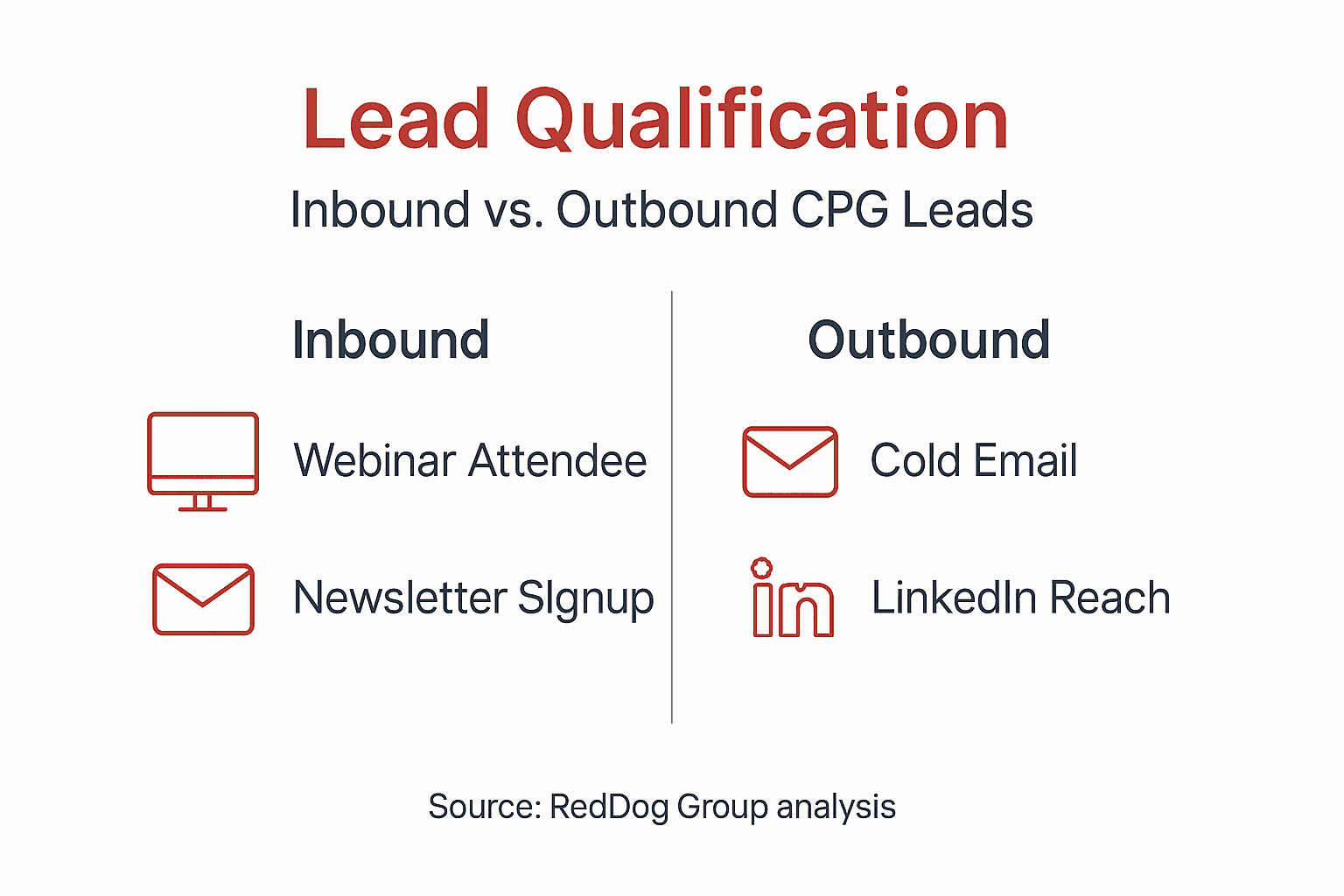
Start by defining qualification criteria specific to CPG retail. Marketing Qualified Leads (MQLs) and Sales Qualified Leads (SQLs) serve different purposes. An MQL might be a prospect who downloaded your pricing guide or opened your email sequence three times. An SQL is a prospect ready for a sales conversation because they fit your ICP, have budget, and show clear buying intent.
For CPG, qualification criteria might include:
Next, assign point values to these criteria. Award points for company size (10 points if revenue matches your ICP), engagement (5 points per email open, 10 points for a form submission), and buying signals (15 points for a demo request). Real-time data like website activity and email engagement allows you to prioritize leads with immediate purchase signals matched to your ICP.
Set a threshold score for SQL qualification. For example, leads scoring 40+ points move to sales immediately. Leads scoring 20-39 get added to nurture sequences for 30 days before re-scoring. Leads below 20 stay in cold storage and re-engage after 60 days.
This table summarizes typical lead scoring outcomes for qualification:
| Lead Score Range | Action Taken | Expected Conversion Rate |
|---|---|---|
| 40+ points | Move to sales immediately | High (3-4x standard) |
| 20-39 points | Add to nurture sequence | Moderate |
| Below 20 points | Hold and re-engage later | Low |
Automate this in your CRM. Use workflow rules that update lead scores when prospects take actions like opening emails, visiting your pricing page, or requesting calls. Your sales team sees a dashboard showing MQLs, SQLs, and their readiness instantly.
A high-quality lead scored at 50 points closes at 3-4x the rate of an unqualified 10-point lead. Quality beats volume every time.
Pro tip: Create a “reverse scoring” system where leads lose points for disqualifying factors, like they’re a competitor, located outside your distribution range, or haven’t engaged in 90 days. This keeps your pipeline clean and prevents your team from chasing dead prospects.
You can’t improve what you don’t measure. Without tracking lead quality and conversion rates, you’re flying blind. This step separates campaigns that actually drive profit from those that drain your marketing budget while looking busy.
Start by defining your baseline metrics. Lead generation metrics include conversion rates, cost per lead, and customer acquisition costs that reveal which channels and campaigns actually work. For CPG brands, focus on metrics that matter to your bottom line, not vanity metrics like impressions or email opens.
Track these core KPIs:
Measure conversion rates by channel separately. Email campaigns, LinkedIn outreach, and Amazon vendor recruitment have different conversion profiles. Email might convert at 8%, while direct calls convert at 25%. Understanding these differences helps you allocate budget to your highest-performing channels.
Set up tracking in your CRM to log every lead touchpoint. When a prospect converts from MQL to SQL, log the date. When they request a demo, log it. When they become a customer, mark it. Over time, patterns emerge showing which channels produce the highest-quality leads.
Lead generation benchmarks vary by channel, with email averaging 6.5% conversion and LinkedIn leads costing more but offering higher qualification. Use industry benchmarks as a reality check, but focus on your own data to identify opportunities.
Review metrics monthly. If your Amazon channel has a 5% conversion rate but wholesale has 12%, understand why. Is your messaging different? Are wholesale prospects naturally more qualified? Are your qualification criteria helping or hurting?
If you’re generating 100 leads monthly but only 5 convert to customers, something is broken. Either your leads are low quality or your sales process needs fixing.
Pro tip: Create a simple monthly dashboard showing conversion rates by channel, average CAC, and sales cycle length. Share it with your sales team weekly so everyone sees which channels are performing and where to focus effort.
The lead generation workflow outlined in this article highlights key challenges like targeting ideal customer profiles, segmenting prospects by sales channels, automating personalized outreach, and qualifying leads effectively. Many CPG brands struggle with low conversion rates, inefficient sales efforts, and margin leakage across Amazon, wholesale, DTC, and brick-and-mortar channels. The pain points of understanding channel-specific profitability, balancing inventory velocity with logistic costs, and aligning messaging to diverse buying personas are real obstacles in scaling profitably.
Our Houston-based team at RedDog Group specializes in addressing these exact complexities. We help emerging and growth-stage CPG brands navigate real retail barriers such as Amazon FBA fees, Walmart WFS margin compression, 3PL costs, and cash flow timing. By focusing on contribution-margin-first strategies and operational clarity, we empower your sales and marketing to work smarter, not just harder. For a tailored approach to refining your lead generation and retail expansion, explore our comprehensive CPG retail growth solutions at RedDog Group CPG Retail Growth Offer.
If you are ready to stop wasting budget on broad tactics and want to focus on profitable, measurable outcomes aligned with your ICP and sales channels, consider partnering with specialists who blend digital marketplace performance with physical retail realities. Discover how you can prioritize high-value leads, optimize channel segmentation, and improve conversion rates today.
Start building a scalable, margin-focused lead generation engine that delivers results. Visit RedDog Group CPG Retail Growth Offer now and turn your multichannel challenges into profitable growth opportunities.
To identify your ideal customer profile, define the characteristics of companies that benefit most from your products. Focus on factors like company size, product categories, and distribution capabilities. Create a clear description of these traits within 30 days to streamline your targeting efforts.
Start by gathering data from multiple sources, including your CRM and industry directories. Next, organize your prospects by sales channel, such as Amazon or wholesale, and prioritize them based on revenue potential and engagement likelihood. Aim to have your segmented lists ready within two weeks to enhance outreach efficiency.
Choose an automation platform that integrates with your CRM to streamline outreach tasks. Set up email sequences tailored to each sales channel, ensuring messages are personalized and relevant. Implement these automated sequences within 30 days to increase engagement and conversion rates.
Define specific criteria, such as budget authority, alignment with your ideal customer profile, and clear buying signals. Assign point values to each criterion and establish a threshold for sales-qualified leads. Review and adjust your scoring system regularly to ensure optimal lead quality.
Track key performance indicators such as conversion rates, cost per lead, and customer acquisition costs. Regularly analyze these metrics monthly to identify trends and areas for improvement. Set benchmarks based on historical data to increase your conversion rates by 15% over the next quarter.
Leave a comment: