
Published: March 2020 | Last Updated:January 2026
© Copyright 2026, Reddog Consulting Group.

A powerful SEO content strategy is the blueprint that guides how your brand creates, optimizes, and distributes content to capture your audience’s attention and drive measurable growth. It’s the difference between publishing random articles and building an intentional content ecosystem that establishes your authority, boosts visibility, and turns search traffic into revenue. This plan dictates which topics you will dominate, who you are speaking to, the specific customer intent you're targeting, and how you will measure success across all channels.
Before you write a single word, an effective SEO content strategy begins with a rock-solid foundation. This is where we replace guesswork with data-driven planning to ensure every piece of content directly supports a clear business objective. We call this the Foundation pillar of our growth framework—it’s the essential first step before moving to Optimization and Amplification.
This foundational stage provides a complete, unfiltered view of your entire digital footprint. We’re not just looking for broken links; we’re analyzing what’s working, what isn't, and where the biggest growth opportunities are hiding across your Shopify store, Amazon listings, and other channels. The goal is to build a 360-degree view of your current performance to inform every strategic decision that follows.
A thorough audit is your strategic starting point—a deep dive into both your content and the technical health of all your digital properties. Without this baseline data, your strategy is based on assumptions, not facts.
Your audit should cover several key areas:
The essential role of content strategy in omnichannel growth is to create a unified customer journey. Your audit exposes the cracks in that journey, showing you precisely where to focus to improve both user experience and revenue.
Understanding your own performance is only half the battle. A critical part of building your foundation is dissecting your competitors' strategies to find content gaps you can own. This isn't about imitation; it's about strategic differentiation.
Look for patterns in their content. Are they dominating informational keywords with in-depth guides? Have they completely ignored video content for key product categories? By identifying their weaknesses, you can pinpoint opportunities to create something far better and more valuable that serves an unmet market need. This analysis allows you to proactively capture market share by becoming the best answer for specific customer questions.
For example, if a competitor ranks for "best hiking boots" with a thin, text-only article, you have a clear opening. You can create a comprehensive guide featuring real-world field testing, customer reviews, and video demos, instantly positioning your brand as the more authoritative and trustworthy source.
With your foundation established, it’s time to move into the Optimization phase by mapping keywords to customer intent. Many brands make the mistake of chasing high-volume keywords, but effective keyword research goes much deeper. It’s about understanding the exact language your customers use at every stage of their journey and creating content that meets them precisely where they are.
Search engines don't reward random effort—they reward structure, clarity, and a deep understanding of what the user is trying to accomplish. Every search has a purpose, and matching that purpose with the right content on the right channel is what drives measurable growth.
To connect with your audience effectively, you must understand the four main types of search intent. Each one signals a different mindset and requires a different content response.
Mastering this framework is key to building an SEO strategy that doesn’t just attract traffic, but attracts the right traffic that is likely to convert.
An SEO content strategy without intent mapping is like having a map without a destination. You might be moving, but you're not getting anywhere meaningful. Aligning content to user intent ensures every asset you create has a clear purpose tied to a business outcome.
The true power of intent mapping is realized when you apply it across your entire omnichannel footprint. A keyword that’s perfect for a blog post will almost always fail on an Amazon product listing. The channel dictates the content strategy.
For example, an informational keyword like "how to choose running shoes" is a perfect fit for a detailed blog post on your website. This content attracts top-of-funnel traffic, builds authority, and introduces potential customers to your brand. According to recent data, companies that blog get 55% more visitors, and with over 53% of all site traffic coming from organic search, it’s a channel you can’t afford to ignore. You can explore more impactful content marketing statistics to see the data for yourself.
Conversely, a high-intent, transactional keyword like "men's trail running shoes size 11" belongs on your product detail pages—whether on your own DTC site or a marketplace like Amazon. These pages must be optimized for one thing: conversion. That means sharp product titles, benefit-driven bullet points, and high-quality images. Trying to rank a blog post for a "buy now" keyword will only lead to high bounce rates and lost sales.
This is why mapping is essential. A solid keyword strategy aligns the searcher's goal with the right content format and the right channel.
| Customer Intent | Keyword Example | Ideal Content Format | Primary Channel |
|---|---|---|---|
| Informational | "how to break in leather boots" | Blog Post / How-To Guide | Your Website (Shopify, etc.) |
| Commercial | "brooks vs. hoka running shoes" | Comparison Article / Video Review | Your Website / YouTube |
| Transactional | "buy nike air zoom pegasus size 9" | Product Detail Page (PDP) | Your Website / Amazon / Walmart |
| Navigational | "zappos customer service" | Contact or About Us Page | Your Website |
By organizing your keywords this way, you ensure that every piece of content you create serves a specific purpose in the customer journey, guiding them smoothly from discovery to purchase.
This graphic illustrates how a proper audit and analysis phase informs your entire strategy, especially keyword mapping.
As you can see, a winning strategy always starts with a deep dive into your current standing. That initial analysis is what allows you to intelligently map keywords to customer needs across every single one of your channels.
With your keywords mapped to intent, it’s time to build a smart content structure. This isn't about publishing random blog posts and hoping for the best. A cohesive structure signals to both search engines and customers that you are an expert, guiding them directly to the solutions they need.
Think of it as the architecture for your authority.
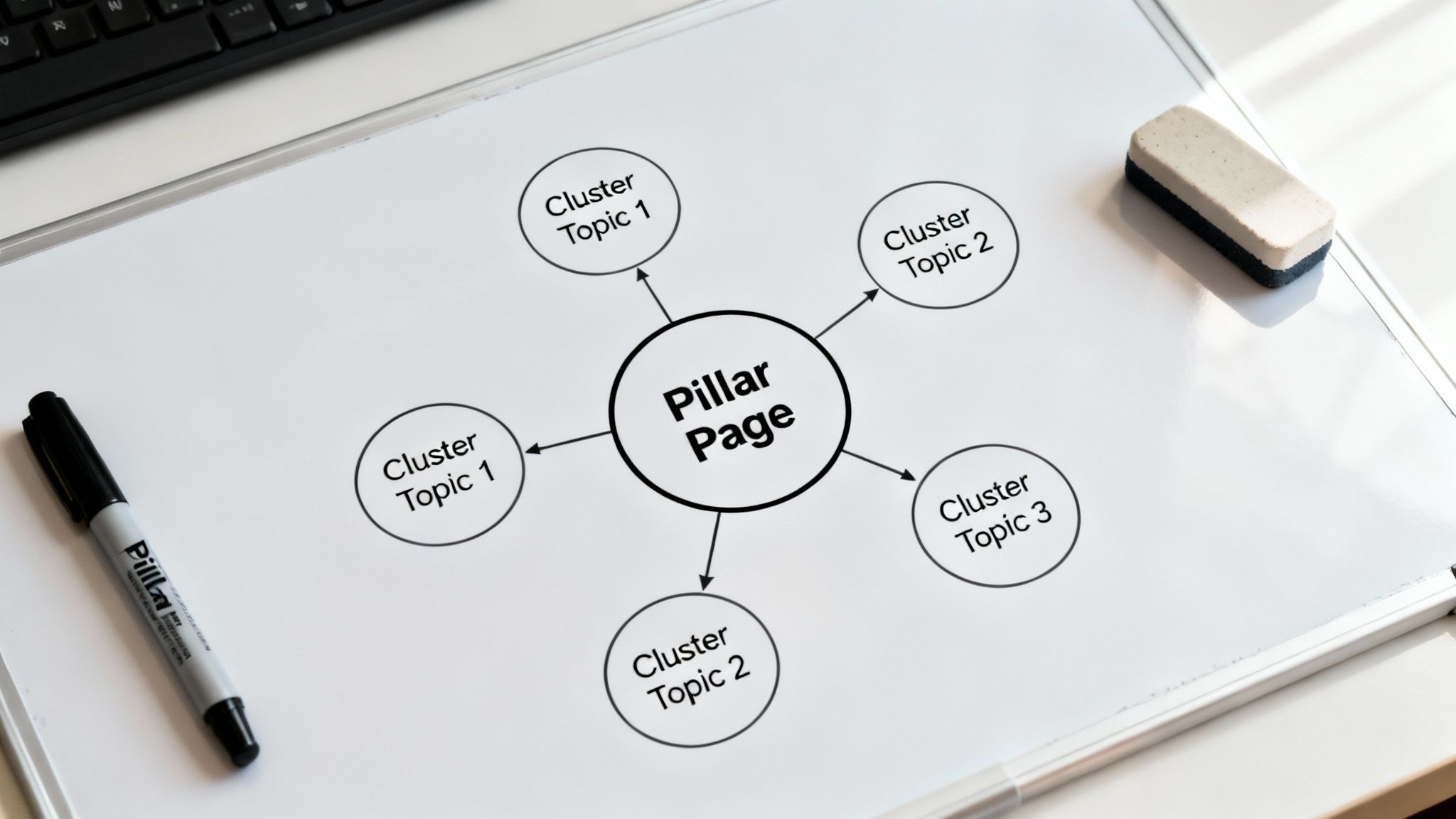
This organized approach is a powerful signal to Google. Search engines reward clarity and organization, and a well-structured site helps them understand your most important pages and how different topics are interconnected.
One of the most effective ways to organize content is with the hub-and-spoke model, also known as topic clustering. The concept is simple but powerful: create a central "hub" page (or pillar page) that provides a broad overview of a major topic. Then, link out from that hub to more specific "spoke" articles that dive deep into subtopics.
Let's say you sell outdoor gear. Your hub page could be a comprehensive guide on "Hiking for Beginners." Your spoke pages would then address related questions:
This model creates a powerful internal linking network. It proves to Google that you have deep expertise on the entire subject of hiking, which helps the whole cluster of pages rank higher. For your audience, it creates a seamless journey from general information to the specific answers they need.
A well-executed hub-and-spoke model does more than just organize your content; it builds topical authority. By comprehensively covering a subject, you signal to Google that your brand is a definitive resource, which can lift the rankings of all associated pages.
Your content structure must also align with the different stages of the customer journey. Not all content serves the same purpose, and your chosen format should match what the user is trying to accomplish—from their first search to the moment they decide to buy.
Top-of-Funnel (Awareness):
At this stage, your goal is to attract new audiences with helpful, informational content. These users aren't ready to buy; they're looking for answers and expertise.
Middle-of-Funnel (Consideration):
Now, users are weighing their options and trying to find the best solution. Your content should help them compare alternatives and make an informed decision.
Bottom-of-Funnel (Conversion):
This is where you close the deal. The content must be laser-focused on the product and make it incredibly easy for someone to make a purchase.
Finally, don't overlook the architectural details that have a significant impact on both SEO and user experience. Simple elements like URLs and meta descriptions are your first chance to earn a click from the search results page.
/blog/how-to-choose-hiking-boots).By blending the hub-and-spoke model with strategic content formats and clean technical elements, you build a scalable architecture that drives results. For a deeper dive into site structure, check out these retail SEO best practices. And to ensure your site is easily crawlable, a clean sitemap is essential; these English XML sitemap best practices are a great resource.
You’ve established your keyword map and content structure. Now it’s time to bring your SEO strategy to life. This is where you turn strategic insights into high-performing content that connects with customers and climbs the search rankings.
A successful workflow is about more than just writing. It involves creating detailed briefs that set your writers up for success, embedding on-page SEO best practices from the start, and ensuring every technical detail is perfected before you hit publish. This process gives every piece of content its best chance to succeed right out of the gate.
In today's search landscape, Google prioritizes content that demonstrates Experience, Expertise, Authoritativeness, and Trustworthiness (E-E-A-T). This isn’t just another SEO acronym; it's a fundamental framework for creating content that both search engines and people will trust.
For example, if you sell specialized running shoes, a product description written by a certified running coach who has logged miles in them will carry far more weight than generic copy from a spec sheet. That’s E-E-A-T in action.
To integrate E-E-A-T into your content:
This shift toward authentic, human-led content is a key differentiator. Analysis shows that human-written content consistently outranks AI-generated fluff, with E-E-A-T emerging as a dominant ranking signal. You can dig deeper into these emerging SEO trends on Marketermilk.com.
Even the most trustworthy content will fail if it’s not technically sound. On-page and technical SEO are the crucial behind-the-scenes optimizations that help search engines find, understand, and rank your pages effectively.
A detail-oriented approach is non-negotiable. Using headings correctly—one H1 per page, followed by a logical flow of H2s and H3s—creates a clear hierarchy for both readers and search engine crawlers. Your internal linking strategy is just as important. Linking from a new blog post to a relevant product or category page guides users deeper into your site while passing authority and showing Google how your content is interconnected.
One of the most common mistakes brands make is treating optimization as an afterthought. Optimization must be built into the creation process. Everything from image file names to meta descriptions should be optimized before you publish.
Don't overlook the small-but-mighty details. Optimizing images by compressing them and using descriptive alt text improves site speed and accessibility. Implementing schema markup (structured data) is another game-changer. It helps Google understand the context of your content and can unlock rich snippets in search results—like star ratings or product prices—that make your listing stand out and significantly boost your click-through rate.
To maintain consistency and prevent costly errors, use a pre-publish checklist for every piece of content. This simple tool ensures nothing is missed and every asset is primed for performance.
By systemizing your production and optimization, you transform your content strategy from a document into a reliable engine for measurable growth.
Creating exceptional, optimized content is a huge step, but it only gets you to the starting line. The real growth in an omnichannel world comes from Amplification—the deliberate process of distributing and adapting that content to meet customers on every channel they use.
This is where your SEO content strategy moves beyond your website and connects directly to sales, creating a seamless brand experience everywhere. Publishing a great blog post and just hoping for the best is a recipe for missed opportunities.
Instead, you need to view each core piece of content as a valuable asset that can be strategically repurposed. A single in-depth guide isn't just one asset; it's the raw material for a dozen micro-assets tailored to different platforms.

This approach maximizes the return on your initial content investment, ensuring your message reaches a wider audience in the formats they prefer.
Let’s get practical. Imagine you’ve just published a comprehensive blog post titled "The Ultimate Guide to Choosing Trail Running Shoes." Instead of just sharing the link, you break it down and amplify it.
This "create once, distribute everywhere" mindset is the core of effective content amplification.
Amplifying your content also means adapting your SEO approach for channels where the rules are different. The ranking algorithms on Amazon and Walmart are not the same as Google's. While Google prioritizes E-E-A-T and user experience, marketplaces are laser-focused on sales velocity and conversion rates.
For marketplace SEO, your focus must shift slightly:
The goal of marketplace content isn't just to inform; it's to convert. Every word and image should be optimized to increase the likelihood of a sale, which in turn fuels the ranking algorithm. This is a direct feedback loop you must master.
As you scale content production, it's tempting to lean heavily on automation. The volume of AI-generated content in search results has surged in recent years, and while AI can offer incredible efficiency for drafting and brainstorming, relying on it entirely is a risky strategy. AI-generated content often lacks the nuance, experience, and authenticity required to build true brand trust and is vulnerable to algorithm updates.
The sustainable path forward is a hybrid approach: blend AI efficiency with genuine human expertise. This ensures your content is not only optimized but also authentic, valuable, and resilient. You can discover more insights about the rise of AI in search results on semrush.com. This approach helps you build a brand that withstands updates and drives consistent, long-term growth.
An effective SEO content strategy is not a "set it and forget it" initiative. It’s a dynamic process that requires constant measurement, analysis, and refinement. This is where your foundational work translates into measurable results that prove ROI and inform smarter decisions.
Without a solid feedback loop, you are simply creating content without knowing if it's contributing to your bottom line.
Effective measurement means looking beyond vanity metrics like total page views. While these numbers can be encouraging, they don't tell you if your content is actually driving revenue. Instead, focus on key performance indicators (KPIs) that are directly tied to your business goals.
To get a true picture of your content’s performance, you must track metrics that reflect genuine business value. These KPIs tell the story of your strategy's impact, from the first click to the final sale.
Your core KPI dashboard should track:
Focusing on business-oriented KPIs transforms your SEO content strategy from a marketing expense into a predictable revenue driver. When you can show that a specific content cluster generated a 15% lift in organic conversions, you're speaking the language of growth.
With the right data, you can move from a "publish and pray" model to a cycle of continuous improvement. Your analytics tools provide the insights needed to refine your approach over time.
Google Search Console is a goldmine for understanding how people find you, showing the exact search queries that drive clicks and impressions. Google Analytics 4 (GA4) then reveals what users do once they land on your site. For a deeper understanding of how to connect these data points across your entire business, explore the principles of omnichannel analytics in our comprehensive guide.
One of the most powerful and often overlooked tactics in any SEO strategy is the content refresh. You don't always need to create new content from scratch. Updating and improving your existing top performers can deliver significant results with a fraction of the effort.
Schedule regular content audits (e.g., quarterly) to identify pages that are:
This iterative approach ensures your content investment delivers compounding returns. By consistently measuring what works and refining what doesn't, you build a resilient content engine that drives sustainable, long-term growth.
If you're digging into building an SEO content strategy, you probably have a few questions. Here are some of the most common ones we hear from brands trying to scale their growth across multiple channels.
Let's be real: SEO is a long game. While you might see some quick wins in the first 3-4 months, a solid SEO content strategy really starts to deliver significant, measurable growth in about 6-12 months. We're talking about real increases in organic traffic and, more importantly, revenue.
Consistency is everything. The initial work—like technical audits and keyword mapping—is all about building a strong foundation. Think of it less like a switch you flip and more like planting a tree; it takes time to grow, but the results are sustainable.
This is a great question, and the answer is usually pretty clear for e-commerce brands. Start with your product and category pages. Always. These are your "money pages," the ones that directly drive sales. Optimizing them is a bottom-of-the-funnel activity that can have an immediate impact on your revenue.
Once those pages are in solid shape, then it's time to build out your blog content. This is where you target those top-of-funnel, informational keywords that attract new audiences.
When you do it this way, your blog draws people in, and your perfectly optimized product pages are ready and waiting to convert them. It’s a powerful one-two punch.
Here's a piece of advice I give everyone: quality and consistency will always beat sheer volume. Don't fall into the trap of thinking you need to churn out content every day.
For most small to mid-sized businesses, publishing one or two truly high-quality, in-depth articles per month is a fantastic goal. It's far better to create one exceptional resource that actually ranks and converts than to publish four mediocre posts that nobody ever finds. The goal is to create the absolute best piece of content out there for your target search query.
Ready to build an SEO content strategy that connects directly to business growth? The team at RedDog Group has the omnichannel expertise to turn your content into a revenue-generating machine.
Leave a comment: