
Published: March 2020 | Last Updated:March 2026
© Copyright 2026, Reddog Consulting Group.

Most CPG founders think supply chain optimization is about cutting costs. That’s only half the story. For brands earning $500K to $20M, optimizing your supply chain unlocks profitability, speeds time to market, and builds resilience across Amazon, Walmart, DTC, and wholesale channels. You’re not just trimming expenses. You’re engineering a system that supports sustainable growth and competitive advantage in multichannel retail. This guide explains what supply chain optimization actually means, the benchmarks that matter, and practical steps to implement it without breaking your budget.
| Point | Details |
|---|---|
| Profit through optimization | Optimization unlocks profitability, speeds time to market, and strengthens resilience across Amazon, Walmart, DTC, and wholesale channels. |
| Benchmarks to track | Key benchmarks include OTIF of 95 to 98 percent, inventory turnover of 8 to 12 times per year, fill rates above 95 percent, and forecast accuracy of 80 to 90 percent, with mature programs delivering up to 23 percent higher profitability. |
| Sku rationalization savings | Reducing SKUs lowers complexity and can unlock millions in savings, as shown when Campbell Soup cut SKUs by 12 percent and saved $53 million. |
| Cloud tools first | Prioritize affordable cloud tools and implement improvements in small steps to manage risk and budget. |
| Beware data silos | Do not over optimize without addressing real world complexity and data silos, and map channel costs to calculate cost to serve across Amazon, Walmart, DTC, and wholesale. |
Supply chain optimization is the process of aligning every step from sourcing raw materials to delivering finished goods to maximize efficiency and profitability. For CPG brands in the $500K to $20M range, this means improving fulfillment strategy and contribution margins across Amazon FBA, Walmart WFS, DTC, and wholesale channels. It’s not just about moving products faster. It’s about understanding which channels actually contribute to profit and where margin leaks hide.
Key benchmarks define success. OTIF rates of 95-98%, inventory turnover of 8 to 12 times annually, fill rates above 95%, and forecast accuracy between 80 and 90% separate high-performing brands from those struggling with stockouts and cash flow issues. Mature, optimized supply chains can be up to 23% more profitable than poorly managed ones. That gap comes from reduced waste, better inventory velocity, and smarter allocation across channels.
Multichannel retail adds complexity. Amazon demands fast replenishment and tight inventory windows. Walmart expects consistent fill rates and promotional support. DTC requires flexible fulfillment and higher customer service standards. Wholesale distributors need predictable lead times and volume commitments. Each channel has different margin structures, velocity expectations, and operational requirements. Optimizing your supply chain means balancing these demands without overextending working capital or creating inventory bottlenecks.
Speed to market matters. Brands that optimize supply chain operations can respond faster to demand shifts, launch new SKUs with confidence, and capture seasonal windows without stockouts. Customer satisfaction improves when orders ship on time and inventory availability stays high. That translates to better reviews, repeat purchases, and lower return rates.
Core supply chain components that impact performance include:
Each component affects profitability differently. Improving forecast accuracy reduces safety stock and storage costs. Shortening supplier lead times increases flexibility. Better warehouse operations lower fulfillment costs per unit. The goal is to identify which levers deliver the highest return for your brand’s specific situation.
Pro Tip: Before investing in new technology or systems, map your current supply chain costs by channel. Calculate cost to serve for Amazon, Walmart, DTC, and wholesale separately. You’ll often find one channel subsidizing another, which changes your optimization priorities.
Having defined supply chain optimization and its benchmarks, let’s explore practical steps CPG brands can take to improve these metrics and realize savings.
SKU rationalization cuts complexity and unlocks savings. Campbell Soup reduced SKUs by 12% and saved $53 million by eliminating slow-moving products, consolidating suppliers, and focusing on high-velocity items. Fewer SKUs mean lower safety stock requirements, simpler forecasting, and better inventory turnover. For brands carrying 50 to 200 SKUs, cutting the bottom 10 to 15% by sales velocity often improves profitability without hurting revenue. The key is analyzing contribution margin per SKU, not just top-line sales.
Demand sensing and integrated business planning improve forecast accuracy. Campbell’s moved from 68% to 86% accuracy by combining point-of-sale data, promotional calendars, and supplier lead times into one planning process. Better forecasts reduce safety stock by 18 to 20%, cutting storage costs and freeing working capital. For CPG brands, this means connecting Amazon Seller Central data, Walmart Retail Link, DTC Shopify orders, and wholesale purchase orders into a single demand signal. Cloud tools like Cin7 or Circana make this affordable without enterprise ERP systems.

Inventory reduction delivers immediate cash flow benefits. Lowering safety stock by 18 to 20% can free up tens of thousands of dollars in working capital for a $2M brand. That capital can fund new product launches, marketing campaigns, or channel expansion. The trick is reducing inventory without increasing stockouts. Use probabilistic forecasting that accounts for demand variability instead of static reorder points. Test changes on a few SKUs before rolling out across your catalog.
Supplier and channel diversification increases resilience. Relying on one supplier or one sales channel creates risk. If your primary supplier faces delays, you can’t fulfill orders. If Amazon changes FBA fees or Walmart adjusts terms, your margins compress overnight. Channel diversification spreads risk and gives you negotiating leverage. Work with at least two suppliers for critical ingredients or packaging. Sell through three or more channels to reduce dependence on any single platform.
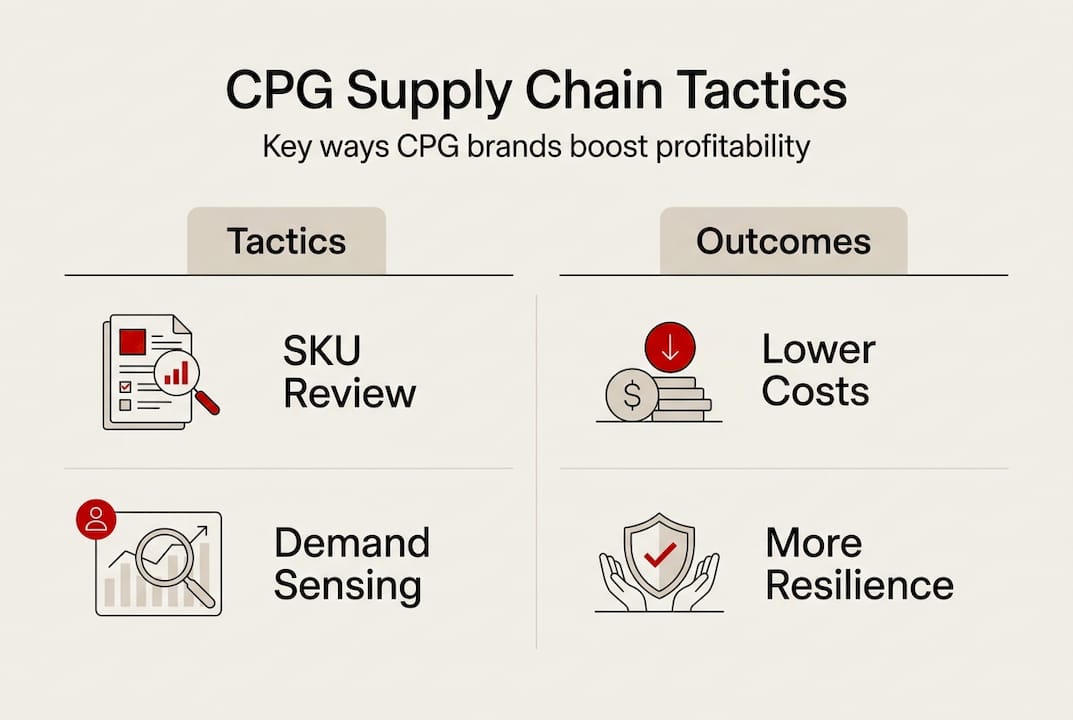
Pro Tip: Start with data unification before scaling AI or automation. Use affordable cloud tools to connect sales, inventory, and supplier data across channels. Once you have clean, unified data, pilot AI-driven demand sensing on a few high-volume SKUs using the PAO framework: Problem definition, Approach selection, Outcome measurement. This avoids costly failures from deploying AI before your data foundation is ready.
Prioritized actions for founders with limited capital:
These steps don’t require massive capital investment. They do require discipline, data hygiene, and willingness to cut underperforming SKUs. The payoff is faster cash conversion, lower storage costs, and better channel profitability.
With these strategies in mind, let’s examine common challenges and limitations you must navigate to ensure your efforts succeed.
The bullwhip effect amplifies demand variability upstream. A small promotion at retail can trigger massive swings in orders to suppliers, leading to stockouts or excess inventory. CPG brands face this during holiday promotions, new product launches, or when retailers run unplanned discounts. Manual deductions and data silos cost brands $140K or more annually in lost margin and administrative overhead. The solution is real-time data sharing with suppliers and retailers, plus buffer inventory positioned strategically to absorb demand spikes.
Perishability adds urgency. Products with short shelf lives require FEFO inventory management and fast turnover. If your brand sells fresh, refrigerated, or limited-shelf-life goods, optimizing supply chain means minimizing time in transit and storage. Multichannel sales conflicts arise when DTC orders pull inventory allocated for wholesale, or Amazon FBA shipments delay retail replenishment. You need clear allocation rules and real-time visibility into inventory by channel.
Data silos erode margins and increase errors. When Amazon sales data lives in Seller Central, Walmart orders sit in Retail Link, DTC runs through Shopify, and wholesale uses spreadsheets, you can’t forecast accurately or allocate inventory efficiently. Manual processes create mistakes. Deductions from retailers for late shipments, incorrect quantities, or labeling errors add up fast. Unifying data across channels into one system reduces errors and gives you a single source of truth for decision making.
Over-optimization using deterministic models fails in volatile CPG environments. Traditional operations research assumes stable demand and predictable lead times. Real CPG supply chains face promotions, seasonality, new product launches, and supply disruptions. Deterministic models optimize for average conditions and break down when variability increases. Probabilistic models that account for demand uncertainty and supply risk perform better. They cost more upfront but prevent costly stockouts and excess inventory.
Mitigation steps to avoid common pitfalls:
| Characteristic | Traditional Deterministic | Probabilistic Optimization |
|---|---|---|
| Demand model | Fixed average forecast | Probability distribution of outcomes |
| Safety stock | Static buffer based on lead time | Dynamic buffer based on variability |
| Response to volatility | Breaks down under uncertainty | Adapts to demand and supply risk |
| Implementation cost | Lower upfront, higher failure risk | Higher upfront, better long-term results |
| Best for | Stable, predictable demand | Volatile, seasonal, promotional CPG |
Pro Tip: Prioritize data unification and clean master data before scaling AI-driven automation. Many brands rush to deploy machine learning for demand forecasting without fixing underlying data quality issues. The result is garbage in, garbage out. Spend three to six months cleaning data, connecting systems, and validating accuracy before piloting advanced analytics.
Understanding these hurdles prepares you to implement optimized fulfillment solutions that balance efficiency with real-world complexity. For deeper expertise on Microsoft 365 and Dynamics integration to unify your supply chain data, consider consulting with specialists like Simetrix Consult.
Key metrics to track continuously include OTIF rate, inventory turnover, forecast accuracy, and cost to serve per channel. OTIF measures whether orders ship on time and in full. Track this weekly by channel. Inventory turnover shows how fast you convert inventory to sales. Calculate it monthly. Forecast accuracy compares predicted demand to actual sales. Measure this at the SKU level. Cost to serve includes fulfillment, storage, and logistics expenses per channel. Calculate contribution margin by channel to understand true profitability.
Affordable cloud supply chain tools outperform enterprise systems for most CPG brands under $20M in revenue. Cin7 connects inventory, sales, and supplier data across channels starting at a few hundred dollars per month. Circana provides demand sensing and forecasting without requiring a full ERP implementation. These tools integrate with Amazon, Walmart, Shopify, and QuickBooks, giving you unified visibility without six-figure software licenses or multi-year implementations.
| Tool Type | Affordable Cloud Tools | Enterprise Systems |
|---|---|---|
| Examples | Cin7, Circana, Katana | SAP, Oracle, JDA |
| Implementation time | 4 to 12 weeks | 6 to 18 months |
| Cost | $200 to $1,000/month | $50K to $500K+ upfront |
| Best for | $500K to $20M brands | $50M+ enterprises |
| Flexibility | High, easy to adjust | Low, rigid configuration |
Piloting AI and automated agents small scale prevents costly failures. Use the PAO framework: define the specific Problem you’re solving, select the best Approach for your data and budget, and measure the Outcome against clear KPIs. Test AI cautiously on a few SKUs or one channel before scaling. Many brands deploy AI-driven replenishment across their entire catalog and discover the models fail during promotions or new product launches. Start small, validate results, then expand.
Best practices for implementing monitoring dashboards and continuous improvement:
Pro Tip: Focus on tracking channel profitability to optimize your DTC versus retail mix. Many CPG brands assume DTC is always more profitable because there’s no retailer margin. In reality, DTC fulfillment costs, customer acquisition, and return rates often make it less profitable than wholesale or Amazon. Channel diversification works best when you know which channels actually contribute to profit and allocate inventory accordingly.
Now that you have practical technology and measurement guidance, let’s explore how to connect this knowledge to expert consulting support.
Optimizing your supply chain across Amazon, Walmart, DTC, and wholesale requires more than tools. It demands strategic clarity on which channels drive profit and where margin leaks hide. RedDog Group specializes in scaling CPG brands by improving OTIF, inventory turnover, and forecast accuracy while keeping contribution margin front and center. We help founders earning $500K to $20M navigate Amazon FBA fees, Walmart WFS dynamics, 3PL costs, and retail expansion with analytical precision.
Our integrated approach combines marketplace performance with physical retail strategy, connecting demand planning, SKU rationalization, and channel allocation into one cohesive plan. We engage affordable cloud tools, test AI pilots using the PAO framework, and prioritize incremental wins over massive capital outlays. Whether you need help with Amazon growth consulting or omnichannel growth solutions, we deliver measurable results rooted in supply chain economics and retail complexity.
With expert support, you can confidently implement these supply chain optimizations and boost your brand’s growth and profits.
Supply chain optimization aligns every process from sourcing to delivery to maximize efficiency and profitability. For CPG brands, this means improving OTIF rates, inventory turnover, forecast accuracy, and cost to serve across Amazon, Walmart, DTC, and wholesale. It’s not just cost cutting. It’s building a system that supports sustainable growth and competitive advantage in multichannel retail.
SKU rationalization cuts complexity and safety stock while enhancing forecast accuracy. Campbell Soup’s 12% SKU reduction saved $53 million by eliminating slow movers and focusing on high-velocity products. For CPG brands, cutting the bottom 10 to 15% of SKUs by contribution margin often improves profitability without hurting revenue. Fewer SKUs mean simpler planning, lower storage costs, and better inventory turnover.
Track OTIF rate, inventory turnover, fill rate, forecast accuracy, and cost to serve per channel. Hitting targets like 95 to 98% OTIF and 8 to 12 times inventory turnover drives up to 23% higher profitability. Measure these metrics weekly or monthly by channel to identify improvement opportunities. Calculate contribution margin by channel to understand which sales channels actually contribute to profit and where margin leaks hide.
Beware over-optimizing using deterministic models that fail to handle demand variability. Traditional operations research assumes stable demand and breaks down during promotions, seasonality, or supply disruptions. Use probabilistic models that account for uncertainty and test AI pilots carefully before scaling. Unify data across channels to prevent costly manual errors and deductions. Prioritize growth-enabling optimization over pure cost minimization to build resilience and flexibility.
Leave a comment: