
Published: March 2020 | Last Updated:May 2026
© Copyright 2026, Reddog Consulting Group.

TL;DR:
- Content marketing functions as a trust-building infrastructure that drives long-term brand credibility and audience engagement. It generates more leads at lower costs, with a small percentage of content delivering the majority of returns over time. Success depends on strategic alignment with the buyer journey, measurement discipline, and building scalable, consistent systems.
Most business owners think content marketing means publishing blog posts and hoping Google notices. That framing undersells the role of content marketing by about 90%. When executed with intention, content marketing functions as your brand’s trust infrastructure. It builds credibility before a prospect is ready to buy, guides buyers through their decision process, and compounds in value long after each piece publishes. This article breaks down what content marketing actually does, where it delivers measurable returns, and how to build a system that makes it work at scale.
| Point | Details |
|---|---|
| Content marketing builds trust first | Educating buyers before a sales conversation makes prospects significantly more likely to convert. |
| Leads cost less, volume is higher | Content marketing generates 3x more leads than outbound at 62% lower cost per lead. |
| Map content to the buyer journey | Aligning content types to awareness, consideration, and decision stages prevents funnel gaps and content waste. |
| Systems drive consistency | Repeatable workflows for research, production, and distribution are what separate brands that scale from brands that stall. |
| ROI compounds over time | Unlike paid ads, organic content keeps generating traffic and leads long after it publishes, improving profitability over time. |
Content marketing is the practice of creating and distributing valuable, relevant content to attract and engage a defined audience with the goal of driving profitable action. That definition sounds clean, but most brands only execute the first half. They create content. They skip the “defined audience” and “profitable action” parts entirely.
The role content marketing actually plays in a modern business goes well beyond lead generation. Here is what it does across the full scope of a brand’s growth:
Content marketing integrates directly with inbound marketing and your broader digital ecosystem. It feeds SEO, gives social media something worth posting, and supports email sequences that would otherwise have nothing valuable to say. Think of it less as a marketing tactic and more as the foundation that makes every other channel perform better.
The importance of content marketing becomes easier to defend when you look at the numbers, though the numbers themselves come with important caveats.
| Metric | Benchmark |
|---|---|
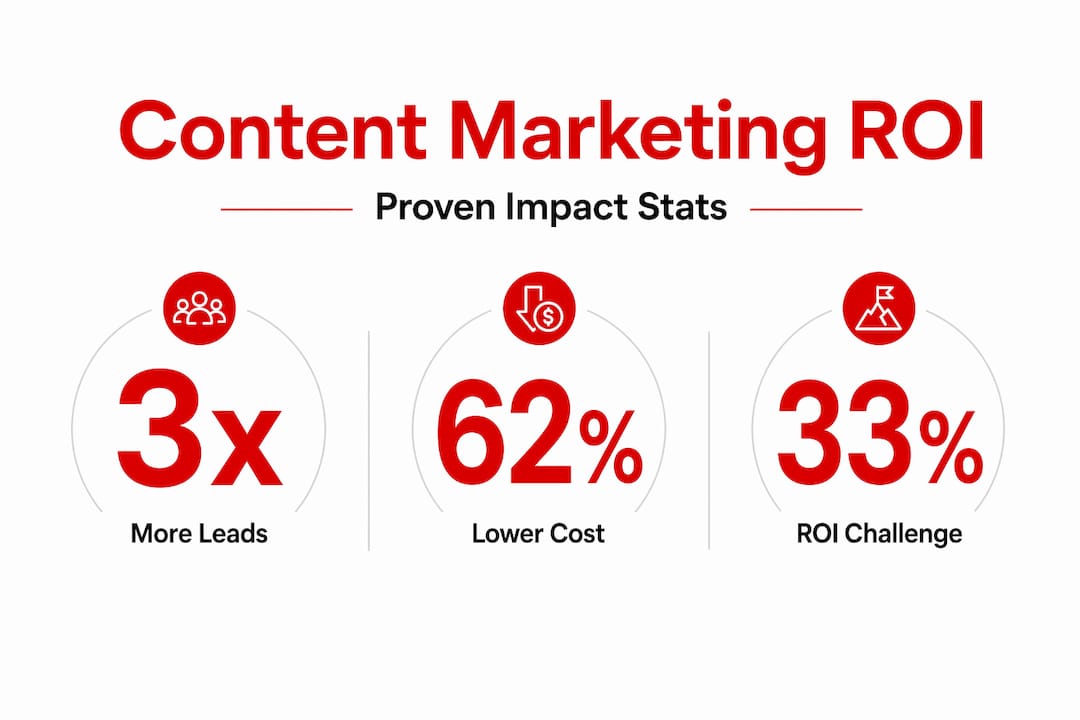
| Lead generation vs. outbound | 3x more leads at 62% lower cost |
| Content ROI distribution | 80% of content loses money; 20% returns 500%+ |
| Top marketer challenge | 33% cite proving ROI as their biggest obstacle |
| Buyer trust lift | 64% of buyers trust brands with educational content |
| Long-term compounding | Organic content keeps generating returns well past publish date |
The headline numbers are compelling. Content marketing generates 3x more leads than outbound marketing at 62% lower cost per lead. That is not a small efficiency gain. That is a structural advantage.
But the 80/20 split deserves serious attention. 80% of content loses money while the top 20% accounts for the majority of returns, sometimes 500% or more. This means volume is not the variable that determines success. Execution quality, audience fit, and strategic intent are.
“Content marketing’s impact compounds in a way paid advertising simply cannot. The blog post you publish today can drive qualified traffic for three years. The ad you run today stops the moment you stop paying for it.”
The measurement challenge is real. 33% of marketers report that proving ROI is their single biggest obstacle. This is not a data problem. It is an attribution architecture problem, and it is solvable with the right setup from the beginning.
A content marketing strategy that does not account for where the buyer is in their decision process is just publishing. The benefits of content marketing multiply when each piece has a specific job to do.
Here is how to think about it by funnel stage:
Top of funnel (awareness): The buyer does not know you exist yet, or they know they have a problem but do not know the solution. Your content job here is to spark curiosity and build recognition. Blog posts answering common questions, short-form video explaining a problem, and educational guides work well. The CTA at this stage is usually low-commitment: subscribe, follow, or download a resource.
Middle of funnel (consideration): The buyer is actively evaluating options. Your content needs to build confidence that you understand their situation better than anyone else. Case studies, comparison content, webinars, and detailed how-to guides belong here. CTAs shift toward demos, free consultations, or tool access.
Bottom of funnel (decision): The buyer is close to choosing. Content at this stage needs to remove final objections and confirm that choosing you is the smart move. Customer testimonials, ROI calculators, detailed product or service pages, and implementation guides are effective. The CTA is direct: buy, book, or start.
Aligning content types to buyer journey stages sounds obvious, but most brands have a top-heavy content strategy. They produce awareness content at high volume and have almost nothing waiting for the buyer when they move to consideration. That funnel gap is where competitors close deals you should be winning.
Pro Tip: Audit your existing content by funnel stage before producing anything new. If you have 40 blog posts and zero case studies, you have a funnel gap problem, not a content volume problem.
Knowing why content marketing matters is only half the equation. The brands that see compounding ROI from organic content are the ones who treat content like a business operation, not a creative exercise.
A scalable content system has five components:
A scalable content engine is not built in a week. But once it runs, it produces consistent output, generates measurable learning from performance data, and improves over time. That is the compounding effect brands are chasing.
Pro Tip: Set up your measurement architecture before you publish your first piece of content, not six months later. Retroactive attribution is nearly impossible and wastes the data you already generated.

If you want a detailed breakdown of how to structure the production side, Reddog’s guide to content workflow for CPG brands covers the operational mechanics in depth.
Why is content marketing essential? Because it compounds in ways no other channel does. But that same compounding nature is also what causes brands to abandon it too early or fund it incorrectly.
Here are the misconceptions that create the most damage:
The impact of content marketing is real, documented, and substantial. But it requires strategic intent, measurement discipline, and patience that most organizations underestimate going in.
I’ve worked with enough CPG brands to see a consistent pattern. They invest in content marketing when things are going well, stop when Q3 budget cuts hit, then wonder why organic traffic never built the way they expected. Content marketing does not work like a faucet. You can’t turn it on and off and expect compound growth.
What I’ve found actually separates brands that win with content from those that don’t is not budget size or creative talent. It is discipline around measurement and audience specificity. The brands that document their customer’s actual questions, build content that answers those questions with real depth, and track what moves through the funnel are the ones generating genuine engagement that builds loyalty before the purchase. Everyone else is just publishing and hoping.
The shift toward AI-generated content has made this worse in some ways. Output has become cheaper and faster, which means the internet is filling up with mediocre content faster than ever. The opportunity that creates for brands willing to publish something genuinely useful is significant. But only if you approach it with the discipline of an operator, not the optimism of a marketer.
My take: treat your content like you treat your margin. Measure it, protect the quality, and build systems that let you do it consistently without burning out your team.
— Reddog
If this article made you think harder about how your content marketing strategy actually maps to revenue, Reddog can help you go further.
Reddog works with CPG founders and operators who need structured growth planning grounded in real numbers, not vanity metrics. We offer a free 30-minute strategy call where we review what your channels are actually contributing to profit, where margin is leaking, and how your content and marketing investments align with your growth goals. No pitch. No pressure. Just a focused review of where you stand and what the data says. If you are in the $500K to $20M revenue range and want a clear-eyed look at your CPG growth strategy, book your call and bring your numbers.
Content marketing builds brand trust, educates buyers, and nurtures prospects across the entire purchase journey. It generates 3x more leads than outbound marketing at significantly lower cost, making it one of the highest-efficiency growth channels available.
Most brands see meaningful organic results within 6 to 18 months of consistent, quality publishing. Unlike paid ads, content marketing ROI compounds over time as content accumulates authority and continues driving traffic long after publication.
Attribution is the core challenge. Most analytics tools track page views but do not automatically connect content engagement to CRM deals or closed revenue. Designing measurement infrastructure before you publish, with UTM tagging and CRM integration, is the only reliable fix.
Awareness content includes blog posts, educational guides, and short-form video. Consideration content includes case studies, webinars, and comparison guides. Decision-stage content includes testimonials, ROI calculators, and detailed service pages. Mapping content to funnel stages prevents the most common content marketing failure: top-heavy strategies that lose buyers at consideration.
Yes, and often more so than for large brands. Smaller brands can move faster, publish with a more authentic voice, and build genuine audience relationships that big competitors cannot replicate. The key is focusing on audience relevance and quality over volume, rather than trying to out-publish brands with larger teams.
Leave a comment: