
Published: March 2020 | Last Updated:December 2025
© Copyright 2026, Reddog Consulting Group.

To succeed on Amazon, you have to know your numbers. That means keeping a close eye on key metrics like your Best Seller Rank (BSR), which measures your sales velocity, and your organic keyword positions, which determine how shoppers find you. This isn't just about vanity metrics; it's about checking the vital signs of your brand's health on the world's biggest marketplace and turning that data into measurable growth.
Understanding how your products perform on Amazon is the bedrock of any solid growth strategy. Think of your rankings as a real-time compass, showing you exactly where you stand against the competition. It’s not just about today's sales—it’s about seeing where the market is headed tomorrow so you can make smarter decisions.
When you track your ranks consistently, you stop reacting and start planning. Instead of guessing why sales suddenly dipped, you can connect the dots. For example, if a rank drop for a top keyword coincides with a competitor launching a big ad campaign, you have a clear, data-driven insight. This removes the guesswork, letting you make confident, strategic moves that drive results.
At RedDog, we see Amazon as the foundational pillar of a strong omnichannel brand. Your visibility and sales momentum on Amazon create a powerful ripple effect that touches every other sales channel, from your direct-to-consumer site to your brick-and-mortar retail partnerships. A top-ranking product on Amazon builds brand authority and consumer trust that strengthens your entire ecosystem.
By meticulously monitoring your rankings, you unlock several key advantages:
In essence, tracking your Amazon rankings is about understanding your customers, your competition, and your product's real place in the market. It’s the first and most critical step in building a brand that can adapt, grow, and win.
Ultimately, this data provides everything you need to optimize your listings, supercharge your marketing, and drive sustainable growth across every part of your business. This isn’t just about selling on Amazon; it's about building a brand that wins everywhere.
Before you can effectively track your Amazon rankings, you need to understand what you’re measuring. The platform uses a few core metrics that, when pieced together, give you a complete picture of your product's health and visibility.
Getting a handle on these numbers is the first step in building a data-driven strategy. It’s how you move beyond guesswork and start making decisions that get real results. These aren’t just vanity numbers; they’re direct indicators of your market position, customer discovery, and overall sales momentum.
Each one tells a different part of your brand’s story on the world's biggest digital shelf.
The most talked-about metric is the Best Seller Rank (BSR). Think of it as a live leaderboard for sales. It ranks your product against others in the same category based purely on sales volume, with recent sales carrying more weight than older ones.
A lower BSR number means you're selling more. For example, a product with a BSR of #50 is significantly outselling one with a BSR of #5,000 in that category at that moment. This metric updates hourly, making it a highly responsive—but often volatile—indicator of performance.
But here’s the key takeaway: BSR only tells you how much you’re selling compared to your competition. It doesn’t tell you how customers are finding you in the first place. That’s where the next metric comes in.
While BSR is all about sales velocity, organic keyword ranking is all about visibility. This metric shows where your product appears in Amazon’s search results for a specific phrase, like “waterproof hiking boots” or “organic dog treats.”
A high organic rank—ideally on the first page—is critical because the vast majority of shoppers never click to page two.
If BSR is your final sales total, think of your keyword rank as the foot traffic coming through your digital door. You could have a great BSR from a flash sale or a viral social media post, but if your organic keyword rankings are poor, you’ll struggle to attract a steady stream of new customers who are actively searching on Amazon.
Strong organic keyword rankings are the engine of sustainable growth. They ensure a steady stream of relevant, high-intent shoppers finds your product without you having to pay for every single click.
Improving your position for high-volume keywords is a direct investment in your brand’s long-term health and reduces your dependency on paid ads over time.
Finally, category rankings give you a more granular view of your performance within a specific niche. A product can have multiple BSRs—one for its main category (like "Home & Kitchen") and others for its sub-categories (like "Kitchen & Dining" > "Small Appliances" > "Blenders").
This is where you can uncover significant strategic opportunities. Competing for the top spot in a massive category like "Toys & Games" is an uphill battle. But earning a #1 Best Seller badge in a more specific sub-category like "Educational STEM Toys"? That’s a much more attainable and valuable goal.
That niche ranking builds social proof and can create a halo effect, boosting your visibility and conversion rate across the board.
For a quick breakdown, here’s how these three core metrics stack up against each other.
| Metric | What It Measures | Why It's Important | Update Frequency |
|---|---|---|---|
| Best Seller Rank (BSR) | Sales volume relative to other products in the same category. | A direct indicator of sales velocity and market momentum. | Hourly |
| Organic Keyword Rank | Your product's position in search results for specific customer queries. | Drives consistent, high-intent organic traffic and reduces ad dependency. | Varies |
| Category Rank | Your product's BSR within specific primary and sub-categories. | Helps you dominate niche markets and earn the coveted Best Seller badge. | Hourly |
Understanding how these metrics interact is key. A well-optimized listing that ranks high for relevant keywords will naturally drive more sales, which in turn improves your BSR. For brands looking to integrate this data across all sales channels, it's essential to grasp the role of omnichannel analytics.
This positive feedback loop is what building a strong Amazon presence is all about: creating a solid data foundation that informs every optimization you make.
Now that you understand the key Amazon metrics, it's time to select the right tools for the job. Choosing how you'll track Amazon rankings isn't about finding one perfect solution. It's about building a smart, balanced approach that mixes quick manual checks with deep, automated analysis.
This toolkit is the engine behind the Optimization phase of our growth framework. It’s how you transform raw data—like a BSR dip or a keyword rank bump—into actionable insights that allow you to fine-tune your strategy and drive measurable growth.
Before diving into complex software, don't underestimate the power of a simple manual search. Open an incognito browser window and type in your top three to five most important keywords.
This gives you a real-time, unfiltered look at the search results page (SERP) exactly as your customers see it. You can instantly spot which competitors are running aggressive ad campaigns or who just snagged a coveted "Amazon's Choice" badge. It's fast, free, and keeps you grounded in the real-world customer experience.
Your Seller Central account is more than a hub for inventory and orders—it's a treasure trove of performance data if you know where to look. While it lacks a dedicated rank tracker, it holds crucial pieces of the puzzle.
You can uncover valuable intelligence from a few key reports:
These built-in tools are the perfect place to start. They provide a solid foundation of data straight from the source, at no extra cost.
Manual checks and Seller Central reports are your foundation, but dedicated third-party tools are where true optimization happens. Platforms like Helium 10, Jungle Scout, and Sellics are purpose-built to track Amazon rankings with precision and at scale.
These tools shift you from being reactive to proactive. To pick the right software, it helps to understand what e-commerce spy tools are and how they arm you with the competitive intelligence you need. They automate the entire tracking process, saving you hours while unlocking much deeper insights.
The true power of a third-party tool isn’t just seeing where you rank today. It's about building a historical record of your performance, monitoring your competitors, and directly connecting your actions—like a price drop or a new PPC campaign—to their impact on your rank.
Imagine setting up a tracker for your top 50 keywords and getting an email the moment one of them falls off the first page. That’s an immediate signal to investigate, rather than discovering the problem weeks later after your sales have already taken a hit.
Not all tracking tools are created equal. When you're evaluating options, focus on features that deliver actionable data, not just pretty charts. For a full rundown, check out our guide on the best Amazon FBA tools for 2025.
Here are the non-negotiables for any serious Amazon brand:
Making data-driven decisions requires a ton of data. A study of Amazon's top 50 bestselling novels from 2009 to 2021 found that 56% were non-fiction and the most common price was just $8. This shows how historical data can reveal powerful consumer trends you'd otherwise miss.
In the end, the right tool comes down to your business size, budget, and goals. A new seller might start lean with Seller Central's free resources, while a growing brand will find that investing in a comprehensive suite like Helium 10 quickly pays for itself. The key is to pick a system that turns data into a clear roadmap for growth.
A great tool is useless without a solid system behind it. Now that you've picked your tools, it's time to build a repeatable process for how you track Amazon rankings. This turns rank tracking from a reactive chore into a proactive engine for growth—a core principle of the Optimization phase.
A tight workflow ensures you’re not just gathering data but actually generating reliable insights. It’s all about being strategic with what you track, how often you check in, and how you organize the information so you can take clear, decisive action.
First things first: you need to decide which keywords to monitor. A common mistake is to only track high-volume “head terms.” A truly effective strategy, however, requires a balanced portfolio that covers the entire customer journey.
Your keyword list should include a healthy mix of:
This diagram breaks down the common tools you'll use in a rank tracking process, from simple manual checks to more advanced software.
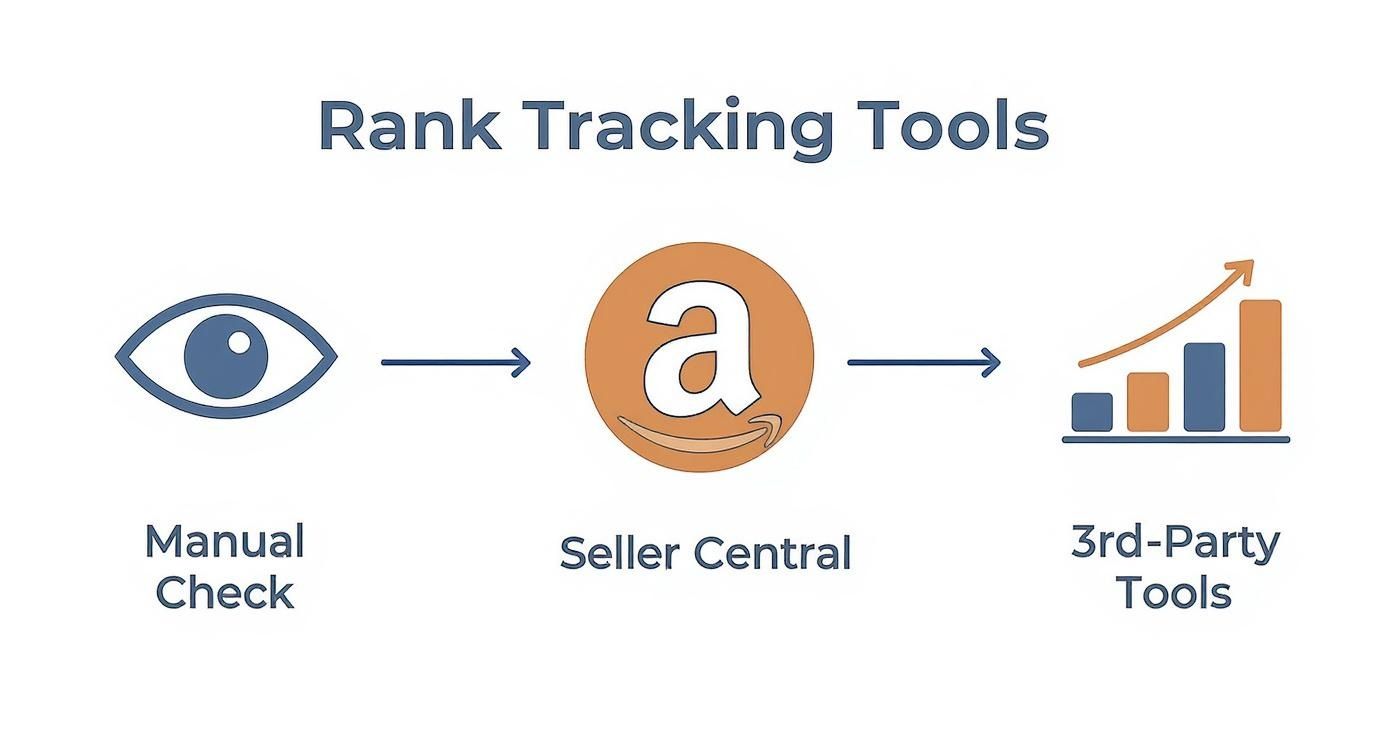
As you can see, the process evolves from basic methods to sophisticated analytics. A mature workflow integrates all three approaches to give you a complete picture of your performance.
Once you have your keywords, it’s time to set up your third-party tool. Don’t just dump your list in and hit “go.” Precision is everything if you want clean, useful data.
Pay close attention to the setup details. For example, make sure you're tracking the correct Amazon marketplace (like Amazon.com vs. Amazon.ca) and specify if you want to monitor mobile versus desktop rankings. These small details can have a huge impact on your data's accuracy, since search behavior often differs by device and location.
A well-configured tracking system acts as your early warning system. It should be set up to flag significant drops immediately, allowing you to diagnose and fix issues before they erode your sales and market share.
The next big question is frequency: how often should you actually check your rankings? The answer depends on what you're tracking. You don't need to obsess over every tiny fluctuation, but you do need a consistent rhythm.
A practical cadence might look like this:
This tiered approach keeps you focused on what truly matters while still maintaining a comprehensive view of your overall visibility. Consistency is what builds the historical data you need to connect your marketing efforts to real ranking improvements. By setting up this clear, organized workflow, you create the foundation for sustained optimization and growth.
Having the data is just the starting line. The real growth kicks in when you translate those numbers into tangible actions, which is the heart of our Amplification pillar. It's time to stop just watching your rankings and start using them to make strategic moves that actually grow your business.
When you track Amazon rankings consistently, you're building a historical record. This record becomes your go-to diagnostic tool, letting you connect every rank change—good or bad—to a specific cause. Was it that listing update you pushed last Tuesday? A new PPC campaign? Or maybe a competitor's surprise promotion? The data always holds the answer.
This process shifts you from being a reactive seller, always playing catch-up, to a proactive strategist. Instead of scratching your head about why sales dipped, you can pinpoint the exact moment a top keyword fell off page one and immediately figure out what went wrong.
A drop in rank is a signal, not a disaster. The trick is knowing what to look for first. A systematic approach to diagnosing these issues saves you a ton of time and stops you from making knee-jerk decisions that could make things worse.
Think of it like a troubleshooting flowchart. When you see a negative change, you can walk through a checklist of probable causes to find the root of the problem fast.
The goal is to develop an instinct for correlation. When you see a rank drop, your first thought should be, 'What changed in the last 24-48 hours?' This mindset is what separates top sellers from the rest.
Here’s a real-world scenario to show what this looks like in practice.
Scenario: Your rank for a primary keyword like “stainless steel water bottle” suddenly tanks from #4 to #18.
Before you hit the panic button, investigate these three areas in this order:
The insights you pull from your Amazon rankings should create ripples across your entire business, influencing everything from ad spend to new product ideas. This is where you really amplify your growth.
For example, detailed historical data can show you how competitive a niche is. In 2023, data tools analyzed over 16,000 Amazon categories and found that categories with older products often signal a saturated market—which can be a huge opportunity for a new, innovative product to shake things up.
This level of detail helps you make smarter decisions everywhere.
By translating ranking data into these concrete actions, you create a powerful feedback loop. Your Amazon performance informs your wider business strategy, and your improved strategy strengthens your Amazon presence. It’s this integrated approach that builds a resilient, profitable brand that wins everywhere.
Even with the right tools and a solid game plan, sellers often have lingering questions about the finer points of Amazon performance. It’s easy to feel overwhelmed by the constant ups and downs in your data, but getting clear answers helps build a more confident and effective strategy.
Let’s tackle some of the most common questions we hear from brands about how to track Amazon rankings and what the numbers are really telling you.
For high-stakes situations—like a new product launch or your most critical keywords—daily tracking is essential. It helps you catch major market shifts before they can damage your sales. Think of it as your frontline defense for your most valuable digital shelf space.
For more established products and a broader list of secondary keywords, weekly check-ins are generally sufficient to spot meaningful trends without getting lost in daily fluctuations. The most important thing is consistency. Most automated tools make daily tracking easy, allowing you to build a rich history of data to inform your big-picture strategy.
The goal isn’t to panic over every little dip and spike. It's to know your baseline performance so that when a massive, unexpected change happens, you can spot it, figure out why, and act on it immediately.
A sudden, sharp change in your Best Seller Rank (BSR) is almost always tied to sales velocity—either yours dropped, or a competitor’s surged. Since Amazon updates BSR hourly, it’s incredibly volatile and reacts instantly to market activity.
Here are a few common culprits behind a rapid BSR change:
The key is to avoid overreacting to a single day’s change. Look at the BSR trend over a week or more to understand your true position in the market.
Yes, and you absolutely should. This isn’t just a good idea—it’s a non-negotiable part of any serious Amazon strategy. Most professional rank trackers allow you to monitor competitor ASINs right alongside your own.
Keeping an eye on their keyword rankings and BSR gives you a massive competitive advantage. You can discover new keywords they’re ranking for, see the impact of their marketing campaigns, and benchmark your own performance against the category leaders. This is a critical tactic for the Amplification phase of your growth, as it provides a clear roadmap for capturing market share.
Ready to turn your Amazon data into a clear, actionable growth plan? The team at RedDog Group builds data-driven strategies that connect your marketplace performance to real omnichannel growth. Let’s Talk Growth.
Leave a comment: