
Published: March 2020 | Last Updated:November 2025
© Copyright 2026, Reddog Consulting Group.

Retail compliance gets a bad rap for being boring paperwork. Yet compliance is anything but just ticking boxes when you realize that non-compliance fines can reach millions of dollars and even permanently shutter businesses. The real shock is that companies who treat retail compliance as a strategic move, not just a legal requirement, end up earning more trust and loyalty from their customers than almost any marketing campaign ever could.
| Takeaway | Explanation |
|---|---|
| Retail compliance is a strategic priority | Treating compliance as essential leads to competitive advantages and sustainable practices. |
| Prioritize product safety and consumer protection | Ensuring products meet safety standards builds trust and safeguards customer interests. |
| Monitoring regulatory changes is crucial | Staying updated on laws helps prevent compliance violations and potential financial losses. |
| Build transparent compliance protocols | Well-documented protocols strengthen relationships with customers and regulators, enhancing brand credibility. |
| Invest in robust compliance infrastructure | A strong compliance framework mitigates risks and helps maintain operational excellence in the retail sector. |
Retail compliance represents a comprehensive framework of regulations, standards, and practices that guide businesses in maintaining legal, ethical, and operational integrity within the retail ecosystem. Retail compliance fundamentally ensures that organizations adhere to established rules protecting consumers, employees, and overall business conduct.
Understanding retail compliance requires recognizing its multifaceted nature. The concept encompasses several critical dimensions that businesses must carefully navigate:
Retail compliance goes beyond mere regulatory checkbox exercises. It represents a strategic approach to building trust, mitigating risks, and creating sustainable business practices. Organizations must develop robust systems that proactively monitor and implement compliance requirements across multiple operational domains.
To help readers quickly grasp the different forms retail compliance can take, the table below summarizes the core elements, their descriptions, and their importance to retail businesses.
| Core Element | Description | Importance to Retail |
|---|---|---|
| Legal Adherence | Compliance with laws and regulations at all relevant levels | Avoids fines, ensures lawful operation |
| Product Safety | Meeting quality and safety standards for all products | Protects consumers, reduces liability |
| Consumer Protection | Safeguarding consumer interests through transparent practices | Builds trust, prevents legal disputes |
| Regulatory Monitoring | Staying updated on changing retail laws and standards | Prevents violations, fosters resilience |
| Transparent Protocols | Maintaining clear and documented compliance processes | Strengthens brand and regulator trust |
| Robust Infrastructure | Investing in systems for ongoing compliance management | Enhances risk management, operational excellence |
The regulatory environment for retail is complex and continuously evolving. Companies must remain vigilant about changes in consumer protection laws, industry standards, and market regulations. Read more about strategic retail frameworks that can help businesses stay ahead of compliance challenges.
Successful retail compliance requires a holistic approach that integrates legal knowledge, operational excellence, and ethical business practices. This means developing internal processes that not only meet minimum regulatory requirements but also demonstrate a genuine commitment to responsible business conduct.
Businesses that treat compliance as a strategic priority rather than a bureaucratic burden can transform potential regulatory challenges into competitive advantages. By establishing transparent, well-documented compliance protocols, organizations can build stronger relationships with customers, regulators, and stakeholders.
Retail compliance represents a critical strategic imperative that goes far beyond simple regulatory adherence. For brands and retailers, maintaining rigorous compliance standards is fundamental to sustainable business success, risk management, and building long-term consumer trust. According to the Federal Trade Commission, organizations that proactively manage compliance can significantly reduce legal and financial risks.
Companies that prioritize retail compliance demonstrate a commitment to ethical business practices. This approach yields multiple strategic advantages:
Beyond avoiding penalties, robust compliance frameworks help businesses establish themselves as responsible market participants. Learn more about strategic retail approaches that can support comprehensive compliance strategies.
Noncompliance can result in substantial financial consequences. Potential risks include hefty fines, legal expenses, product recalls, and reputational damage that can dramatically impact a company’s bottom line. Regulatory infractions might also lead to temporary or permanent business disruptions, making compliance an essential investment in organizational stability.
Strategic retail compliance is not merely about avoiding negative outcomes but creating positive business opportunities. Organizations that develop sophisticated compliance systems can differentiate themselves in competitive markets, demonstrating superior operational excellence and commitment to ethical standards.
By treating compliance as a core business strategy rather than an administrative burden, brands and retailers can transform potential regulatory challenges into sustainable competitive advantages.
Retail compliance encompasses a complex network of regulations designed to protect consumers, ensure fair business practices, and maintain marketplace integrity. According to regulatory experts at the Consumer Product Safety Commission, these standards span multiple domains critical to responsible retail operations.
Key regulatory frameworks that retailers must navigate include comprehensive standards addressing product quality, safety, and consumer rights:
These regulations are not merely bureaucratic checkboxes but fundamental mechanisms for maintaining marketplace trust and protecting consumer welfare. Learn more about strategic retail management to understand how compliance intersects with business strategy.
Different retail sectors face unique regulatory landscapes. Specialized industries like food, pharmaceuticals, electronics, and children’s products have additional layers of compliance requirements. For instance, food retailers must adhere to strict FDA guidelines regarding product handling, storage, and labeling, while electronics manufacturers must meet specific electromagnetic compatibility standards.
Companies must remain proactive in understanding and implementing these sector-specific regulations. This requires continuous monitoring of evolving legal frameworks, investing in robust compliance infrastructure, and developing organizational cultures that prioritize regulatory awareness.
Successful retail compliance is not about rigid adherence but about creating adaptive systems that can quickly respond to changing regulatory environments while maintaining consistent operational excellence.
Non-compliance represents a significant risk that can devastate retail businesses, creating multifaceted challenges that extend far beyond immediate financial penalties. According to legal compliance research, organizations facing regulatory violations often experience cascading negative consequences that can threaten their entire operational sustainability.
The financial implications of non-compliance can be catastrophic for retail organizations. Potential consequences include:
These financial burdens can quickly erode profit margins and compromise a company’s competitive positioning. Learn more about strategic business resilience to understand how proactive compliance management protects business interests.
Beyond immediate financial impacts, non-compliance can inflict long-lasting damage to a brand’s reputation. Consumer trust, once compromised, becomes exceptionally difficult to rebuild. Negative publicity surrounding regulatory violations can lead to:
Modern consumers are increasingly sophisticated and value transparency. A single compliance failure can trigger widespread negative perceptions that persist long after the initial incident, potentially causing irreparable harm to a brand’s market positioning.
The table below organizes the main consequences of non-compliance, allowing readers to quickly see the major areas of business impact described in the article.
| Impact Area | Examples/Outcomes | Long-Term Consequences |
|---|---|---|
| Financial/Litigation | Fines, legal settlements | Eroded profits, business closure risk |
| Operational Disruptions | Suspensions, recalls | Interrupted sales, supply chain issues |
| Reputational Damage | Negative publicity, loss of credibility | Decreased customer loyalty, harder growth |
| Loss of Consumer Trust | Damaged public perception | Reduced repeat purchases, market share loss |
Ultimately, retail compliance is not a discretionary expense but a critical investment in organizational sustainability.
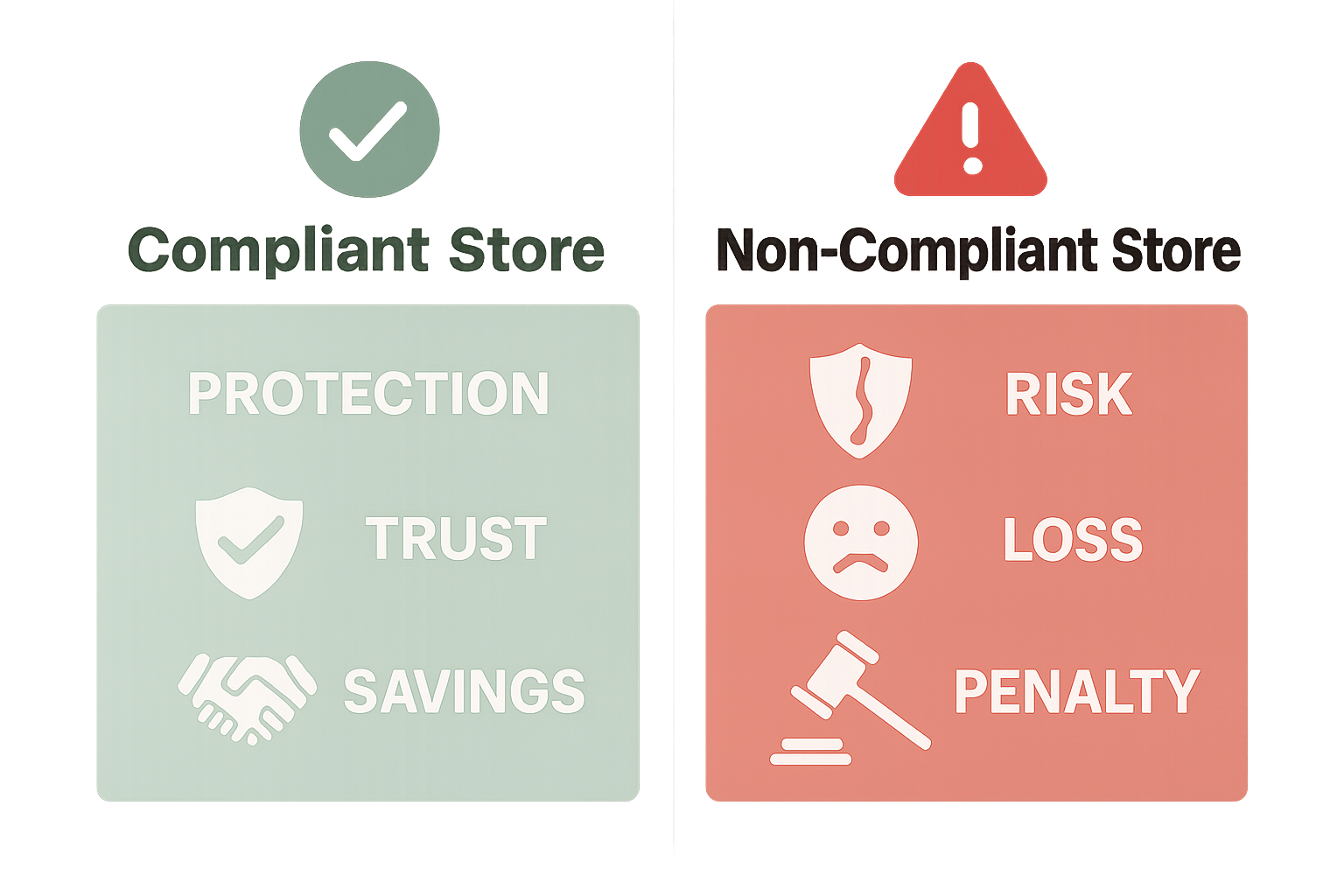 Businesses must view regulatory adherence as a fundamental component of their strategic planning, recognizing that the cost of prevention is always substantially lower than the potential consequences of non-compliance.
Customer trust represents a delicate and critical asset that retailers must carefully cultivate and protect through consistent, transparent compliance practices. According to consumer behavior research, organizations that demonstrate genuine commitment to regulatory standards can significantly enhance their brand reputation and customer loyalty.
Retail compliance serves as a powerful mechanism for building meaningful connections with consumers. When businesses prioritize transparent operations, they communicate several key messages:
These compliance-driven signals help transform transactional relationships into deeper, more meaningful brand interactions. Explore strategies for building customer loyalty to understand how compliance intersects with engagement.
Consumers increasingly make purchasing decisions based on perceived brand values and ethical standards. Robust compliance frameworks signal to customers that a company:
By consistently demonstrating these qualities, retailers can differentiate themselves in competitive markets.
Modern consumers do not just purchase products they invest in brands that align with their personal values and expectations of responsible business conduct.

Ultimately, retail compliance transcends regulatory checkboxes. It represents a strategic approach to building lasting customer relationships founded on trust, transparency, and genuine commitment to consumer well-being.
Struggling to keep up with complex retail compliance and worried about costly mistakes? You are not alone. Many small and medium-sized brands face the same hurdles when it comes to adapting to regulatory changes, securing consumer trust, and protecting their reputation. As highlighted in the article, regulatory noncompliance can derail your business with financial penalties and lasting reputational damage. But achieving seamless retail compliance is not just about avoiding risks—it is also about building a foundation for brand loyalty and sustainable growth across all your sales channels.
Reddog Group specializes in omnichannel retail, digital marketing, and marketplace management. Our proven track record working with over 50 brands shows you do not have to choose between compliance and growth. From integrated inventory management and listing optimization to strategies that ensure you meet both national and industry-specific requirements, our team is ready to help you build trust and capture new customers. Do not let compliance uncertainty slow you down. Visit Reddog Group now to discover how our expertise can safeguard your business and drive measurable results today.
Retail compliance refers to the framework of regulations, standards, and practices that guide businesses in ensuring legal, ethical, and operational integrity within the retail environment. It involves adherence to laws that protect consumers, employees, and facilitate fair business conduct.
Retail compliance is essential as it helps businesses mitigate risks, protect their reputation, and build consumer trust. By prioritizing compliance, organizations can avoid legal issues and financial penalties while demonstrating a commitment to ethical business practices.
The core elements of retail compliance include legal adherence, product safety, and consumer protection. Effective retail compliance systems ensure that products meet safety standards, information is accurately provided to consumers, and business practices remain transparent and ethical.
Non-compliance can lead to significant financial and legal repercussions, including hefty fines and operational disruptions. Moreover, it can damage a brand’s reputation, leading to loss of consumer trust and decreased market credibility.
Leave a comment: