
Published: March 2020 | Last Updated:February 2026
© Copyright 2026, Reddog Consulting Group.

Standing out in the Texas retail scene means more than just getting shelf space. Building brand authority is what sets Consumer Packaged Goods companies apart and drives true growth. With consumer demands shifting toward personalization, health, and sustainability, authority becomes the foundation for trust and loyalty. Explore how mastering brand authority positions your business for premium pricing, loyal customers, and stronger returns across every channel.
| Point | Details |
|---|---|
| Importance of Brand Authority | Brand authority is essential for CPG companies to transition from commodity producers to trusted market leaders. Establishing authority involves consistent quality, transparency, and alignment with consumer values. |
| Impact on Business Outcomes | Higher brand authority leads to strong customer loyalty, pricing power, and reduced operational costs. Companies should focus on building genuine connections with consumers to enhance their market position. |
| Channel-Specific Strategies | Different retail channels require tailored approaches to maintain brand credibility. CPG brands must adapt their messaging and customer engagement techniques to match specific market dynamics. |
| Financial Implications | Weak brand authority can lead to pricing power erosion and increased operational costs. Investing strategically in brand building can create value and improve profitability in competitive environments. |
Brand authority represents a strategic cornerstone for Consumer Packaged Goods (CPG) companies seeking sustainable market growth. In the dynamic landscape of retail and consumer preferences, brand authority emerges as the critical differentiator that transforms companies from commodity producers into trusted market leaders. Consumer trends in CPG sectors demonstrate that brands which successfully establish authority create deeper connections with their target audiences.
At its core, brand authority encompasses several key dimensions for CPG brands:
The most successful CPG brands understand that brand authority is not merely about marketing messages, but about creating genuine trust through measurable actions. Technology integration in consumer brand strategies has become increasingly important, with leading companies like Procter & Gamble and Coca-Cola leveraging data analytics, AI, and omnichannel approaches to strengthen their market positioning.
Building brand authority requires a holistic approach that goes beyond traditional advertising. Modern CPG brands must demonstrate their value proposition through consistent performance, ethical practices, and a deep understanding of consumer expectations. This means developing products that not only meet functional needs but also align with broader societal values like sustainability, health, and social responsibility.
Here’s how brand authority impacts CPG business outcomes at various stages:
| Aspect | Low Brand Authority | Moderate Brand Authority | Strong Brand Authority |
|---|---|---|---|
| Pricing Power | Product seen as commodity | Some ability to differentiate | Premium pricing, loyal buyers |
| Customer Loyalty | Limited, driven by discounts | Moderate, occasional repeat | Strong, frequent repeat sales |
| Operational Costs | High, heavy manual marketing | Average, mixed efficiency | Lower, driven by word-of-mouth |
| Market Differentiation | Easily replaced, less visibility | Some consumer recognition | Leader, distinct market role |
Pro tip: Conduct quarterly consumer sentiment surveys to track and validate your brand’s perceived authority and adjust strategies accordingly.
Brand authority in retail channels is a nuanced concept that varies significantly across different market environments. Marketing channels for CPG brands demonstrate that effective brand positioning requires a strategic approach tailored to specific retail contexts. Understanding these variations becomes crucial for CPG companies seeking to establish a robust market presence.
The primary types of brand authority in retail channels include:
Direct Sales Channels
Indirect Sales Channels
Each channel type demands a unique approach to building brand credibility. Brand management strategies reveal that successful brands must adapt their communication, product placement, and customer engagement techniques to match the specific dynamics of each retail environment. This might mean developing channel-specific messaging, creating tailored product presentations, or implementing distinct customer interaction protocols.
Multichannel brand authority requires a holistic strategy that maintains consistent brand identity while remaining flexible enough to meet the unique expectations of different retail contexts. Modern CPG brands must invest in robust omnichannel capabilities, ensuring seamless experiences that reinforce brand trust across physical and digital touchpoints. This approach demands sophisticated data analytics, responsive marketing technologies, and a deep understanding of consumer behavior across various retail platforms.
Compare strategies for building brand authority in direct and indirect retail channels:
| Strategy Focus | Direct Channels | Indirect Channels |
|---|---|---|
| Consumer Data Use | Personalized experiences | Aggregate market analytics |
| Brand Messaging | Direct engagement, storytelling | Channel-specific communication |
| Customer Support | Immediate, branded assistance | Dependent on external partners |
| Product Placement | Full brand control | Shared space with competitors |
Pro tip: Develop channel-specific brand guidelines that provide clear frameworks for maintaining consistent brand messaging while allowing adaptive communication strategies.
Brand authority is the critical engine that transforms retail potential into measurable success. Brand equity dynamics reveal how powerful brands create emotional connections that transcend simple transactional relationships. This deeper connection enables CPG companies to command premium pricing, cultivate customer loyalty, and differentiate themselves in increasingly competitive markets.
The key mechanisms through which brand authority drives retail success include:
Emotional Resonance
Economic Performance
Consumer psychology plays a pivotal role in brand authority. Consumer trust and brand respect demonstrate that successful brands do more than sell products – they create experiences that consumers are willing to advocate for. This means developing a brand narrative that goes beyond functional benefits and taps into deeper emotional and aspirational needs.

Modern retail success requires brands to be adaptive, transparent, and consistently aligned with consumer values. CPG brands must invest in building brand authority through continuous innovation, responsive customer engagement, and a commitment to delivering exceptional experiences across all touchpoints. By focusing on creating genuine connections rather than merely pushing products, companies can transform brand authority into sustainable competitive advantage.
Pro tip: Conduct quarterly consumer sentiment analysis to track emotional brand perception and identify emerging connection opportunities.
Consumer brand relationships reveal that credibility is a fragile construct easily damaged by strategic missteps. Modern CPG brands must navigate a complex landscape where every communication and interaction can either build or erode consumer trust. Understanding the fundamental pitfalls becomes critical for maintaining a robust brand reputation.
The most significant credibility destroyers include:
Communication Failures
Performance Gaps
Brand credibility research demonstrates that consumers are increasingly sophisticated in detecting inauthentic brand behaviors. High-risk product categories amplify the consequences of credibility failures, where trust becomes the primary differentiator between successful and struggling brands. CPG companies must recognize that modern consumers demand more than functional product benefits – they seek genuine connections and transparent relationships.
Building sustainable brand credibility requires a holistic approach that goes beyond marketing rhetoric. Brands must consistently demonstrate their values through actions, maintain open communication channels, and show genuine commitment to consumer needs. This means creating feedback loops, embracing vulnerability, and being willing to acknowledge and rectify mistakes quickly and transparently.
Pro tip: Implement a monthly cross-functional credibility audit that reviews customer feedback, communication consistency, and alignment between brand promises and actual performance.
Brand equity analysis reveals that weak brand authority creates substantial financial vulnerabilities for CPG companies. Without a robust brand foundation, organizations face significant margin compression and revenue challenges that extend far beyond traditional marketing metrics. These financial risks manifest through multiple interconnected channels that systematically erode profitability and competitive positioning.
The primary financial risks associated with low brand authority include:
Pricing Power Erosion
Margin Vulnerability
Brand performance research demonstrates that companies with weak brand authority face exponentially higher operational costs. These brands must invest disproportionately in marketing and customer acquisition strategies to compensate for their limited consumer trust. The financial implications become particularly acute in competitive markets where differentiation determines market success.
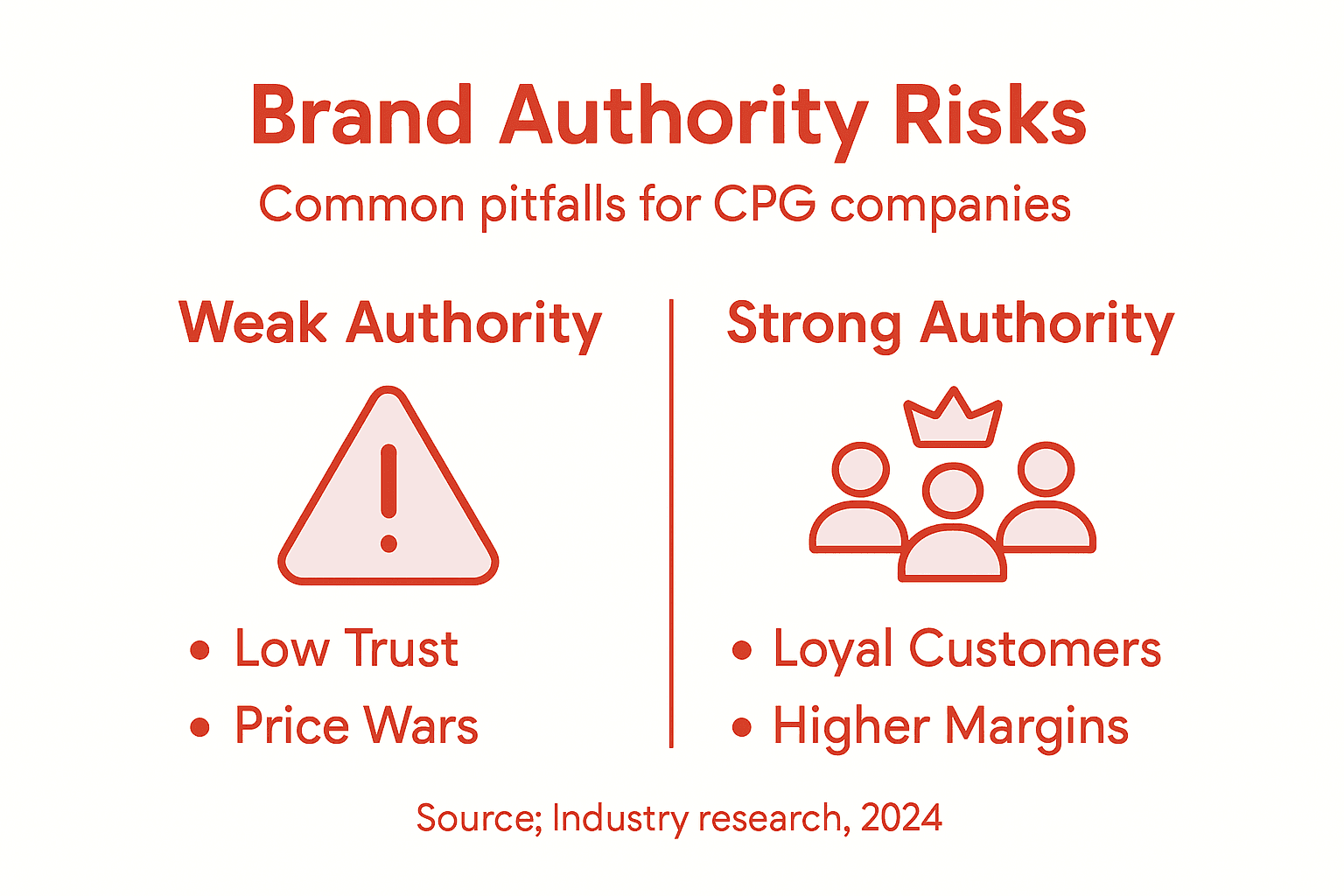
Strategic brand investment requires a holistic approach that transcends traditional marketing spending. CPG brands must develop sophisticated brand-building strategies that create genuine value, foster emotional connections, and demonstrate consistent reliability. This means developing comprehensive brand experiences that justify premium pricing and create sustainable competitive advantages through trust and perceived excellence.
Pro tip: Conduct quarterly margin impact assessments that quantify the direct financial relationship between brand perception and pricing elasticity.
Building strong brand authority is essential for CPG companies that want to unlock pricing power, deepen customer loyalty, and reduce costly operational inefficiencies. This article highlights how inconsistent messaging and weak channel strategies erode credibility and margin opportunity. If you are grappling with challenges like marketplace margin compression, pricing strategy complexity, or aligning omnichannel storytelling that drives genuine consumer trust, you are not alone.
RedDog Group specializes in helping emerging and growth-stage CPG brands navigate these exact hurdles across Amazon, Walmart, direct-to-consumer, wholesale, and distribution channels. Our contribution-margin-first strategy focuses on revealing where margin leaks hide and how each channel impacts your profitability. We blend digital marketplace growth with physical retail readiness to build sustainable brand authority that generates premium pricing and operational clarity.
Discover how to transform brand authority into measurable retail success by partnering with a team who understands the real complexity of scaling CPG products. Visit our CPG Retail Growth Offer to learn more.
Ready to strengthen your brand credibility and boost profits? Connect with RedDog Group today to craft a structured growth plan that prioritizes margin, marketplace economics, and authentic consumer engagement. Take the first step toward lasting brand authority and profitable retail expansion now at https://reddog.group/pages/cpg-retail-growth-offer.
Brand authority refers to the level of trust and credibility a brand has in the CPG sector, characterized by consistent quality, transparent communication, innovative responses to consumer needs, and a commitment to values like sustainability.
Strong brand authority enables CPG brands to command premium pricing and foster customer loyalty. Consumers are more likely to repeatedly purchase from brands they trust, which can lead to increased customer lifetime value.
Common pitfalls include inconsistent messaging, lack of transparency, overpromising and underdelivering, and failing to respond to customer feedback, all of which can erode consumer trust.
CPG brands can build brand authority by delivering consistent product quality, engaging authentically with consumers, leveraging data for personalized experiences, and demonstrating a commitment to their stated values through measurable actions.
Leave a comment: