
Published: March 2020 | Last Updated:June 2026
© Copyright 2026, Reddog Consulting Group.

TL;DR:
- Video marketing boosts engagement and conversions by leveraging video’s ability to quickly capture attention and improve memory. Most brands see significant ROI and faster results when mapping videos to specific funnel stages and repurposing content across channels. Building in-house capabilities with AI tools offers a cost-effective way to sustain and scale video efforts.
Video marketing is the strategic use of video content to increase audience engagement, improve conversion rates, and generate measurable business growth across digital channels. If you are a brand manager or business owner still treating video as optional, the numbers say otherwise. 91% of businesses actively use video marketing in 2026, and the gap between brands that commit to it and those that dabble is widening fast. Understanding why to use video for marketing starts with understanding what it actually does to buyer behavior, not just brand awareness.
Video captures attention faster than any other content format. Video captures attention 5x faster than text. That speed advantage compounds when you consider how short attention windows are across social feeds, inboxes, and product pages.
The cognitive explanation is straightforward. Cognitive load theory confirms that video communicates information with less mental effort than written content. That makes video the right format for complex product explanations, ingredient breakdowns, or anything that requires a buyer to understand before they buy. A CPG brand explaining a supplement stack or a multi-step skincare routine will always convert better with a 60-second video than a 400-word description.
Email is where the engagement lift becomes impossible to ignore. Incorporating video in emails increases click-through rates by 65%–300%. That range reflects differences in list quality and subject line framing, but even the low end of that range is a significant performance gain for any campaign.
Video also builds memory in a way text cannot. Video content is remembered longer and recalled more accurately than other formats. For brand managers running awareness campaigns, that recall advantage directly supports top-of-funnel recognition and repeat purchase behavior.
Pro Tip: Add a video thumbnail to your next email campaign instead of a static image. Even a fake play button on a still frame lifts click-through rates measurably.
The financial case for video is direct. Video marketing delivers an average ROI of $4.20 for every $1 spent. That figure reflects the full cost of production and distribution, not just ad spend, which makes it a credible benchmark for budget planning.

Speed of return matters as much as magnitude. 75% of users achieve ROI within 6 months of launching a video marketing program. For growth-stage brands managing cash flow carefully, a 6-month payback window is a realistic and plannable timeline.
Conversion rate data is equally strong. Placing product videos on landing pages can increase conversions by 80%. For SaaS product pages specifically, the lift reaches up to 92%. The mechanism is trust. Video reduces purchase uncertainty by showing the product in use, which is something a static image cannot do.
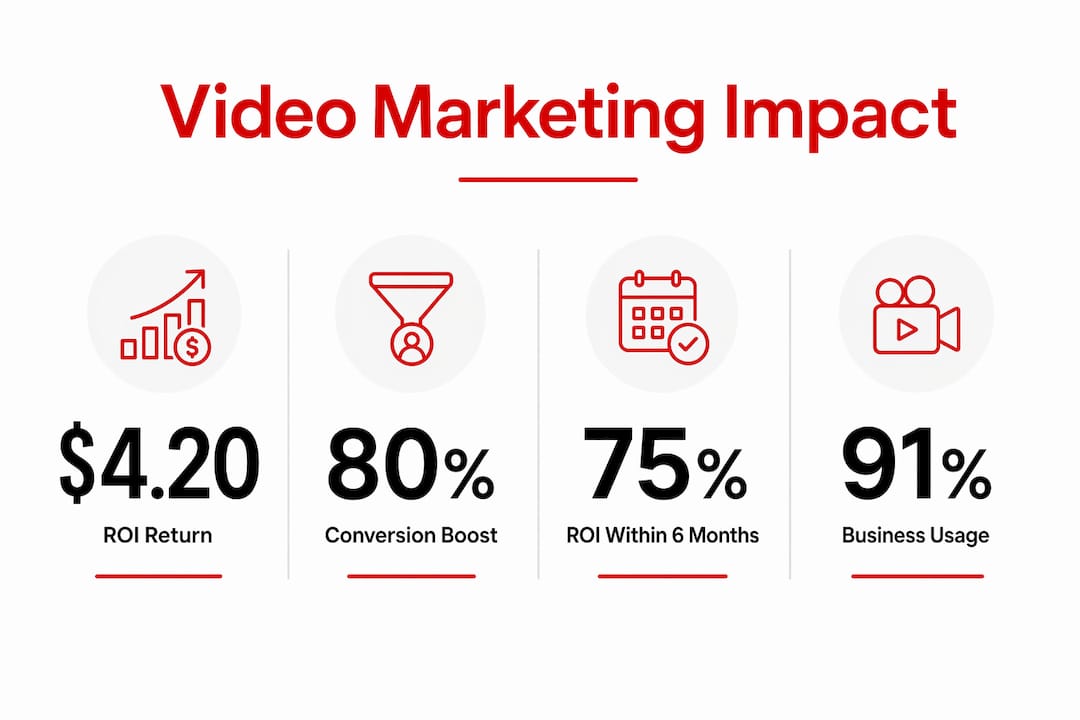
| Business Metric | Video Marketing Impact |
|---|---|
| Average ROI | $4.20 returned per $1 invested |
| ROI timeline | 75% of brands see returns within 6 months |
| Landing page conversions | Up to 80% lift with product video |
| SaaS conversion lift | Up to 92% on product landing pages |
| Email click-through rate | 65%–300% increase with video inclusion |
Pro Tip: Track video performance against pipeline contribution and customer acquisition cost, not just view counts. A video with 500 views that closes 10 deals outperforms a viral clip that generates zero revenue.
The most common mistake brands make is producing video without mapping it to a specific funnel stage. Video marketing must be mapped to funnel stages to drive specific business goals. A brand awareness video and a conversion-focused product demo require different formats, lengths, and calls to action.
A practical funnel framework looks like this:
Repurposing is the multiplier that most brands underuse. Repurposing content systematically maximizes ROI without proportionally increasing production costs. A single 3-minute product video can become a 30-second social clip, a GIF for email, a thumbnail for a blog post, and a transcript for SEO. That one shoot now serves five channels. For content marketing best practices across CPG brands, repurposing is not optional. It is the only way to maintain volume without burning through budget.
Measurement is where most video programs lose credibility internally. Measuring business impact KPIs like pipeline contribution, customer acquisition cost, and lead quality is what proves video’s value to finance and leadership. Views are a distribution metric. They tell you reach, not revenue.
Building internal video capacity is now more accessible than it has ever been. The majority of companies build in-house video capabilities using AI to aid scripting, editing, and accessibility, which reduces reliance on outside agencies. The cost and speed advantages are significant.
The modern in-house video role has changed. Video producers are evolving into versatile multimedia contributors who handle scripting, filming, editing, and distribution within a single workflow. Brands that hire for this profile get more output per headcount than those who separate those functions.
Practical steps for building internal capacity:
For brands exploring digital marketing trends in 2025 and beyond, in-house video production is consistently listed as a top capability investment. The brands building this now will have a structural cost advantage over those who continue to outsource every shoot.
Video marketing generates measurable returns across engagement, conversion, and revenue when it is mapped to funnel stages, measured against business KPIs, and built on a repurposing-first production system.
| Point | Details |
|---|---|
| Adoption is near-universal | 91% of businesses use video marketing in 2026, making it a baseline expectation. |
| ROI is fast and strong | Brands average $4.20 per $1 spent, with 75% seeing returns within 6 months. |
| Funnel mapping is required | Match video format and message to awareness, consideration, conversion, or retention goals. |
| Repurposing multiplies output | One core video asset can serve five or more channels without additional production cost. |
| Measure business KPIs | Track pipeline contribution and customer acquisition cost, not views or likes. |
Most brands treat video as a creative project rather than a revenue channel. They produce a polished brand film, post it once, and move on. That approach generates views and zero pipeline.
The brands that get real returns from video share one habit: they plan distribution before they plan production. They know which funnel stage the video serves, which channel it will run on, and what KPI it is accountable for before the camera turns on. That discipline is rare, and it is the actual differentiator between brands that report “video didn’t work” and those that report a 4x return.
Repurposing is the second gap I see consistently. A single well-produced video can fuel a month of content across email, social, and paid channels. Most brands use it once and archive it. That is a direct waste of production budget. Build the repurposing plan into the brief, not as an afterthought after the shoot.
The third mistake is measuring the wrong things. If your video report leads with views, your leadership team will eventually question the budget. If it leads with leads generated, pipeline influenced, and customer acquisition cost reduction, video becomes a protected line item. Measure what finance cares about, and video will always have a seat at the table.
— Reddog
Video strategy does not exist in isolation. For CPG brands scaling across Amazon, Walmart, and DTC channels, video is one piece of a larger growth system that includes pricing, margin, and channel economics.

Reddog works with emerging and growth-stage CPG brands in the $500K–$20M revenue range that need structured growth planning and measurable results. If you want a practical review of how your marketing channels, including video, are contributing to contribution margin and profitable growth, a free 30-minute strategy call is a direct way to get there. Book your session through the Reddog growth offer page and come with your current channel mix and margin targets. The conversation will focus on what is actually moving the needle, and where the gaps are.
Video marketing is the use of video content to promote products, build brand awareness, and drive conversions across digital channels. It matters because 92% of marketers report positive ROI from video, making it one of the highest-returning content formats available.
Product videos placed on landing pages can increase conversions by up to 80% by reducing purchase uncertainty and building buyer confidence before checkout.
Track pipeline contribution, customer acquisition cost, and lead quality rather than views or likes. These metrics connect video directly to revenue and justify budget to leadership.
75% of brands that invest in video marketing report positive ROI within 6 months. Planning distribution and funnel alignment before production accelerates that timeline.
Yes. Most companies now build in-house video capacity using AI tools for scripting, editing, and captioning. A single versatile team member with a basic studio setup can produce consistent, high-quality content across multiple channels.
Leave a comment: