
Published: March 2020 | Last Updated:May 2026
© Copyright 2026, Reddog Consulting Group.

TL;DR:
- A 5% increase in customer loyalty can significantly boost lifetime profits for CPG brands, often by up to 86%. Building genuine emotional connections and consistent brand experience across channels fosters loyalty that reduces acquisition costs and enhances retail positioning. Effective loyalty strategies turn customers into advocates, creating a sustainable growth engine rooted in trust rather than transactional incentives.
A 5% increase in loyalty can boost lifetime profits by 86%, yet most CPG brands spend the overwhelming majority of their marketing budgets chasing new customers they may never retain. For founders operating in the $500K to $20M revenue range, that math is quietly killing margins. Whether you’re selling on Amazon, in regional grocery chains, or through your own DTC site, the brands that compound growth are the ones that get customers to come back without spending another dollar on acquisition. This guide unpacks why loyalty is your most powerful growth lever and gives you the frameworks to actually build it.
| Point | Details |
|---|---|
| Loyalty boosts profits | Small increases in customer loyalty can have a huge impact on long-term profitability for CPG brands. |
| Retention is far cheaper | It costs dramatically less to keep an existing customer than to acquire a new one—especially in retail. |
| Growth through repeat sales | Loyal customers drive more frequent purchases and generate valuable word-of-mouth. |
| Frameworks matter | Proven steps and consistent value delivery build lasting loyalty across retail channels. |
| Focus on connection | Emotional brand connection—not just discounts—fuels genuine, defensible loyalty. |
Brand loyalty in a CPG context is more than a customer liking your product. It is a customer’s deep commitment to repeatedly choosing your brand over every competing option on the shelf, the screen, or the app, even when a competitor is running a promotion or priced lower. That distinction matters enormously. Satisfaction says “I liked it.” Loyalty says “I’ll be back, and I’ll tell my friends.”
For brands scaling across multiple retail channels, this distinction drives operational clarity. A loyal customer base reduces your dependence on constant new customer acquisition, which is the most expensive part of any CPG growth model. Instead of running perpetual promo cycles to stay relevant, you build a stable revenue foundation that keeps cash flowing even during off-peak seasons or supply disruptions.
Building customer loyalty also directly affects your positioning in the retail ecosystem. Retailers like shelf velocity. When your product turns over consistently because your customers repurchase it without prompting, you earn better placement, better terms, and reduced risk of getting de-listed during a reset. That is a concrete, margin-protecting benefit most founders undervalue.
Here is what strong brand loyalty actually delivers for a CPG brand:
“Brand loyalty is not just a marketing outcome. It is a financial asset that makes every channel you operate in more efficient and more profitable.”
Understanding branding and loyalty fundamentals from the start helps you build systems around retention, not just conversion. The CPG brands that win long-term treat loyalty as infrastructure, not a campaign.
The numbers on loyalty are not subtle. It costs 15 to 22 times more to recruit a new customer than to retain an existing one. For a CPG brand spending $8 to acquire a new customer, retaining that same buyer costs roughly $0.40 to $0.50 worth of ongoing engagement. That delta compounds fast across a customer base of thousands.

And the profit impact is just as striking. A modest 5% improvement in customer loyalty can increase lifetime profits per customer by up to 86%. That is not a rounding error. For a brand doing $2M in annual revenue, even conservative loyalty improvements can translate to six figures in additional margin without adding a single new SKU or retail door.
The table below breaks down how loyalty economics shift the cost structure of a CPG brand:
| Metric | Acquisition-reliant brand | Loyalty-driven brand |
|---|---|---|
| Customer acquisition cost | $8 to $20 per customer | $2 to $5 per returning customer |
| Repeat purchase rate | 15 to 25% | 45 to 65% |
| Word-of-mouth referrals | Low | High |
| LTV ratio (LTV to CAC) | 2:1 to 3:1 | 5:1 to 8:1 |
| Promo dependency | High | Low |
| Margin per unit over time | Declining | Stable or improving |
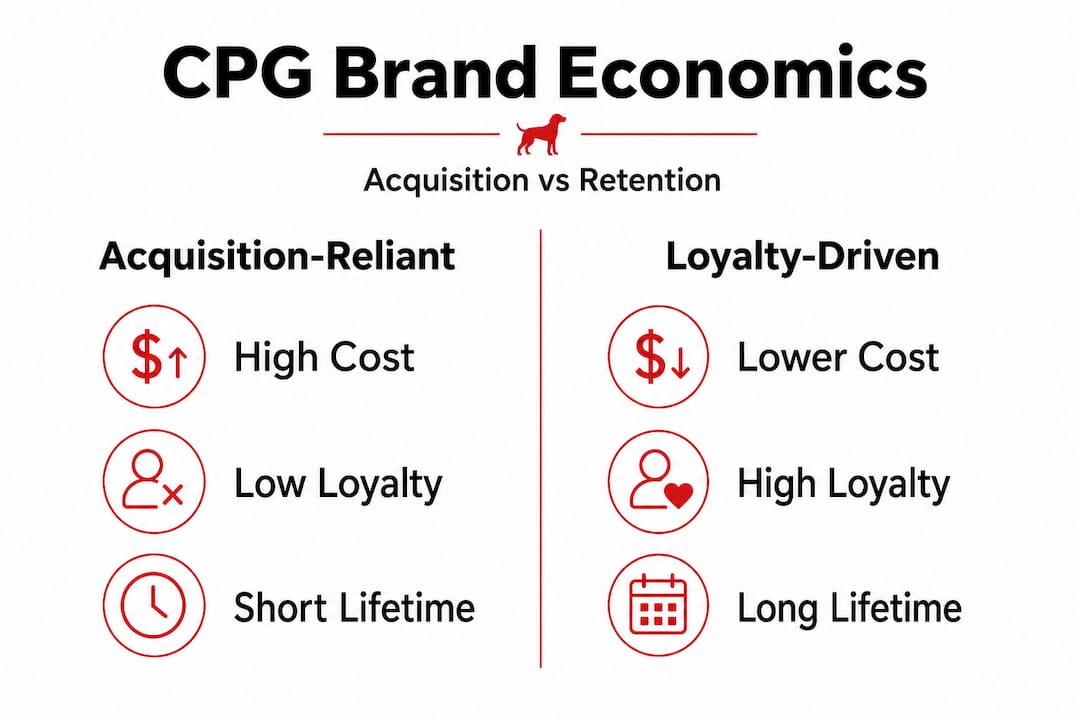
The contrast is stark. Customer retention strategies that even modestly shift a brand from the left column to the right are not nice-to-haves. They are survival mechanics for brands in competitive retail categories.
Statistic worth printing and posting: A customer who has purchased from you twice is nine times more likely to convert on a third purchase than a brand-new prospect. That compounding loyalty behavior is why calculating your retention rate is one of the most useful diagnostics you can run right now.
Brand positioning for loyalty works because it aligns your messaging with what drives repurchase behavior, which according to retail research is significantly influenced by brand loyalty and the emotional connection customers feel toward the brand. Price alone rarely sustains that connection.
Loyalty is not just a defensive tool that reduces churn. It is an active growth engine. Here is how it works in practice across retail and digital channels.
The mechanics of loyalty-driven growth:
Let’s compare two growth models directly:
| Growth driver | Acquisition-reliant brand | Loyalty-driven brand |
|---|---|---|
| Primary revenue source | Constant new customer flow | Repeat buyers plus referrals |
| Ad spend efficiency | Low, rising CAC | Improving over time |
| Margin trend | Compressing | Expanding |
| Retail buyer relationship | Inconsistent | Strong, data-backed |
| Resilience to market shifts | Vulnerable | Stable |
A real-world example: a natural grocery brand in the Texas market shifted its marketing focus from weekly social ads toward post-purchase engagement sequences and in-store sampling events. Within 12 months, their repeat purchase rate went from 22% to 47%. Their Amazon ACOS improved because organic repeat buys were boosting their sales velocity, reducing the need for sponsored spend.
Pro Tip: Track your repeat purchase rate by channel. If Amazon shows 40% repeat buyers but your retail accounts show 18%, you have a retail execution problem, not a product problem. Fix the in-store experience, the shelf presentation, or the post-purchase touchpoint strategy.
A solid multichannel branding strategy ties these growth mechanisms together so that loyalty built in one channel reinforces behavior in another. That is the compounding effect most brands leave on the table. And following brand building tips grounded in retail reality, rather than generic marketing advice, keeps your execution focused on what actually moves customers from first buy to loyal advocates.
For a deeper look at brand identity for growth, the core principle is that loyalty is built through consistent identity expression across every touchpoint, not just great product quality.
Knowing loyalty matters is one thing. Building it systematically is another. Here is a practical framework designed for CPG brands managing complexity across multiple retail channels.
Step-by-step loyalty-building framework:
Pitfalls to avoid:
Local marketing strategies are particularly powerful for in-store loyalty because regional shoppers often respond to community relevance more than national campaigns. A Texas-based brand that shows up at local farmers markets, sponsors a regional event, and earns shelf space at a community-trusted retailer has built something a national brand cannot easily replicate from a spreadsheet in New York.
Pro Tip: Train your retail account managers or broker reps to educate store staff about your brand story. A knowledgeable store employee who recommends your product is worth more than three months of paid ads.
Following a structured brand strategy approach helps you sequence these steps in a way that fits your stage of growth and channel mix. A long-term brand strategy always anchors loyalty tactics to a clear brand identity, so that each tactic reinforces the larger story rather than creating noise.
Here is the uncomfortable truth: most CPG brands treat loyalty as a tactic when it is actually a culture. They launch points programs, run promo cycles, and call it retention strategy. Then they wonder why their repeat purchase rate stays flat.
Points programs are not wrong. They are just insufficient. A customer who redeems points is not necessarily loyal. They are economically incentivized. The moment a competitor offers a better deal or a bigger reward, they are gone. That is not loyalty. That is a transaction with extra steps.
Real loyalty in CPG comes from something harder to manufacture and harder to copy: emotional connection. Customers who trust your brand, who feel it aligns with their values or their identity, do not shop around when the economy shifts or a competitor discounts. They feel like switching would be a small betrayal of something they believe in. That sounds abstract, but it shows up in concrete metrics like reduced promo sensitivity, higher average order value, and unsolicited social sharing.
The brands getting this right are not necessarily spending more on marketing. They are spending more intentionally. They invest in packaging that communicates quality before anyone reads the label. They build community through authentic storytelling rather than generic lifestyle content. They engage in two-way conversations with their customers rather than broadcasting campaigns.
Omnichannel integration is the structural version of this. When a customer sees a consistent brand experience on your Amazon listing, your DTC site, and the shelf at their local grocery store, trust compounds. Every touchpoint reinforces the last. That is the flywheel most brands talk about but rarely build with any discipline.
Studying online branding examples from brands that have successfully built multichannel loyalty reveals a consistent pattern. They obsess over brand coherence, they prioritize perceived value over promotional volume, and they treat every channel as an opportunity to deepen the relationship rather than just close a sale.
The one takeaway from years of working with CPG founders in competitive retail markets: stop asking how to get customers to buy again and start asking why they would ever choose someone else. Answer that question with every decision you make, and loyalty follows.
Loyalty is not a marketing line item. It is the structure that makes every other investment in your brand pay off. When your customers come back, refer others, and resist competitor offers, you are not just growing revenue. You are building a business that is genuinely defensible.
At RedDog Group, we work directly with CPG founders and operators to build the systems and strategies that make loyalty measurable and scalable. From contribution margin analysis to multichannel retail execution, we help you identify where loyalty is leaking and how to fix it. Whether you’re managing an Amazon storefront, expanding into regional retail, or trying to connect your DTC and wholesale channels, we bring the analytical rigor and retail experience to turn loyalty from an idea into a growth driver. Ready to take the next step? Let’s talk strategy.
It costs 15 to 22 times more to acquire a new customer than to retain someone already loyal to your brand, making retention one of the highest-ROI investments in CPG.
Early signs include repeat purchases, positive reviews, and rising referral rates, behaviors that research shows are significantly influenced by brand loyalty even before any formal loyalty program exists.
Yes. A 5% increase in loyalty can boost lifetime profits by 86%, making even modest gains in retention dramatically impactful at the margin level.
Loyalty can begin forming within the first few purchases when value, experience, and connection are consistently delivered, since early repurchase behavior and word-of-mouth are heavily influenced by perceived brand value from the start.
Loyalty adds measurable value in both channels, but strong brand affinity has an outsize impact in crowded physical retail where shelf placement, price pressure, and competitor proximity make perceived value and loyalty outcomes especially critical.
Leave a comment: