
Published: March 2020 | Last Updated:May 2026
© Copyright 2026, Reddog Consulting Group.

TL;DR:
- Most CPG brands treat online marketplaces like vending machines, focusing on volume without profit. Understanding marketplaces as multi-sided platforms that facilitate interactions rather than just listings is crucial for profitable scaling. Managing network effects, multi-homing, and platform dynamics enables brands to build sustainable, margin-driven marketplace strategies.
Most CPG founders treat online marketplaces like a vending machine: stock the shelves, wait for the quarters to roll in. That mental model works until you’re staring at thin margins, suppressed listings, and a cost structure that eats your contribution profit before you can reinvest. The reality is that online marketplaces are multi-sided platforms built to create value through facilitated interactions, not just product listings, and understanding that distinction is the difference between scaling profitably and spinning revenue without building a real business. This guide gives CPG operators a strategic framework for doing the former.
| Point | Details |
|---|---|
| True marketplace value | It comes from orchestrating interactions and leveraging platform dynamics, not just increased shelf space. |
| Network effects | More buyers and sellers boost value for all but increase competition, demanding strategic planning. |
| Platform risks | Multi-homing, fragmentation, and loss of control can limit profits if ignored or unmanaged. |
| Profit frameworks | Leading CPGs combine analytics, unique benefits, and careful channel selection for long-term marketplace wins. |
Let’s start with a definition that actually matters for your P&L. An online marketplace is a multi-sided digital platform that connects two or more distinct user groups, typically buyers and sellers, and creates value by facilitating their interactions under defined rules and pricing. The platform itself rarely owns inventory. Instead, it orchestrates the exchange. That distinction is not academic. It has direct implications for how you think about pricing power, brand control, and long-term margin.
Compare that to an online store, which is a single-sided channel where one brand sells its own products directly to consumers. The differences matter enormously:
| Feature | Online store | Online marketplace |
|---|---|---|
| Ownership | Brand owns the experience | Platform sets the rules |
| Traffic | Brand must drive its own | Built-in buyer audience |
| Product control | Full control | Shared or contested |
| Data access | First-party, complete | Limited or platform-mediated |
| Competition | Isolated | Head-to-head with competitors |
| Trust signals | Brand-dependent | Platform-level credibility |
This table is worth studying for a few minutes. When you join a marketplace, you are trading some control for access to a massive, pre-qualified buyer pool. The platforms know this, and they price that access accordingly. Amazon charges FBA fees, referral fees, and advertising costs that can collectively consume 30 to 50 percent of your top-line revenue depending on the category. Walmart Marketplace has its own fee structure that compounds similarly.
Marketplaces also differ by type. Horizontal marketplaces like Amazon or Walmart serve broad categories across nearly every consumer need. Vertical marketplaces specialize in a niche, think beauty, outdoor gear, or pet products. Managed marketplaces add more curation and service layers, often handling fulfillment or quality control on both sides. Open marketplaces accept virtually any seller and product. Each type comes with different dynamics around competition density, buyer intent, and brand positioning. Exploring examples of marketplace strategies across these types helps you see why not every platform is the right fit for every brand at every stage.
Understanding how these models differ is foundational to marketplace management strategies that prioritize profit over pure volume. The best CPG operators choose platforms deliberately and configure their go-to-market approach accordingly, not the other way around. If you want a practical starting point, e-commerce strategy tips from practitioners in the space can sharpen your thinking before you commit capital to a new channel.
Here is where the real leverage lives. Marketplaces do not just connect buyers and sellers. They reduce the cost and friction of that connection in ways that neither side could achieve independently.
Marketplaces reduce search and transaction costs for both sides by aggregating participants, standardizing information, and instituting trust mechanisms. For a CPG brand, this translates directly to benefits you can measure: immediate discovery by buyers already searching your category, review infrastructure that builds credibility faster than any brand-built website, and fulfillment networks that compress delivery windows to expectations your DTC site cannot easily match alone.

The core mechanic is the network effect. More buyers attract more sellers. More sellers attract more buyers. Each new participant increases the value of the platform for everyone already on it. This dynamic is called an indirect network effect, meaning the value you get as a seller comes largely from the buyer side growing, not from more sellers joining (which actually increases competition for you). Understanding this asymmetry helps you time your entry into emerging marketplaces before they become oversaturated.
Here is how these value levers stack up:
| Value lever | What it does | CPG implication |
|---|---|---|
| Network effects | More users increase platform value | Entry timing matters; early movers win shelf position |
| Aggregation | Centralizes buyers in one place | Lower customer acquisition cost than standalone DTC |
| Trust mechanisms | Reviews, ratings, dispute systems | Brand reputation is amplified and exposed publicly |
| Standardization | Consistent listing format, pricing, fulfillment | Less flexibility but lower operational setup cost |
For CPG brands specifically, here are the frictions that marketplaces solve in sequence:
Pro Tip: Your rating and review profile is a strategic asset, not a nice-to-have. A brand dropping below a 4.0-star average on a major marketplace loses organic ranking within weeks. Actively monitor and respond to reviews, and operationalize a post-purchase follow-up process to protect that score. The role of marketplaces for SMEs often hinges on how well small and mid-size brands manage this trust layer relative to their larger competitors.
Now for the part most playbooks skip. Winning platform strategy requires managing dynamics like clustering, fragmentation, risk of disintermediation, multi-homing, and network bridging. These are not theoretical risks. They show up in your margin reports every quarter.
Multi-homing is when buyers or sellers participate on multiple competing platforms simultaneously. Your customer shops on Amazon, Walmart, and Target.com in the same week. You as a brand sell on all three. This dilutes your pricing power because buyers can instantly find the cheapest version of your product across every channel. Multi-homing is nearly universal in CPG categories, and pretending it does not affect you is expensive.
Fragmentation happens when your brand presence and pricing are inconsistent across platforms. One unauthorized reseller lists your product at a discount on one marketplace, which suppresses your price across all of them because algorithmic price-matching pulls your listings down to meet the lowest available price. You lose margin without making a single bad decision yourself.
Disintermediation is the risk that either the platform eventually cuts you out by launching a private-label competitor in your category, or a major retail buyer starts sourcing from your manufacturer directly. Both happen regularly in CPG, especially in commodity-adjacent categories.
Here is how leading CPG brands mitigate these risks:
Pro Tip: If you are on three marketplaces and struggling to maintain pricing integrity, do not add a fourth. Double down on the platform where you can build the strongest brand presence and own the most of the customer relationship. Selective expansion beats fragmented presence every time. Thinking through your CPG growth strategies in marketplaces as a staged process, not a simultaneous land-grab, is the discipline that separates profitable brands from high-revenue-but-broke ones. Studying e-commerce marketing strategies with a multi-channel lens can also help you see how platform-specific tactics compound when deployed sequentially.
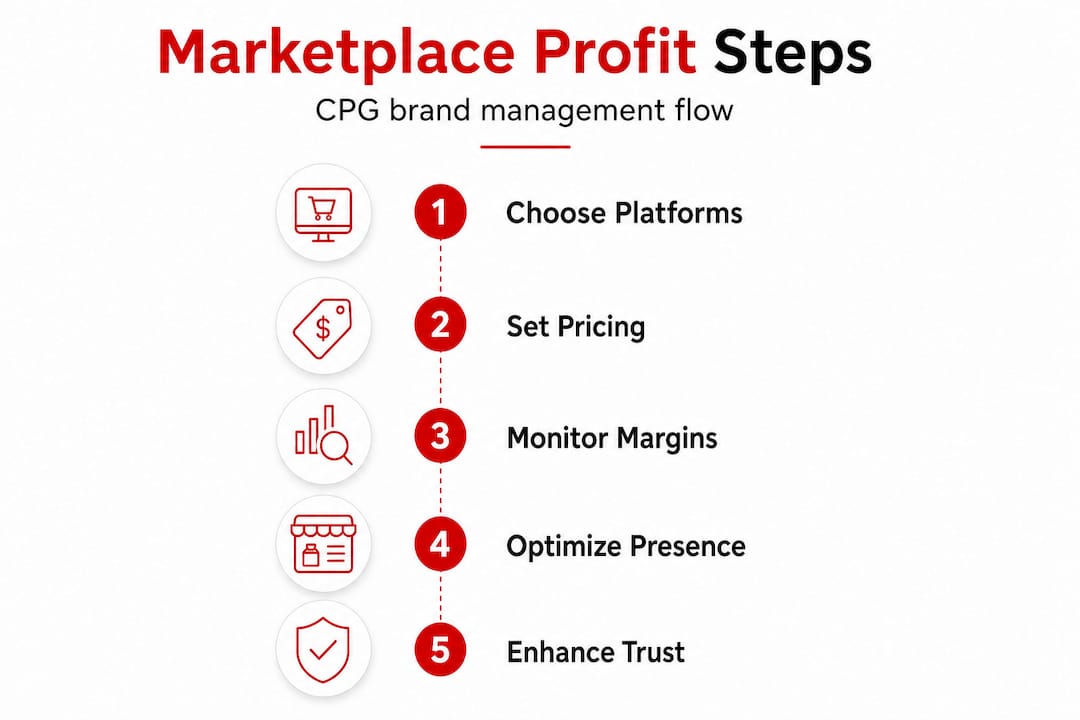
Now let’s talk execution. Long-term marketplace advantage depends on orchestrating network effects and building data and coordination advantages, not just assuming that scale alone guarantees profit. Here is a repeatable framework for CPG brands in the $500K to $20M range:
Choose your primary marketplace with margin math first. Before listing anywhere, model the full cost structure. Include the platform referral fee, FBA or WFS fulfillment fees, advertising cost of sale, storage costs, and return rates. If your contribution margin after all marketplace-specific costs is below 20 percent, you either have a pricing problem or the wrong channel for that SKU.
Differentiate at the listing level. Your title, images, A-plus content, and bullet points are not cosmetic. They are conversion rate levers. A 3 percent improvement in conversion on a high-traffic keyword can outperform a 15 percent increase in ad spend. Invest in professional photography and copy that speaks to the buyer’s specific use case, not generic product features.
Develop a platform-specific pricing strategy. Your retail price, promotional cadence, and bundle architecture should be engineered per platform. What works on Amazon does not automatically translate to Walmart or a specialty vertical marketplace. Each platform has its own algorithmic signals for surfacing products and its own buyer demographics.
Monitor network effect signals. Track your category rank, review velocity, and share of search on a weekly basis. These are leading indicators of your marketplace health, not lagging ones. If review velocity drops or a competitor surges in category rank, you have a window to respond before it hits your revenue.
Integrate your marketplace data with your broader channel view. Your marketplace performance should inform your DTC strategy, your wholesale buy volumes, and your inventory planning. Use a marketplace optimization guide to connect channel-level data into a unified picture of contribution margin across all channels.
Run the lifetime value math, not just the transaction math. Your customer acquisition cost on a marketplace might look reasonable at $4 per order. But if the platform owns the customer relationship and you cannot remarket to them, the LTV of that acquisition is near zero compared to a DTC buyer you can reach again at low cost.
Pro Tip: Track three metrics above all others for marketplace profitability: contribution margin per unit after all marketplace-specific costs, repeat purchase rate segmented by channel, and incremental profit per advertising dollar spent. If you are not tracking these at the SKU level, your marketplace “growth” may actually be destroying capital. The profit-first marketplace playbook is a useful starting point for operators building this analytical muscle for the first time.
Most marketplace strategy advice for CPG brands focuses on tactics: better images, more keywords, smarter ad bids. That stuff matters. But it treats the symptom, not the structure.
The real mistake most CPG operators make is assuming that catalog breadth and revenue scale on a marketplace translate to profit and brand equity. They do not, automatically. The brands that build durable marketplace businesses understand that the game is actually about three things: owning part of the trust layer with buyers, controlling your data and pricing across the ecosystem, and finding the specific platform where your network effect advantages compound rather than dilute.
Conventional playbooks also ignore multi-homing almost entirely. They are written as if your buyers are loyal to one platform and your competitors are not already present everywhere you are. That is not the market any of us operate in. A CPG brand in food, personal care, or household products is competing on four to six surfaces simultaneously, and the buyer is doing real-time cross-channel price and review comparisons. Your strategy has to account for that reality, not paper over it with ad spend.
The brands we have seen win on marketplaces share one habit: they treat marketplaces as adaptable ecosystems with rules that shift, not as fixed sales channels with predictable economics. They test narrow, learn fast, and scale only what they can do profitably. Looking at examples of marketplace strategies from brands that have navigated this well gives you a concrete map rather than a generic framework.
The uncomfortable truth is that many brands would be more profitable with deep presence on two platforms than shallow presence on six. Fewer fronts, more control, better data, stronger contribution margins.
If this article has you rethinking how your brand is positioned across Amazon, Walmart, or other marketplaces, you are asking the right questions. At RedDog Group, we work with CPG brands in the $500K to $20M revenue range to build margin-first marketplace strategies that hold up under real cost pressure. We do not just optimize listings. We model your full channel economics, identify where margin is leaking, and build a scalable plan that connects your marketplace performance to your broader retail ambition.
Whether you are entering a new marketplace, struggling with margin compression on your current channels, or ready to integrate your digital and physical retail strategy, we can help you build a plan that prioritizes profit over vanity metrics. Explore how we work and what a focused engagement looks like at our CPG retail growth offer page. The next step is a conversation, not a commitment.
They aggregate buyers and sellers, standardize transactions, and use built-in trust mechanisms like reviews and dispute resolution to lower the complexity of selling online at scale.
A marketplace connects multiple sellers and buyers under shared platform rules, while a DTC site gives a single brand full control over the buying experience and customer relationship.
Because multi-homing and fragmentation allow buyers to compare prices across platforms instantly, and without strong MAP enforcement and distribution controls, competitive pressure drives prices down.
Watch for platform fragmentation and disintermediation risk, along with the gradual loss of pricing control and customer data access as platform dependence grows.
Leave a comment: