
Published: March 2020 | Last Updated:April 2026
© Copyright 2026, Reddog Consulting Group.

TL;DR:
- Expanding to online marketplaces unlocks new customer insights and omnichannel leverage for brands.
- Careful margin modeling and strategic channel management are crucial to profitable marketplace growth.
- Data from marketplaces enhances demand planning, product development, and long-term brand value.
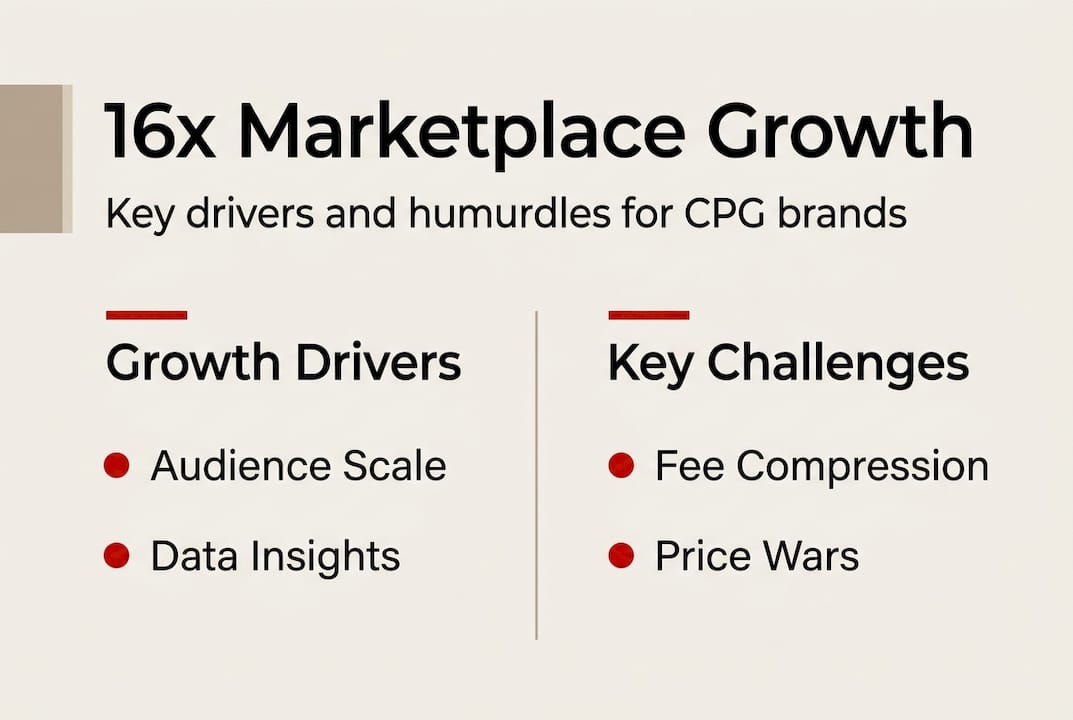
Many CPG brand founders assume that expanding to online marketplaces will crush their margins and hand over brand control to a platform algorithm. That assumption is costing them real growth. Brands like 5% Nutrition achieved 16x year-over-year revenue growth by leaning into marketplace infrastructure rather than fighting it. The reality is that well-executed marketplace strategies don’t just add revenue, they sharpen your demand planning, surface new consumer insights, and create omnichannel leverage that a standalone DTC site simply can’t replicate. This guide breaks down why marketplace expansion matters, what the real benefits and risks look like, and how to approach it profitably.
| Point | Details |
|---|---|
| Unlock new growth | Online marketplaces provide instant access to millions of new CPG shoppers and built-in trust infrastructure. |
| Leverage valuable data | Marketplace analytics drive smarter demand planning, inventory allocation, and targeted marketing. |
| Protect margins and brand | Brands must actively manage pricing, differentiation, and channel conflicts to avoid commoditization and profitability loss. |
| Enable omnichannel strategies | Marketplace presence strengthens cross-channel synergy—aligning DTC, retail, and online touchpoints for greater impact. |
Online marketplaces have moved well past their early “list it and they’ll come” era. Today, they function as full retail ecosystems with advertising platforms, fulfillment networks, first-party data engines, and loyalty programs built in. For CPG brands in the $500K to $20M range, that shift changes everything about how you should think about channel strategy.
Marketplaces now account for more than half of global e-commerce sales, and the infrastructure gap between a marketplace and a standalone DTC site has never been wider. Amazon’s logistics network, Walmart’s physical store footprint, and TikTok Shop’s social commerce engine each offer capabilities that would cost millions to replicate independently. The question isn’t whether these platforms have scale. It’s whether your brand can operate profitably within their economics.
“The brands winning on marketplaces in 2026 aren’t the ones with the biggest ad budgets. They’re the ones with the clearest unit economics and the most disciplined channel architecture.”
Walmart Marketplace alone averages over 100 million monthly visitors. That’s not a niche audience. That’s a retail channel that rivals the foot traffic of the largest brick-and-mortar chains in the country. And unlike traditional retail, you get data back.
Here’s what’s changed most about how top platforms operate today:
The brands that thrive aren’t just listing products on every platform. They’re building channel-specific strategies anchored to contribution margin, not just top-line revenue.
Now that we understand the landscape, let’s examine what CPG brands actually gain by targeting marketplaces.
The most obvious benefit is audience access. Marketplaces put your products in front of buyers who are already in purchase mode, with payment information saved and delivery expectations set. You’re not building awareness from scratch. You’re converting intent. That changes your customer acquisition economics significantly compared to cold DTC traffic.
But the less obvious benefit is data. Marketplaces provide consumer insights for product refinement, demand planning, and omnichannel synergy that most brands underutilize. Search term reports, conversion rate data by SKU, return reason codes, and review sentiment are all signals that can feed your product development roadmap and your retail sell-in story.
| Benefit | What it means for your brand |
|---|---|
| Audience scale | Millions of in-market buyers with built-in trust |
| First-party data | SKU-level insights for demand planning and innovation |
| Fulfillment options | FBA and WFS reduce operational complexity |
| Brand visibility | Marketplace presence reinforces omnichannel touchpoints |
| Faster cash cycles | Marketplace payouts often faster than wholesale net terms |
Integrated fulfillment is another underrated advantage. Amazon FBA and Walmart Fulfillment Services handle pick, pack, ship, and returns. For a brand doing $2M in revenue, that can mean avoiding a dedicated 3PL relationship, reducing storage overhead, and improving delivery speed without capital investment. The fees are real, but so is the operational lift you’re offloading.

Marketplace presence also strengthens your omnichannel sales success by creating additional shopper touchpoints that reinforce brand recognition across channels. A buyer who sees your product on Walmart.com is more likely to recognize it on a Target shelf. That halo effect is hard to quantify but very real in buyer conversations.
Key reasons to expand now:
Pro Tip: Before launching on a new marketplace, model your contribution margin at the SKU level including platform fees, ad spend, and fulfillment costs. If the math doesn’t work at current velocity, it won’t fix itself with volume. Understand the omnichannel supply chains implications before you commit inventory.
However, moving to marketplaces isn’t without its risks, which CPG leaders must anticipate and solve.
The biggest trap is treating marketplace revenue the same as DTC or wholesale revenue. It isn’t. Marketplace fees compound quickly. A 15% referral fee, plus 3PL or FBA costs, plus sponsored product spend, plus promotional discounts can easily consume 40 to 50 cents of every dollar before you account for COGS. Brands that don’t model this upfront often discover the margin problem after they’ve already scaled.
Price competition is the other structural risk. Marketplaces are inherently price-transparent. Shoppers can sort by price in one click, and algorithms often favor lower-priced listings. Without a MAP (minimum advertised price) policy and enforcement, you can find your own retail partners undercutting you on the same platform where you’re running ads.
| Risk | Impact | Mitigation |
|---|---|---|
| Fee compression | Erodes contribution margin | Model fees before launch |
| Price competition | Commoditizes your brand | Enforce MAP, use exclusive SKUs |
| Channel conflict | Damages retail relationships | Align pricing across channels |
| Data leakage | Platform learns your customers | Build owned CRM in parallel |
| Copycat products | Splits your search traffic | Strengthen brand registry and IP |
Channel conflict with brick-and-mortar partners is a real concern, especially if you’re in regional grocery or specialty retail. Retailers watch online pricing closely. If your Walmart.com price is consistently below your in-store shelf price, expect a conversation with your buyer about margin support or delistings.
Here’s a prioritized approach to managing marketplace risks:
The strategic shift that separates profitable marketplace brands from struggling ones is focusing on LTV over first-order ROAS. Marketplaces commoditize on price. Your defense is brand equity, repeat purchase rates, and customer relationships that extend beyond the platform. Pair marketplace promotions with upper-funnel brand building to stay differentiated.
Pro Tip: Use contract logistics strategies to maintain flexibility across fulfillment options. Locking into a single fulfillment provider before you understand your velocity patterns can create expensive storage fees and restock delays.
With the challenges in mind, here are proven steps to make marketplace expansion work for your CPG brand.
Start with architecture, not tactics. Before you optimize a listing or run a sponsored product campaign, define how each channel fits into your overall brand strategy. Which marketplace serves new customer acquisition? Which one supports your retail sell-in story? Which SKUs belong where? Omnichannel synergy is what separates brands that grow profitably from those that just grow.
Here’s what a disciplined marketplace expansion looks like in practice:
For examples of marketplace strategies that work across categories, the common thread is always the same: disciplined economics, clear channel roles, and consistent brand expression. Tactics change. That framework doesn’t.
Pro Tip: Use marketplace marketing strategies that connect your paid spend to organic rank improvement. Every dollar you spend on sponsored products should be evaluated not just for immediate ROAS but for its impact on organic search position over time.
Zooming out, here’s what even experienced CPG operators often gloss over about successful marketplace journeys.
Most brands celebrate the revenue spike when they launch on a new marketplace. Very few do a rigorous post-mortem 90 days later to ask whether that revenue was actually profitable and whether it was incremental or just cannibalized their DTC channel. That analysis is where the real learning lives.
The brands that build durable marketplace businesses don’t just show up where their shoppers are. They integrate upstream and downstream data to create operational leverage. That means using marketplace sell-through data to inform production planning, using review sentiment to brief your next product iteration, and using search term data to sharpen your retail sell-in pitch.
Efficiency now beats expansion at any cost. The brands we see winning in 2026 are not the ones on the most platforms. They’re the ones with the clearest picture of what each channel contributes to margin and lifetime value. They look at omnichannel retail examples not for inspiration but for operational frameworks they can adapt.
Building internal capability to interpret marketplace analytics is a genuine competitive advantage. Most brands outsource this entirely and lose the institutional knowledge that compounds over time. Even a single operator who deeply understands your marketplace data is worth more than a large agency that treats your account as one of hundreds.
If you’re ready to capture the full advantage of online marketplace expansion, here’s how we can help accelerate the path.
At RedDog Group, we work with CPG brands in the $500K to $20M range to design, execute, and optimize marketplace and omnichannel strategies built around contribution margin, not just top-line growth. We help you model the real economics of each channel, identify where margin is leaking, and build a channel architecture that scales.
Whether you’re launching on Walmart for the first time, trying to fix a broken Amazon margin structure, or building a multi-channel growth plan, our omnichannel growth consulting is built for exactly this stage of your brand’s journey. Explore our CPG retail growth offer and book a consultation to get started with a team that understands the real complexity of scaling CPG profitably.
Marketplaces drive profitability by connecting your brand to millions of in-market buyers while generating consumer data insights that sharpen demand planning and reduce costly inventory errors.
The most common mistake is chasing top-line revenue without modeling margin. Brands that prioritize LTV over ROAS build sustainable marketplace businesses; those focused only on short-term sales often discover profitability problems after scaling.
Marketplace data gives brands SKU-level visibility into what’s selling, why products get returned, and what search terms drive conversion, all of which feed smarter product refinement and planning decisions.
Amazon and Walmart are the strongest starting points given their fulfillment networks and audience scale. Walmart alone draws over 100 million monthly visitors, but TikTok Shop and category-specific platforms can add meaningful volume for the right brand.
Leave a comment: