
Published: March 2020 | Last Updated:January 2026
© Copyright 2026, Reddog Consulting Group.

If you sell on Amazon, an effective ad strategy is no longer optional—it’s the engine that powers visibility, sales, and brand growth. Mastering amazon ad campaigns is your direct line to millions of shoppers already on the platform with a clear intent to buy.

Think of Amazon's advertising platform less like an expense and more like a scalable, sales-generating machine. The goal isn’t just to “run ads.” It’s to build a measurable, profitable system that puts your brand in front of shoppers actively searching for what you sell.
The data confirms this shift. Amazon’s ad revenue recently surpassed $56.2 billion worldwide, a 20% year-over-year increase. This growth cements its place as a top-tier digital ad platform where brands invest to connect with customers at the most critical moment: the point of purchase.
At RedDog Group, we approach every growth challenge with a simple but powerful framework: Foundation → Optimization → Amplification. This blueprint applies perfectly to amazon ad campaigns, providing a clear path from setup to market leadership. It’s how you build a strategy that delivers measurable, long-term results.
Foundation: This is about getting the fundamentals right. We’re talking about a logical campaign structure, thorough keyword research, and ensuring your product listings are polished and ready to convert clicks into sales. A shaky foundation will collapse the moment you try to scale.
Optimization: With a solid foundation in place, the focus shifts to data-driven refinement. This is where you analyze key metrics like ACOS (Advertising Cost of Sale), adjust bids, and eliminate wasted spend to maximize the return on every dollar.
Amplification: Once your campaigns are running efficiently, it’s time to expand your reach. This means strategically moving into new ad types, targeting competitors, and using advanced tactics to not just meet existing demand, but create it.
A winning Amazon advertising strategy is an asset that benefits your entire business. The data and insights gathered from your campaigns can inform everything from new product development and offline retail strategy to your broader omnichannel marketing message.
This guide will walk you through each phase, offering practical takeaways for brands ready to compete and win. To sustain that momentum, it's also crucial to understand how to scale your content marketing efforts beyond a single channel. Let's dive into the ad types, bidding strategies, and optimization tactics that turn ad spend into predictable growth.
To build effective amazon ad campaigns, you have to know your tools. Amazon offers three main ad types, each designed for a specific purpose. Think of them like tools in a workshop: one for precision targeting, another for broad brand building, and a third for re-engaging interested shoppers.
Using the right ad at the right time is critical. Let's break down the big three—Sponsored Products, Sponsored Brands, and Sponsored Display—in plain language. Understanding what each one does, where it appears, and how it helps you achieve your goals is a foundational step for any brand.
Imagine a shopper walking down a physical store aisle. A bright sign on the shelf points them directly to your product. That's what a Sponsored Products ad does in the digital marketplace.
These are the most common ads on Amazon, appearing within search results and on product detail pages. Their primary job is to drive sales for individual products. When someone searches for "running shoes," a Sponsored Product ad places your specific pair of shoes in front of them, blending seamlessly with organic results. They are incredibly effective for capturing high-intent shoppers at the exact moment they are ready to buy.
Because they look native to the shopping experience, they feel less like an ad to the customer, making them a powerhouse for driving conversions.
Now, picture a large, branded banner hanging over the entrance of a flagship store in a mall. That’s the role of Sponsored Brands.
These ads typically appear as a banner at the top of the search results page, featuring your brand logo, a custom headline, and several of your products. Instead of promoting a single item, Sponsored Brands build awareness for your entire brand and drive traffic to a collection of products or your Amazon Storefront. This format is about telling a bigger brand story and showcasing the breadth of your offerings.
These ads are perfect for answering the question, "What is this brand all about?" They help customers discover your full product line and associate your brand name with a specific category, like "outdoor gear" or "organic skincare."
Sponsored Brands help you claim valuable digital real estate, ensuring your brand is the first thing a shopper sees. This visibility is crucial for building brand recognition and trust over time.
Finally, think of Sponsored Display ads as a helpful brand ambassador that reminds interested shoppers about products they’ve viewed. These ads can appear both on and off Amazon, reaching potential customers even after they’ve left your product page.
Their real power lies in retargeting. If someone viewed your coffee maker but didn't add it to their cart, a Sponsored Display ad can appear later while they are browsing a different website or another part of Amazon. This keeps your product top-of-mind and encourages them to return and complete the purchase.
This ad type allows you to target audiences based on shopping behaviors, interests, or views of specific product pages—including your competitors'. This makes Sponsored Display an essential tool for re-engaging shoppers and amplifying your reach beyond the initial search.
Choosing the right ad type depends entirely on your objective. Are you aiming for a quick sale, building long-term brand equity, or bringing back undecided shoppers? Each goal requires a different tool.
This table breaks down the three ad types to help you match your campaign goals with the right format.
| Ad Type | Primary Goal | Key Targeting Options | Best For |
|---|---|---|---|
| Sponsored Products | Immediate Sales & Visibility | Keywords, ASINs, Categories | Launching new products, promoting best-sellers, capturing high-intent shoppers. |
| Sponsored Brands | Brand Awareness & Consideration | Keywords, ASINs, Categories | Building brand recognition, driving traffic to your Storefront, showcasing a product line. |
| Sponsored Display | Retargeting & Reach | Audiences (Views, Purchases), Product Targeting | Re-engaging past visitors, reaching shoppers off-Amazon, cross-selling to existing customers. |
Ultimately, a sophisticated Amazon advertising strategy doesn't rely on a single ad type. The most successful brands use a mix of all three, creating a full-funnel approach that engages customers at every stage of their buying journey.
A successful amazon ad campaign isn’t just about choosing keywords—it’s built on a smart, logical structure. Think of your campaign structure as the architectural blueprint for your advertising. Without a solid plan, ad spend becomes disorganized, performance is difficult to measure, and you can’t tell what’s actually working.
A well-organized account is the foundation for control and scalability. It’s the difference between guessing what drives growth and knowing exactly which levers to pull. This structured approach allows you to allocate budget effectively, analyze performance clearly, and optimize with confidence.
This flowchart breaks down the primary ad types that serve as the building blocks for your campaigns.
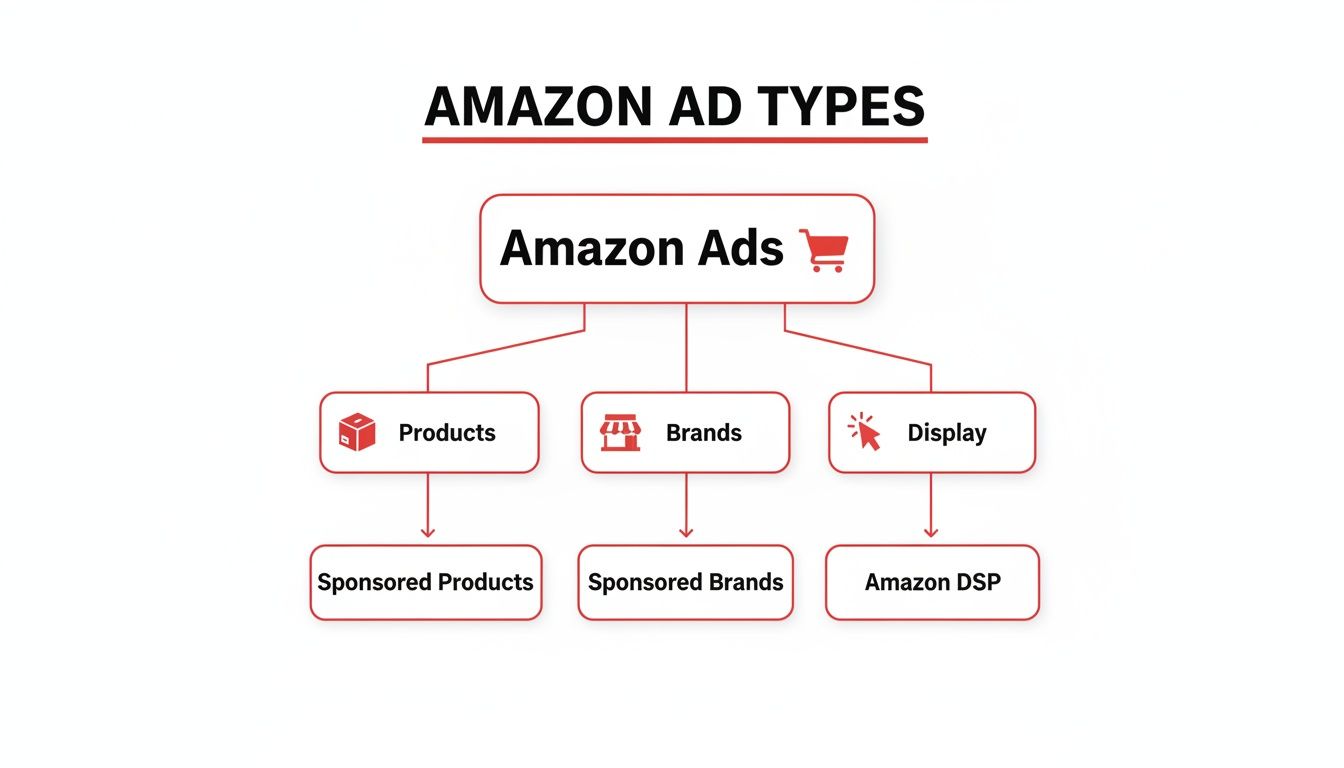
As you can see, Sponsored Products, Brands, and Display ads each play a distinct role. A winning structure knows how to strategically combine them.
The first step is to segment your campaigns based on clear business logic. Grouping all your products into a single campaign is a recipe for wasted spend. Instead, a segmented structure gives you granular control over budgets and performance.
There are several effective ways to organize your amazon ad campaigns:
A clean campaign structure isn't just for neatness—it's a strategic tool. It allows you to instantly shift budget to your best-performing product lines and diagnose issues in underperforming categories without untangling a web of mixed ad groups.
Let’s look at a practical example. A mid-sized apparel brand could structure its account this way for clarity and control.
Example Campaign Structure for an Apparel Brand:
This setup allows the brand to manage spend for each product line and targeting strategy independently, simplifying optimization.
With your structure planned, the next layer is targeting—how you tell Amazon who should see your ads. The two primary methods are keyword targeting and product targeting.
When you bid on keywords, you also choose how closely a customer's search must align with that keyword. There are three main types:
Instead of keywords, you can target specific products or entire categories. This is known as Product Attribute Targeting (PAT).
By combining a logical campaign structure with a deliberate targeting strategy, you build a solid foundation. This organized approach ensures your amazon ad campaigns are engineered for measurable, scalable growth from day one.
Once your campaign structure is in place, it's time to focus on the financial engine of your advertising: bids and budgets. This is the core of our Optimization framework, where you ensure every ad dollar is a strategic investment in growth.
Think of it this way: a bid is the maximum you’re willing to pay for a single click, while a budget is your total daily spending limit. The key to profitable amazon ad campaigns is finding the sweet spot between visibility and efficiency without overspending.
Amazon offers several ways to manage your bids, each designed for a specific goal. Selecting the right one is crucial for aligning your spend with your business objectives.
You have three main bidding strategies to work with:
When launching a new campaign, Dynamic Bids (Down Only) is often the wisest choice. It allows you to gather performance data and establish baseline conversion rates without the risk of overspending on low-quality clicks.
Once you have reliable data, you can test more aggressive strategies on your top-performing campaigns to amplify results.
Setting your first bids and budgets can feel like a guess, but a data-informed approach is best. Your daily budget should be high enough to gather meaningful data—a starting point of $20-$30 per campaign typically provides enough clicks to see what's working.
When setting bids, remember you are in a competitive auction. The average cost-per-click (CPC) on Amazon recently hit $1.12, a 15.5% increase year-over-year. This figure varies significantly by category, from $0.28 in culinary to $1.41 in health. You can find more of these Amazon advertising statistics on sequencecommerce.com.
A practical way to set your initial bid is to start with Amazon’s suggested bid and adjust based on your product’s price and profit margin. If your margins are tight, your bids must be lower to maintain profitability.
To effectively optimize your campaigns, you need to understand the language of Amazon advertising. Mastering these key performance indicators (KPIs) will tell you whether your strategy is working.
Here are the four essential metrics:
ACOS (Advertising Cost of Sale): The most common efficiency metric. It is your ad spend as a percentage of ad revenue, calculated as (Ad Spend ÷ Ad Sales) x 100. A lower ACOS indicates a more profitable campaign.
ROAS (Return on Ad Spend): The inverse of ACOS. ROAS shows you how many dollars you earn for every dollar spent on ads, calculated as (Ad Sales ÷ Ad Spend). A ROAS of 5 means you’re generating $5 in revenue for every $1 of ad spend.
TACOS (Total Advertising Cost of Sale): This metric provides a holistic view of your brand's health. It measures your ad spend against your total sales (organic and ad-driven), calculated as (Ad Spend ÷ Total Sales) x 100. TACOS reveals how your advertising is impacting your overall business growth.
CPC (Cost Per Click): The average amount you pay each time someone clicks your ad. Monitoring CPC is key to managing bid efficiency and understanding keyword competitiveness.
While ACOS is a great tool for campaign-level efficiency, TACOS is arguably more important for measuring the long-term health of your brand. A decreasing TACOS over time is a strong indicator that your ads are successfully boosting organic sales, making your brand less reliant on paid traffic—the hallmark of sustainable growth.
To dive deeper into this key metric, read our guide on how to calculate and use ACOS effectively. Mastering these metrics will empower you to make data-driven decisions that lead to real, measurable profit.
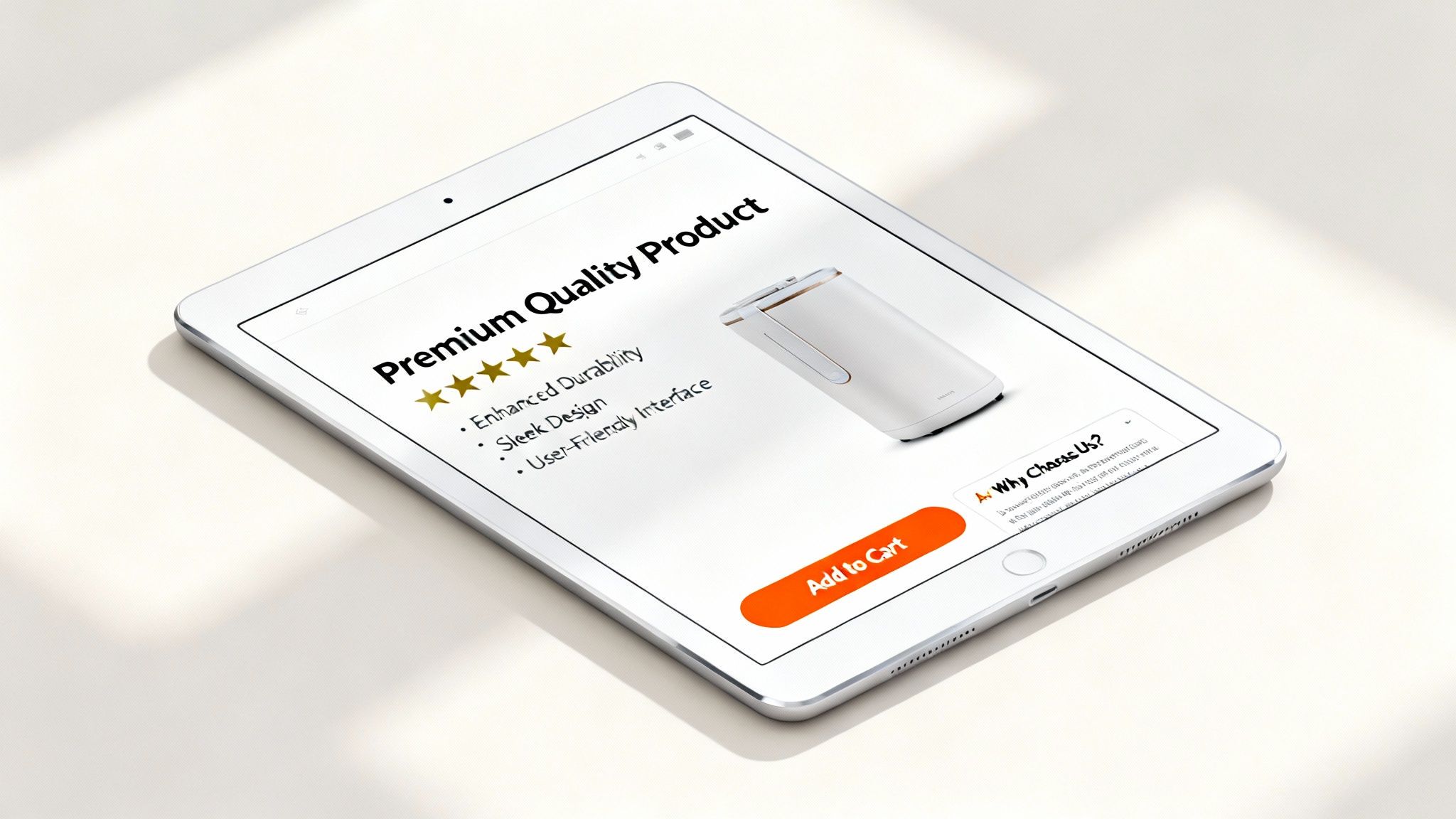
You can drive thousands of clicks to your products, but if your detail page doesn't convert shoppers into customers, you're simply paying for traffic. The connection between your amazon ad campaigns and your product listings is direct and powerful.
Think of it this way: your ad is the invitation to the party; your product page is the party itself. If the party looks unappealing, your guests will leave.
This is a core pillar of our Optimization framework. Improving your conversion rate creates a positive feedback loop across your entire advertising ecosystem. It directly lowers your ACOS, boosts ROAS, and signals to Amazon's algorithm that your product is a winner, which can improve your organic rank. A well-optimized listing turns every ad dollar into a more productive investment.
A "retail-ready" listing contains all the elements a customer needs to answer their questions, build trust, and feel confident clicking "Add to Cart." It is your digital salesperson, working 24/7. To achieve this, focus on these key components.
High-Quality Images and Video: Shoppers can't physically interact with your product, so your visuals must do the heavy lifting. Use a mix of crisp studio shots on a white background, lifestyle images showing the product in use, and infographics highlighting key features. Video is particularly effective for demonstrating functionality or telling a compelling brand story.
A Compelling, Keyword-Rich Title: Your title is often the first thing a shopper reads. It must be clear, descriptive, and include your most important keywords while remaining readable. Include the brand name, key features, material, and quantity to provide essential information at a glance.
Benefit-Driven Bullet Points: Don't just list features; sell the benefits. Instead of saying "10,000 mAh battery," say "Power your phone for a full day on a single charge." Each bullet point should address a customer pain point and present your product as the solution.
Your product listing isn’t just a page; it’s the final step in a customer's journey. Every element, from the title to the last photo, should be engineered to remove friction and build the confidence needed to make a purchase.
Getting these elements right is foundational. For a deeper dive, check out our complete guide on how to optimize Amazon product listings for maximum sales.
Beyond your product page, the ad creative itself is crucial, especially for Sponsored Brands and Sponsored Display. In a crowded feed, generic visuals are ignored. Your creative must be a scroll-stopper that communicates your value proposition in a split second.
Custom Imagery: For Sponsored Brands and Display ads, avoid simply reusing your main product image. Create custom lifestyle shots or graphics that are visually striking and aligned with your ad's headline and targeting.
Video That Captures Attention: The first 3-5 seconds of a video ad are critical. Start with an engaging hook that shows the product in action or highlights its biggest benefit. Keep videos short, design them for sound-off viewing with clear text overlays, and end with a strong call to action.
Brand Consistency: Your ad creative should feel like your brand. Use consistent colors, fonts, and messaging across your ads, product page, and Storefront to build brand recognition and trust.
Ultimately, a commitment to conversion rate optimization strategies is essential for maximizing every click. By treating your listings and ad creatives as integral parts of your campaign strategy, you create a powerful cycle where great ads lead to a great landing page, resulting in higher conversions and more profitable growth.
This is about moving beyond the basics. These advanced strategies for amazon ad campaigns focus on intelligent expansion and continuous improvement. You'll refine targeting, eliminate wasted spend, and create a powerful feedback loop that fuels your growth.
One of the most powerful optimization tactics is keyword harvesting. The process starts with an automatic Sponsored Products campaign, where you let Amazon's algorithm identify new, high-converting search terms for you. Think of this as a discovery tool for finding untapped customer demand.
Once the auto campaign has collected sufficient data, you "harvest" the best-performing customer search terms and move them into a manual campaign. In the manual campaign, you can set precise bids and control your spend far more effectively. This creates a continuous cycle of discovery and optimization that keeps your targeting sharp.
At the same time, you must be strategic with negative keywords. These are terms you instruct Amazon not to show your ads for, preventing you from wasting money on irrelevant clicks.
For example, if you sell premium leather shoes, you would add terms like "cheap" and "vegan" as negative keywords. This simple action prevents your ad from showing to shoppers looking for something you don't offer, instantly improving your ACOS and protecting your budget.
Sponsored Display is your key to reaching shoppers beyond the search results page. Its real strength lies in retargeting—the ability to re-engage customers who viewed your product but did not make a purchase.
These ads can follow shoppers across Amazon and to other websites, keeping your brand top-of-mind and pulling them back into your sales funnel. This is a crucial tactic for growing your brand's footprint and increasing customer lifetime value. The audience data you gather can even inform your marketing efforts off-Amazon, revealing which customer segments respond best to your products.
For brands serious about building a dominant market presence, a deeper dive into how Amazon DSP advertising can unlock even greater growth is the next logical step.
By combining precise keyword management with intelligent retargeting, you transform your ad campaigns from a simple sales tool into a true brand-building engine. These tactics ensure every dollar is working to reach the right customer at the right time, driving both immediate sales and long-term brand equity.
Navigating Amazon advertising can be complex, and it's normal to have questions. This section provides clear, practical answers to some of the most common challenges brands face.
This is the most frequent question, and the honest answer is: it depends on your goals and profit margins. There’s no single "good" ACOS (Advertising Cost of Sale) that fits every product or brand.
While an industry benchmark of 25-40% is often cited, this is just a general guideline.
For a new product launch, a high ACOS—even over 100%—can be a strategic investment. You are paying for data, initial sales velocity, and market visibility. For a mature product, however, the goal shifts to profitability, and you'll want an ACOS that sits comfortably below your profit margin.
The key is to calculate your breakeven ACOS. This is the point at which you are no longer making a profit on ad-driven sales. Knowing this number empowers you to set realistic targets and manage your campaigns with confidence.
It’s frustrating to set up a campaign only to see zero visibility. If your ads aren't getting impressions, it's typically due to one of a few common issues.
First, check if you are winning the Buy Box. If another seller holds the Buy Box for your product, your Sponsored Products ads will not run. This is a non-negotiable requirement from Amazon.
If the Buy Box isn't the problem, investigate these other potential culprits:
Start by systematically checking these factors. Often, a small adjustment to your bids or a quick confirmation that your listing is retail-ready is all it takes to get your ads back on track and in front of shoppers.
Ready to move beyond troubleshooting and start driving measurable growth with your amazon ad campaigns? The team at RedDog Group builds and manages omnichannel advertising strategies that deliver results. Let's Talk Growth.
Leave a comment: