
Published: March 2020 | Last Updated:January 2026
© Copyright 2026, Reddog Consulting Group.

Finding new ways to connect with shoppers online has never felt more urgent for American eCommerce business owners. Social commerce stands apart by merging social media, technology, and real customer behavior into one seamless experience that makes shopping feel natural and interactive. Rather than pushing customers away from their favorite apps, social commerce brings your products right into their everyday scroll, creating new opportunities for brand growth and sales that traditional eCommerce cannot match.
| Point | Details |
|---|---|
| Understanding Social Commerce | Social commerce integrates social media with shopping, allowing seamless transactions without requiring users to leave their favorite platforms. |
| Platform-Specific Strategies | Tailor your approach according to each social platform, focusing on user behavior and unique strengths for optimal engagement. |
| Integration Across Channels | Ensure synchronization of inventory, pricing, and customer data across all platforms to create a unified customer experience. |
| Compliance and Security | Stay informed on regulatory requirements and implement security measures to protect customer data and maintain trust. |
Social commerce is where shopping meets social media, but it’s more than just selling products in Instagram comments. At its core, social commerce integrates social, commercial, technological, and behavioral dimensions to create a shopping experience that feels natural, interactive, and built for how people actually use social platforms today. Rather than forcing customers to leave their favorite apps to make a purchase, social commerce brings the entire transaction into the space where they’re already spending time scrolling, commenting, and engaging with content they care about.
The definition matters because social commerce sits at a unique intersection. It’s not just e-commerce that happens to use social media for marketing. It’s not just social media with a shopping feature bolted on. Instead, it blends consumer behavior, Web 2.0 technologies, artificial intelligence, and genuine social interaction to fundamentally reshape how transactions happen online. When a customer sees a product in a friend’s post, clicks to view it, reads reviews from other users, and completes checkout without ever leaving the app, that’s social commerce working exactly as intended. The term itself emerged around 2005, evolving through phases of social networking sites and virtual communities before becoming the sophisticated, AI-powered sales channel it is today.
For small and medium-sized eCommerce businesses, understanding this distinction is critical. You’re likely already managing multiple sales channels, whether that’s your own website, Amazon, Etsy, or marketplace platforms. Social commerce represents a fundamentally different opportunity because it operates within the customer’s existing social behavior rather than asking them to change their habits to shop. When customers encounter your products while scrolling through Instagram or TikTok, they can evaluate, compare, and purchase within seconds. This reduction in friction points directly impacts conversion rates. The behavioral dimension here cannot be overstated: social commerce works because it respects how modern consumers actually shop, incorporating elements like peer recommendations, user-generated content, and community feedback that traditional e-commerce platforms struggle to replicate authentically.
The core concepts that define social commerce fall into several key areas. First, there’s the social element, which includes genuine peer influence, community interaction, and trust-building through shared experiences rather than corporate messaging. Second, the commercial aspect involves the full transaction lifecycle, from product discovery through payment and fulfillment. Third, technological integration enables seamless shopping features directly within social platforms, including shoppable posts, live shopping events, and in-app checkout. Finally, the behavioral component recognizes that successful social commerce must align with how people naturally interact on these platforms. You can’t force a hard sell in a space designed for connection; instead, social commerce succeeds when products feel like a natural extension of the content users already engage with.
Your strategy needs to account for how social media strategies integrate with overall retail growth across all your channels. This isn’t about abandoning your other sales channels; it’s about recognizing that customers now expect a seamless experience where they can shop from multiple touchpoints throughout their journey. A customer might discover your product on social media, research it on your website, check inventory on Amazon, and ultimately purchase through your DTC platform. Each of these interactions builds toward a sale, and social commerce simply captures sales that might otherwise be lost during the transition between platforms.
Pro tip: Start by identifying which social platforms your target customers actively use and which product categories perform best in visual, social contexts, then test shoppable features on your highest-performing products before rolling out a broader social commerce strategy.
Not all social commerce looks the same. Instagram shoppable posts function completely differently from TikTok Shop, which operates differently from Facebook Marketplace, which differs again from Pinterest’s shopping features. Each platform has evolved its social commerce capabilities in ways that match how users naturally behave on that specific channel. The key distinction lies in understanding that social media platforms emphasize discovery, social influence, and impulsive buying behavior rather than the efficiency and convenience that drive traditional e-commerce platforms like Amazon. This fundamental difference shapes everything about how you should approach each channel.
Instagram remains the dominant player for visually driven social commerce. Its shoppable posts, Stories with product tags, and Instagram Shop feature allow customers to tap directly to product pages without leaving the app. Facebook operates similarly but with stronger emphasis on community pages and group selling, where relationship quality and social support carry more weight than on other platforms. For small and medium-sized businesses, Facebook Marketplace offers lower friction entry into social commerce since many customers already use it for local buying and selling. The difference between Instagram’s global reach and Facebook’s community focus matters: Instagram converts the impulse buyer scrolling through aspirational content, while Facebook captures the customer actively seeking solutions within their local community.

TikTok represents a different beast entirely. The algorithm surfaces products to users who haven’t explicitly followed creators or searched for them, making discovery fundamentally different. TikTok Shop integrates directly with creator content, allowing influencers to showcase products naturally within entertainment rather than as standalone product pages. Users on TikTok are primed for impulse purchases because they’re in a consumption mindset focused on entertainment value. This platform excels when your products work within creator narratives, whether that’s fashion hauls, unboxing videos, or problem-solving demonstrations. For brands selling trending items or targeting younger demographics, TikTok Shop offers unmatched discoverability.
Pinterest operates on intent rather than social connection. Users actively come to the platform to discover products, making it less about social influence and more about aspirational inspiration. Pins act as visual bookmarks that drive traffic to your website or directly to product pages. This platform performs exceptionally well for home decor, fashion, beauty, and DIY products. Unlike Instagram or TikTok where you’re competing with entertainment content, Pinterest users are already in shopping mode, making the conversion journey shorter.
Research shows that different platforms prioritize different quality factors for success. On Amazon, information quality and product specifications drive purchases. On Facebook, relationship quality and community support matter most. On Instagram, visual presentation and influencer credibility carry weight. Understanding these differences prevents the mistake of applying a one-size-fits-all strategy across platforms.
When selecting platforms for your social commerce strategy, consider where your specific customer segments spend time and what shopping mindset they’re in when they arrive. A customer scrolling Instagram is in discovery mode. A customer searching Facebook Marketplace is in problem-solving mode. A TikTok user is in entertainment mode. Your content, product presentation, and messaging need to match each audience’s mental state. Additionally, consider where your competitors operate and where your product category performs best. Luxury items might thrive on Instagram but struggle on TikTok Shop. Trending, price-conscious products might dominate TikTok but underperform on Pinterest. When evaluating which platforms to prioritize, remember that successful ecommerce platform selection depends on matching your business model to your customer behavior.
Most successful small and medium-sized businesses don’t try to excel on every platform simultaneously. Instead, they select two to three platforms where their audience concentrates, master the native features and best practices for each, and expand strategically once they’ve built sustainable sales and operations on their core channels.
Here is a comparison of major social commerce platforms and their ideal use cases for businesses:
| Platform | Best For | Typical User Behavior | Unique Strength |
|---|---|---|---|
| Visual products, impulse buying | Discovery and sharing | Influencer-driven shopping | |
| Community-focused, local selling | Solution-seeking, community | Marketplace and group selling | |
| TikTok | Trendy, youth-oriented items | Entertainment, impulse buying | Algorithmic product discovery |
| Aspirational, DIY, home and decor | Intent-driven product research | Visual bookmarks, high intent |
Pro tip: Start with the platform where your target customers already spend the most time and where your products align naturally with that platform’s content culture, then test your approach with a small product selection before scaling inventory and ad spend.
Social commerce works because it removes friction from the buying journey. Instead of seeing a product on Instagram, clicking a link, waiting for your browser to load a website, navigating to the product page, and completing checkout on a mobile interface that wasn’t designed for phones, customers now tap directly within the app and purchase in seconds. This streamlined experience represents the core mechanic behind social commerce’s explosive growth. The key features powering this transformation include seamless in-app purchasing, influencer partnerships, user-generated content, and social proof mechanisms that make customers trust recommendations from people like themselves rather than corporate messaging.
The transaction flow looks like this: A customer discovers your product through several entry points. They might see it in an influencer’s Instagram post, stumble across it via the platform’s algorithm, find it through a friend’s share, or locate it in a dedicated shop tab. That discovery happens passively while they’re already on the platform. Next comes the critical moment where they engage with the product without friction. They can view multiple photos, read reviews from other customers, check comments where friends have tagged them, and see how many people have liked or saved the item. All of this happens inside the social app, never requiring them to leave.
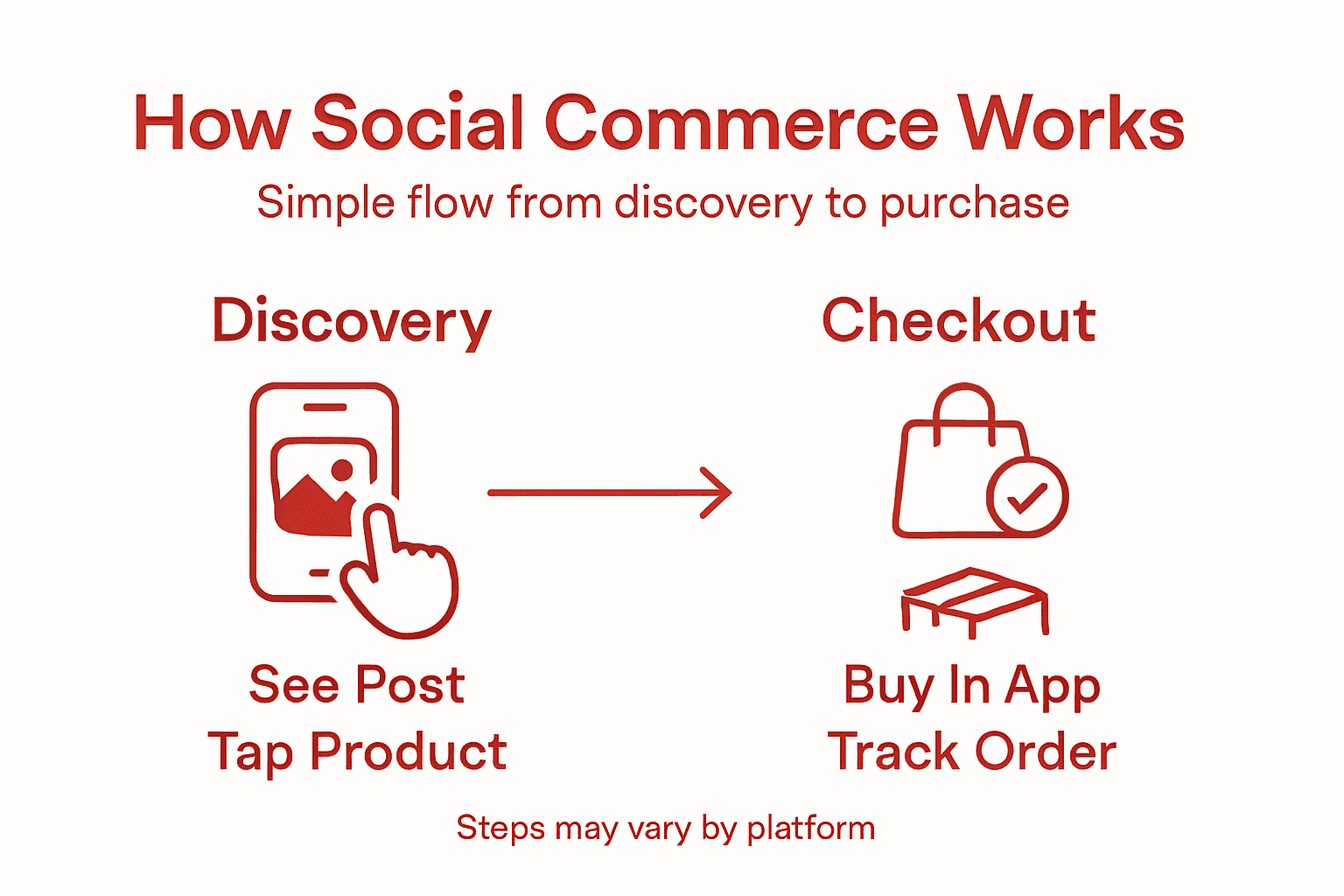
Once they decide to purchase, the checkout experience is minimal. Most platforms now support one-click purchasing for returning customers, with payment information already stored from previous purchases. Shipping address, payment method, and delivery options load automatically. A customer who took fifteen minutes to discover a product might complete the actual purchase in under thirty seconds. This speed and convenience explain why impulse purchases spike dramatically on social commerce platforms compared to traditional e-commerce sites.
After purchase, the social experience continues. Customers receive order confirmations and tracking information through the same app, can share their purchase with followers, and see what others bought. They might post unboxing photos, tag your brand, and create organic content that becomes marketing for you. This post-purchase engagement cycle transforms customers into brand advocates automatically.
Several specific features make social commerce particularly effective. Shoppable posts and stories let customers tap directly on products tagged within content. Live shopping events create urgency and real-time interaction where hosts present products, answer questions, and offer limited-time deals while customers watch and purchase simultaneously. These livestream experiences are particularly powerful because they combine entertainment, real-time engagement, and direct selling in ways traditional retail cannot replicate. User-generated content shows authentic customers using products, which carries more credibility than branded photography. Social proof elements like review counts, star ratings, and comments from friends create trust at the moment of decision.
Influencer integrations function differently on social commerce platforms than traditional sponsored posts. Rather than influencers directing followers to external links, they can offer exclusive discounts, limited products, or first-access opportunities directly within the platform. Followers who purchase through an influencer’s unique link or code feel they’re getting insider access. For your business, this creates measurable attribution: you know exactly which influencer drove which sales.
Personalization powered by AI learns what each user engages with and surfaces products accordingly. Someone who consistently likes minimalist home decor will see your products differently than someone interested in maximalist styles. This personalization extends to recommendations: the algorithm suggests complementary products based on browsing behavior and purchase history across the entire platform.
What makes social commerce particularly valuable for small and medium-sized businesses is the data it generates. Every interaction provides signals: which products get viewed, paused on, scrolled past, or saved. Which price points generate clicks versus purchases. Which product photos drive engagement. Which customer segments respond to which messaging. This information feeds into strategic social media marketing approaches that optimize spend and improve targeting.
Unlike traditional e-commerce where you see purchase data but limited context about the discovery process, social commerce platforms provide visibility into the entire customer journey. You understand not just what sold, but what nearly sold, what captured attention but lost customers, and what resonated across different demographics. This visibility lets you test variations rapidly and optimize in real-time rather than waiting for monthly reports.
Pro tip: Start by setting up shop features on your highest-performing platforms and enabling shoppable posts for your best-selling products, then monitor which product images, price points, and descriptions drive the most clicks before expanding to livestream shopping or influencer partnerships.
Social commerce doesn’t exist in isolation. Your customers don’t think of their shopping experience as separate channels that happen to connect. They think of it as one continuous journey where they expect to move fluidly between platforms without friction or repetition. You discover a product on TikTok, check inventory on your website, read detailed reviews on Amazon, see how friends rated it on Instagram, and ultimately purchase through whichever channel offers the best experience at that moment. For your business, this means creating seamless, personalized experiences across all customer touchpoints including social media, online storefronts, and physical locations to stay competitive. Social commerce isn’t replacing your existing channels; it’s becoming another critical node in a unified system.
Think about what happens when social commerce operates in isolation from your other sales channels. A customer discovers your product on Instagram, purchases it through Instagram Shop, and completes checkout. But what if your inventory system on Amazon shows different stock levels? What if your website displays a different price? What if a customer wants to return the Instagram purchase but your return policy is only documented on your website? These disconnects destroy trust and create operational chaos.
Omnichannel integration means your inventory syncs across all platforms in real-time. A customer buys one unit through social commerce, and that same inventory immediately reflects as sold on your website and Amazon. Pricing stays consistent across channels, preventing confusion and protecting margin. Customer data from social commerce feeds into your broader customer relationship system, so follow-up emails, loyalty program credit, and personalized recommendations feel connected rather than like random messages from different companies.
The practical benefit for small and medium-sized eCommerce businesses is significant. Instead of managing three separate sales operations, you manage one unified operation that happens to have multiple storefronts. Instead of three different customer service queues, you have one consolidated view of each customer’s complete purchase history. Instead of three separate inventory counts that never quite match, you have a single source of truth. This consolidation reduces operational complexity while improving customer experience.
Data synchronization forms the foundation. Your point-of-sale system, eCommerce platform, Amazon integration, social commerce shops, and inventory management all need to communicate constantly. When inventory drops below reorder points, that triggers purchase orders automatically. When a customer is recognized across platforms, their information consolidates into a single profile. When they abandon a cart on Instagram, you can retarget them on Facebook with the exact same product at the same price.
Consistent product information means maintaining a single master catalog that feeds into all channels. Rather than uploading product descriptions, photos, and specifications separately to Instagram, Facebook, TikTok, Amazon, and your website, you maintain one authoritative source that distributes to all channels. Updates happen once and cascade everywhere. This prevents the common problem where your website shows a different product description than your social commerce shop, creating confusion and inconsistency.
Customer data unification recognizes that a person who buys on your website might also follow you on Instagram, purchase through Amazon, and engage with your TikTok content. Rather than treating these as three separate customer profiles, omnichannel systems recognize they’re the same person. This allows you to understand complete customer lifetime value and send appropriately sequenced communications. Someone who buys through social commerce but has browsed your website without purchasing might receive follow-up emails about complementary products they viewed on your site.
Unified customer experience means a customer can start their journey on any channel and complete it on another without friction. They research on your website, add items to a wishlist, see those same items in their Instagram feed, purchase through Instagram, receive order confirmation via email, track the package through SMS, and return items through your website. Each touchpoint recognizes their identity and history.
Implementing omnichannel sales strategies creates competitive advantage by reducing customer acquisition cost and increasing lifetime value. Customers who purchase across multiple channels show significantly higher retention and spend more overall. A customer who buys once through social commerce and once through your website has higher lifetime value than a customer who only buys through one channel.
Start by mapping which customers come from which channels and what they purchase. Do your Instagram customers buy different products than your Amazon customers? Do they have different average order values? Different return rates? This analysis reveals where integration creates the most value. Next, implement real-time inventory synchronization across your top two channels. If managing three channels feels chaotic, focus excellence on two before expanding.
Then address pricing consistency. Promotional pricing should be coordinated across channels, not randomly different. Customer communication should feel like it comes from one brand with one voice, not multiple disconnected entities. Loyalty programs should accumulate points regardless of where the purchase happened.
Pro tip: Begin by synchronizing inventory and pricing across your top-performing social commerce platform and your website, then add Amazon once that integration runs smoothly, focusing on solving real operational problems rather than attempting perfect integration everywhere simultaneously.
Social commerce moves fast. A product goes viral on TikTok, you set up a shop within hours, sales flood in, and everything feels like success. Until you receive a cease-and-desist letter from a customer whose data was compromised. Or the FTC contacts you about misleading influencer disclosures. Or you realize you’ve been storing payment information in ways that violate PCI compliance. Moving quickly without understanding the regulatory landscape creates significant legal and financial exposure. Privacy concerns and inadequate data protection frameworks significantly erode consumer trust and create legal liability in social commerce environments. In the United States, regulatory pressure continues to intensify around data privacy, advertising transparency, and consumer protection, making compliance not optional but foundational.
Customer data is the currency of social commerce. Every purchase, every click, every abandoned cart generates information about shopping behavior, preferences, and personal demographics. This data is valuable for personalization and marketing, but it’s also a liability. United States regulations like the California Consumer Privacy Act (CCPA) and emerging federal privacy legislation grant consumers rights over their data. They can request what you collect, demand deletion, and opt out of data sales. Failure to honor these requests results in fines ranging from thousands to millions of dollars.
Beyond privacy regulations, payment security is non-negotiable. If you’re storing customer payment card information, you must comply with PCI Data Security Standard (PCI DSS) requirements. Many small and medium-sized businesses assume their payment processor handles this, but that’s not always true. If you’re storing card data yourself or using unsecured third-party integrations, you’re personally liable for breaches. A data breach doesn’t just result in regulatory fines; it destroys customer trust and generates expensive notification requirements, credit monitoring services, and potential lawsuits.
The practical risk here is that social commerce platforms often encourage you to build custom integrations and collect more data than you actually need. Your Instagram Shop might have access to customer email addresses, purchase history, and device information. Unless you have explicit consent and a clear privacy policy explaining what you do with this data, you’re operating in a gray area legally.
Influencer partnerships and sponsored content require transparent disclosures. The Federal Trade Commission has clear guidelines: when an influencer promotes your product in exchange for payment or free products, that relationship must be disclosed clearly. Words like sponsored, ad, or paid partnership must appear prominently, not buried in fine print or hashtags. The FTC has levied substantial fines against brands and influencers who fail to disclose these relationships clearly.
Misleading claims represent another minefield. If your product listing claims weight loss results, anti-aging benefits, or medical efficacy without substantiation, you’re violating FTC regulations. Testimonials and user-generated content showing remarkable results can create liability if those results aren’t typical or substantiated. Social commerce platforms make it easy to share customer photos and reviews, but each one carries legal risk if it makes unsupported claims.
Cybersecurity risks and AI-enabled fraud present evolving challenges for organizations managing social commerce. Chargebacks increase significantly on social commerce platforms because the purchase journey is shorter and less authenticated. Fraudsters test stolen payment cards with small purchases, then charge larger amounts once confirmed. Without proper fraud detection, you absorb chargeback losses. Additionally, counterfeit products sold through your platforms or seller networks damage brand reputation and create legal liability.
Another operational risk involves terms of service violations. Each social commerce platform has specific requirements about what you can and cannot sell, how you must represent products, and what customer data you can access. Violating these terms can result in account suspension, loss of inventory, and inability to access customer refund information.
Start by documenting your data collection. What customer information do you collect? Where does it go? Who has access? How long do you retain it? Your privacy policy must answer these questions clearly. Next, review influencer partnerships. Every paid collaboration should include written disclosure requirements and approval processes to ensure compliance appears prominently.
Implement fraud prevention tools that identify suspicious patterns without creating false positives that damage customer experience. Monitor chargebacks carefully and contest inappropriate ones. Consider purchasing cyber liability insurance that covers data breaches and regulatory fines. Finally, stay informed about regulatory changes. Privacy laws continue evolving at both state and federal levels, and what’s compliant today might not be tomorrow.
Understanding retail compliance fundamentals helps you build sustainable operations that protect both your customers and your business. Compliance isn’t about checking boxes; it’s about building trust with customers while protecting yourself from significant financial and legal exposure.
To help navigate compliance, here is a summary of key U.S. legal risks in social commerce and mitigation steps:
| Risk Area | Core Threat | Example Consequence | Key Preventive Measure |
|---|---|---|---|
| Data Privacy | Inadequate user data protection | Regulatory fines, loss of trust | CCPA compliance, clear policies |
| Payment Security | Unsecured payment handling | PCI penalties, customer lawsuits | Use secure processors, audit flows |
| Advertising Disclosures | Insufficient influencer transparency | FTC penalties, reputational damage | Prominent sponsorship disclosures |
| Fraud & Chargebacks | High fraudulent activity | Financial losses, platform bans | Fraud detection, chargeback review |
Pro tip: Document your current data practices, review your privacy policy against CCPA requirements even if you’re outside California (many customers will be subject to these rules), and implement clear influencer disclosure processes before scaling advertising spend.
Social commerce offers an incredible opportunity for small and medium-sized businesses to engage customers where they already spend their time and to convert impulse interest into immediate sales. Yet, navigating the complexities of multiple platforms like Instagram, TikTok, and Facebook requires more than just listing products. Challenges like platform-specific content strategies, seamless inventory synchronization, compliance risks, and leveraging influencer partnerships demand expert guidance. If you want to reduce friction, maximize conversions, and create a truly unified customer experience across social channels and traditional marketplaces, you need a partner who understands the nuances.

Reddog Group specializes in helping brands master omnichannel retailing and social commerce integration to drive measurable growth. With experience managing over 50 brands and tens of thousands of product SKUs, we offer tailored solutions in marketplace management, Amazon FBA, and direct-to-consumer channels that align perfectly with how today’s consumers shop. Whether you need marketing campaign expertise, inventory synchronization, or strategic guidance on social selling innovations, our team delivers proven results that fuel year-over-year revenue increases. Discover how to harness the power of social commerce and build sustainable retail success by visiting Reddog Group. Reach out today and take the first step toward transforming your social channels into powerful sales engines.
Social commerce is the integration of social media and e-commerce, allowing customers to shop directly within social platforms. It provides a seamless experience by combining product discovery, customer engagement, and the entire transaction lifecycle without needing to leave the app used for social interaction.
Unlike traditional e-commerce, which typically relies on independent websites and platforms for transactions, social commerce leverages social media’s interactive nature. It emphasizes peer influence, community feedback, and integrates shopping experiences within platforms where users are already engaged, creating a more natural and less friction-filled purchasing process.
Key features that enhance social commerce conversions include shoppable posts, in-app purchasing options, live shopping events, user-generated content, and social proof mechanisms like reviews and ratings. These features make product engagement intuitive and help build trust among potential buyers.
Adopting social commerce strategies allows businesses to align with modern consumer behaviors and expectations, streamline the buying process, and capture sales opportunities that may be lost through traditional sales channels. This approach can significantly improve conversion rates by respecting how consumers naturally shop and engage with brands online.
Leave a comment: