
Published: March 2020 | Last Updated:March 2026
© Copyright 2026, Reddog Consulting Group.

Growth-stage CPG brands often mistake multichannel presence for true channel integration, leaving millions in potential revenue on the table. You might be selling on Amazon, Walmart, your DTC site, and through wholesale partners, yet still experiencing pricing conflicts, inventory chaos, and margin erosion. Real channel integration unifies these touchpoints into a cohesive, profitable system. This guide walks you through defining integration, preventing conflicts, implementing strategic frameworks, and leveraging technology to transform fragmented channels into a seamless growth engine. You’ll discover actionable tactics to optimize spend, improve customer experience, and scale profitably in 2026.
| Point | Details |
|---|---|
| Channel integration unifies sales channels | Creates consistent brand experience and prevents revenue-draining conflicts across DTC, retail, and wholesale |
| Strategic guardrails prevent cannibalization | MAP policies, pricing parity, and promotional calendars coordinate marketing spend and protect margins |
| Technology enables scalable operations | Unified OMS and AI forecasting optimize inventory allocation and prevent costly overselling |
| Integration drives higher lifetime value | Omnichannel approaches yield 15-25% better LTV compared to siloed multichannel strategies |
Channel integration means the strategic orchestration of your direct-to-consumer, retail marketplace, wholesale, and distribution channels into a unified operational system. It’s not just selling everywhere. It’s ensuring these channels work together under consistent pricing, unified inventory management, and coordinated marketing efforts.
Many founders confuse multichannel presence with integration. You might be on Amazon, Walmart, Target shelves, and running your own Shopify store. That’s multichannel. But if your Amazon listing undercuts your retail price by 15%, you’re creating channel conflict that damages retailer relationships and erodes brand equity.
True channel integration in CPG delivers consistent customer experiences while maximizing profitable sell-through and preventing conflicts. When a customer sees your product at Whole Foods, searches for it on Amazon, and visits your website, they should encounter aligned messaging, comparable pricing, and reliable availability.
Consider what happens without integration:
Strong integration drives better sell-through rates across all channels. Your wholesale partners move product faster when customers already know your brand from DTC marketing. Your Amazon presence builds awareness that converts in physical retail. Each channel amplifies the others rather than competing for the same customer dollar.
For growth-stage CPG brands in the $500K to $20M range, integration becomes essential as you scale. Early-stage brands can manage channel chaos manually. But as you add retailers, expand marketplace presence, and grow DTC, siloed approaches generate compounding inefficiencies that strangle profitability.
Effective channel integration requires clear frameworks and operational guardrails. You can’t just launch everywhere and hope channels cooperate. You need structured role assignment, economic protections, and phased implementation.
Start with the Direct versus Indirect Channel Matrix. This framework assigns each channel a primary role in your customer acquisition and fulfillment strategy. Your DTC site might focus on brand storytelling and customer data collection. Amazon handles convenience-driven purchases and discovery. Wholesale provides geographic reach and credibility. Each channel serves distinct strategic purposes rather than competing for identical customers.
Implement economic guardrails immediately. Minimum Advertised Price policies and pricing parity prevent your channels from undercutting each other. If your suggested retail price is $24.99, your Amazon price should align within a reasonable range, and your DTC site shouldn’t constantly run 40% off sales that make retailers look overpriced.

Promo Tip: Start with unifying inventory and order management systems before adding new channels. Focus on profitable sell-through metrics across existing channels rather than isolated ROAS numbers that ignore channel interactions.
Coordinated promotional calendars prevent cannibalization. If you’re running a major DTC promotion in June, don’t simultaneously flood Amazon with coupons that steal sales from your own higher-margin channel. Sequence promotions strategically so each channel gets dedicated windows to convert customers.
Pilot integrations in controlled markets before full rollouts. Test your unified inventory approach in one region or product line. Measure incrementality carefully. Did adding Walmart.com actually generate new customers, or did it just shift existing Amazon buyers to a lower-margin channel?
The implementation sequence matters:
Leverage technology for operational integration. Order Management Systems provide the single source of truth for inventory. AI-driven demand forecasting improves allocation decisions by predicting channel-specific velocity. When your system knows that Amazon moves 60% of inventory in the first week while wholesale takes 45 days, you can allocate smarter.
Allocation rules become critical as you scale. When supply is constrained, how do you divide limited inventory fairly? Pure revenue maximization might favor Amazon, but strategic thinking considers retailer relationships and long-term channel health. Define allocation policies based on contribution margin, strategic importance, and contractual commitments.
Even with strong frameworks, channel integration faces predictable obstacles. Understanding these challenges helps you build preemptive solutions rather than reacting to crises.
Pricing parity violations create immediate conflicts. A retailer discovers your Amazon price is 20% below their shelf price and threatens delisting. Or worse, Amazon’s algorithm detects you’re cheaper on Walmart.com and suppresses your Buy Box. Strict compliance with your pricing policies is non-negotiable. Monitor all channels weekly and address violations immediately.
Overselling destroys customer trust and generates penalties. Without unified inventory, you might sell the same unit on Amazon, your DTC site, and to a wholesale customer simultaneously. The result is canceled orders, Amazon suspensions, and damaged retailer relationships. Unified inventory systems with real-time updates prevent this disaster.
Siloed data complicates attribution and optimization. Your DTC analytics show Facebook ads driving sales. But you’re missing that many customers discover you on Instagram, research on Amazon, then convert on your website. Without integrated data, you undervalue social channels and over-invest in bottom-funnel tactics. Cross-channel attribution reveals the true customer journey.
High customer acquisition costs in DTC channels squeeze margins as retail competition intensifies. Customer acquisition costs have climbed while retail media networks fragment attention. You can’t just keep spending more on Facebook. Integration helps by using lower-cost channels like retail media to build awareness that converts more efficiently in DTC.
Key challenges to address:
Allocation rules help manage constrained supply fairly. When you can’t fulfill all demand, transparent policies prevent channel conflicts. You might prioritize contractual wholesale commitments first, then allocate remaining inventory based on contribution margin and strategic value.
Pro Tip: Integrate retail media with non-retail channels for full-funnel optimization. Use Amazon Sponsored Products to build awareness, then retarget those audiences on Facebook to drive DTC conversions at lower cost.
Channel conflict often stems from misaligned incentives. If your Amazon team gets bonuses for revenue growth while your wholesale team focuses on retailer relationships, they’ll work against each other. Align compensation around total company profitability and customer lifetime value rather than channel-specific metrics.
Successful initial integration is just the foundation. Sustainable growth requires scalable technology architecture, unified data systems, and organizational structures that support omnichannel thinking.
Composable MACH architecture enables flexible, scalable integration. Microservices let you swap components without rebuilding everything. API-first design connects disparate systems seamlessly. Cloud-native infrastructure scales with demand. Headless commerce separates frontend experiences from backend operations. This flexibility matters as you add channels and test new approaches.
Data unification across sales, marketing, and inventory prevents silos that cripple decision-making. Your marketing team needs to see which channels drive profitable customers, not just clicks. Your inventory team needs demand signals from all channels to forecast accurately. Your finance team needs contribution margin by channel, not just top-line revenue.
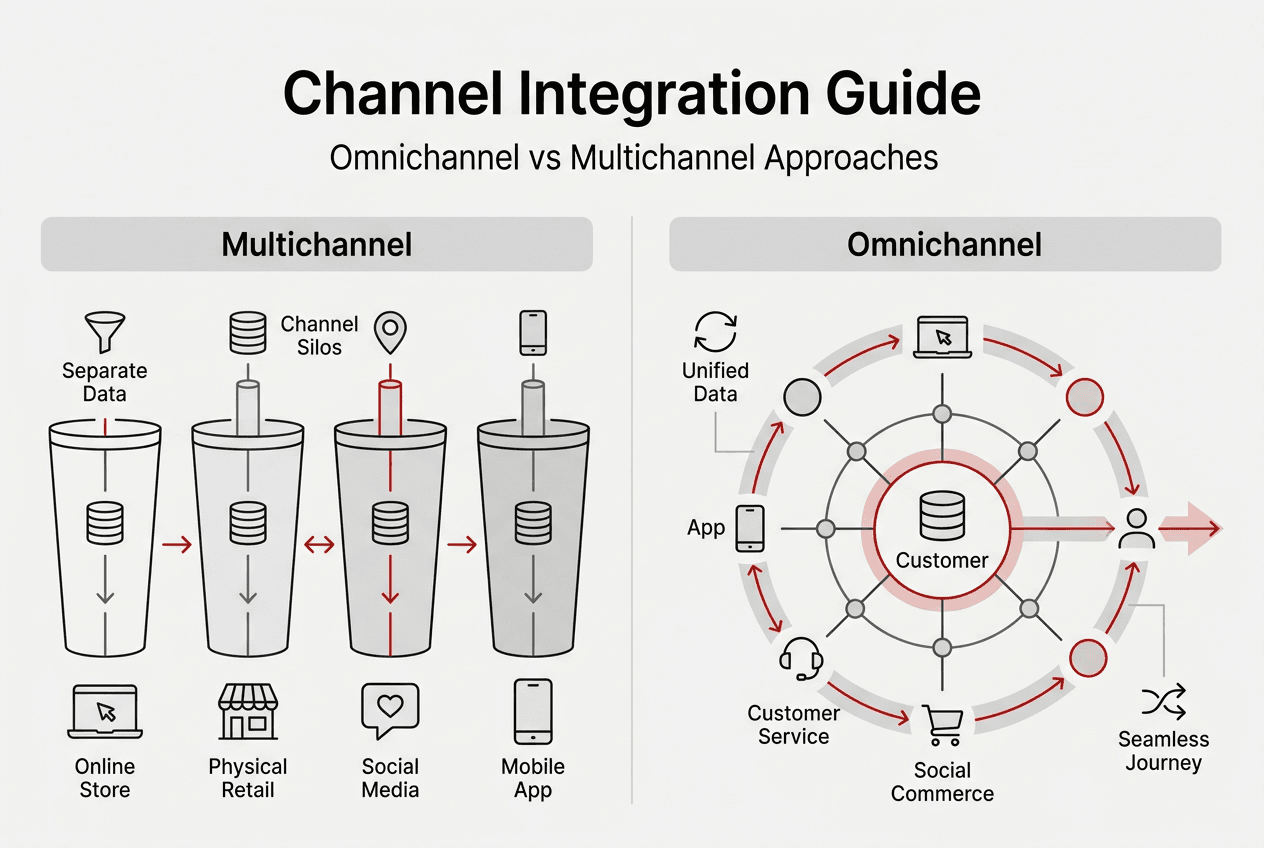
Cross-functional pods break down departmental barriers. Instead of separate teams for Amazon, DTC, and wholesale, create pods responsible for customer segments or product categories across all channels. This structure forces omnichannel thinking and prevents channel teams from optimizing their metrics at the company’s expense.
Integrated omnichannel approaches deliver 15-25% higher customer lifetime value compared to siloed multichannel strategies. Customers who engage across multiple touchpoints spend more and stay loyal longer. But capturing this value requires technology investment and organizational change.
The comparison between multichannel and true integration reveals critical differences:
| Dimension | Multichannel Presence | Omnichannel Integration |
|---|---|---|
| Customer experience | Inconsistent across channels | Seamless and unified |
| Inventory management | Siloed by channel | Unified with real-time visibility |
| Pricing strategy | Independent channel pricing | Coordinated with parity guardrails |
| Data and analytics | Channel-specific reporting | Cross-channel attribution |
| Operational complexity | Lower initial setup | Higher but scalable |
| Technology requirements | Basic channel connections | Unified OMS, AI forecasting, composable architecture |
| Profitability potential | Revenue focused | Margin and LTV optimized |
| Organizational structure | Channel-based teams | Cross-functional pods |
Investment in technology and organizational change is necessary for sustainable profitable scale. You can’t just bolt channels together with spreadsheets and hope. Proper inventory management requires sophisticated systems that track stock across warehouses, 3PLs, Amazon FBA, and retail distribution centers.
Multichannel approaches prioritize reach but risk inconsistency and operational chaos. True integration demands data unification and heavier technology investment, but delivers better customer lifetime value and sustainable margins. The choice isn’t whether to integrate, but how quickly you can build the capabilities to do it well.
Scaling also requires process documentation and training. As your team grows, new hires need to understand channel roles, pricing policies, and allocation rules. Document your integration playbook so knowledge doesn’t live only in founders’ heads.
Continuous optimization separates good integration from great. Monitor channel performance weekly. Test pricing adjustments in one channel and measure cross-channel impact. Experiment with promotional sequencing. Use data-driven approaches to refine allocation rules as you learn which channels drive the most profitable growth.
Navigating channel integration complexity requires specialized expertise. RedDog Group helps growth-stage CPG brands build profitable omnichannel strategies tailored to your specific challenges. We address channel conflict, unify inventory systems, and optimize marketing spend to maximize contribution margin, not just revenue.
Our omnichannel growth consulting focuses on the realities of scaling CPG brands across Amazon, Walmart, DTC, and wholesale. We help you understand what each channel actually contributes to profit and where margin leaks hide. From marketplace economics to retail expansion readiness, our analytical approach delivers measurable results.
Partner with experts who understand both digital marketplaces and physical retail distribution. We’ve helped brands in the $500K to $20M range build scalable retail growth strategies that balance channel expansion with operational clarity. Early engagement prevents costly missteps and accelerates your path to profitable integration.
Multichannel means selling across multiple independent channels like Amazon, retail stores, and your website, but each operates separately. Omnichannel integration unifies these channels into a cohesive system with shared inventory, consistent pricing, and coordinated customer experiences. Integration requires data unification and operational alignment beyond just being present on many platforms.
Implement clear pricing guardrails like MAP and parity policies that prevent channels from undercutting each other. Use promotional calendars to coordinate marketing spend and avoid simultaneous discounts across channels. Pilot integrations in controlled markets before full rollouts to test allocation rules and measure incrementality without risking retailer relationships.
Order Management Systems provide unified inventory visibility and prevent overselling across channels. AI-powered demand forecasting improves allocation decisions by predicting channel-specific velocity and seasonal patterns. Composable MACH architecture enables scalable integrations that adapt as you add new platforms and test different approaches.
Begin by unifying inventory with an effective OMS that shows real-time stock across all channels. Focus on profitable sell-through metrics and contribution margin rather than isolated ROAS numbers that ignore channel interactions. Build cross-functional teams that manage channels collectively rather than in silos, and start small with pilot programs before scaling integration across your entire operation.
Leave a comment: