
Published: March 2020 | Last Updated:May 2026
© Copyright 2026, Reddog Consulting Group.

TL;DR:
- A bloated product assortment often leads to invisible margin erosion across channels.
- Smart brands optimize SKUs by demand, margin, and operational costs tailored to each sales channel.
More SKUs on more shelves sounds like a growth strategy. It isn’t. For CPG founders operating across Amazon, Walmart, DTC, and wholesale channels, a bloated assortment is often the single biggest driver of invisible margin erosion. The brands that scale profitably aren’t the ones with the widest product lines. They’re the ones who know exactly which products belong in which channels and why. This guide breaks down assortment optimization in practical terms, giving you a framework to align your product mix with real channel economics and contribution margin.
| Point | Details |
|---|---|
| Channel-specific focus | Optimizing assortment for each channel is vital to maximize margin and reduce risk. |
| Demand variability matters | Ignoring demand variability can lead to costly inventory and sales mistakes. |
| Hybrid models add complexity | Models like BOPIS require blended strategies to keep inventory and service levels in balance. |
| Frameworks drive clarity | Applying margin-focused frameworks enables repeatable, data-driven assortment decisions. |
Assortment optimization is the strategic process of deciding which products to offer, in which channels, at which quantities, based on demand, margin, and operational cost. It isn’t about carrying fewer products for the sake of simplicity. It’s about making sure every SKU you carry in every channel is pulling its weight financially.
For CPG brands in the $500K to $20M revenue range, this matters enormously. You’re likely managing limited working capital, constrained warehouse capacity, and 3PL relationships that charge by the pallet. Every slow-moving SKU in your Amazon FBA inventory is accumulating storage fees. Every product you push into a Walmart store without accounting for the channel’s cost structure is a margin liability waiting to surface.
The strategic value of getting this right includes:
The research backs this up. Omnichannel demand pooling, when done without accounting for stochastic demand, leads to suboptimal assortments online versus in-store. In plain terms, treating all your channel demand as one unified pool and making assortment decisions from that pooled view will produce the wrong product mix for each individual channel.
Smart brands apply merchandising best practices that account for channel-specific behavior, pricing sensitivity, and fulfillment costs. The goal is alignment between what you sell, where you sell it, and what it actually costs to get it there and keep it in stock.
Building that alignment starts with understanding the distinct demands of each channel. Strong omnichannel merchandising strategies give you the structural thinking to separate those demands clearly rather than averaging them together.
Now that we’ve defined the what and why, it’s critical to surface the unique challenges that multichannel introduces for CPG brands. The mistake most founders make is assuming one optimized assortment strategy can serve all channels equally. It cannot.
Every channel has a distinct demand profile, consumer intent, fulfillment cost, and margin structure. What sells consistently at Walmart may be completely wrong for your DTC store, not because the product is bad, but because the consumer showing up in each place is different, the price expectation is different, and the economics of getting the product there are different.

Here’s a direct comparison of the key variables at play:
| Factor | In-store (brick-and-mortar) | Online (ecommerce) |
|---|---|---|
| Consumer intent | Browsing, impulse, habitual | Search-driven, research-based |
| SKU visibility | Shelf space constrained | Virtually unlimited |
| Demand variability | Regional, seasonal, predictable | High, influenced by ads and algorithms |
| Inventory risk | Overstock penalties, clearance | FBA/WFS storage fees, long-tail SKU waste |
| Returns cost | Lower, in-store handled | Higher, reverse logistics required |
| Margin pressure | Slotting fees, EDLP demands | Fulfillment fees, ad spend per unit |
The BOPIS (buy online, pick up in store) model adds another layer of complexity. Research shows that high demand variability has a dual effect on optimal assortment size, sometimes calling for a broader assortment to buffer against stockouts, and sometimes demanding a tighter one to protect margin. BOPIS blurs traditional channel boundaries, meaning your physical and digital assortment decisions can no longer be made in complete isolation.
“BOPIS blurs traditional channel boundaries, forcing CPG brands to rethink assortment planning as a unified but channel-sensitive exercise rather than separate silos.”
The pitfalls that trap most brands include:
Studying omnichannel retail examples from brands that have navigated this well reveals one consistent theme: they made deliberate, channel-specific assortment decisions early rather than letting channel expansion happen reactively. The brands that plan for this with structured omnichannel strategy types consistently outperform those that treat multichannel as simply “selling the same stuff in more places.”
Given these channel-specific complexities, what does a margin-driven, founder-ready optimization process look like in practice? Here’s a five-step framework built for CPG brands with real operational constraints.
Step 1: Diagnose your current assortment by channel Pull a channel-level SKU report that includes contribution margin, sell-through rate, average inventory holding cost, and return rate. Most founders are shocked to find that their bottom 20% of SKUs by margin represent 40% or more of their inventory investment. You cannot fix what you cannot see.
Step 2: Segment SKUs by demand profile and channel fit Classify each SKU as a core performer, seasonal or tactical, or underperformer. Then overlay channel fit based on fulfillment economics. A high-margin, low-weight product may be ideal for DTC and Amazon FBA. A high-velocity, low-margin product may only make sense in physical retail where your cost per unit to fulfill is lower.
Step 3: Test channel-specific assortments with defined metrics Don’t try to optimize everything at once. Pick your top two channels and run a 60 to 90 day test with a tighter assortment. Set specific KPIs: contribution margin per channel, sell-through velocity, and out-of-stock rate. Track all three.
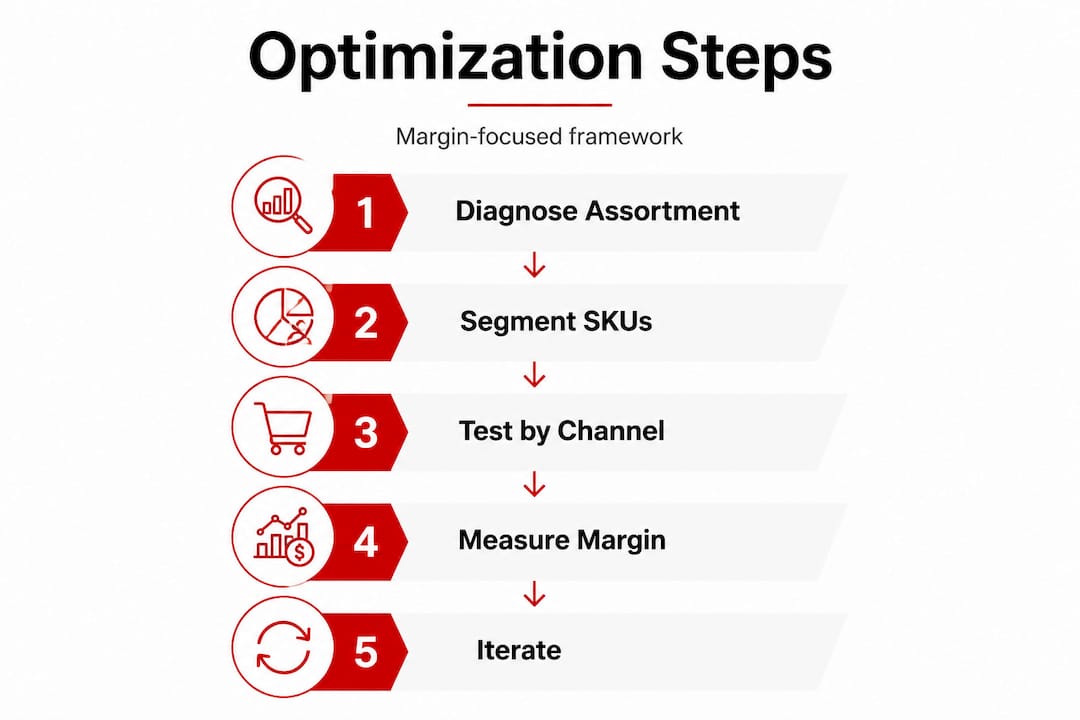
Step 4: Measure the margin impact, not just revenue This is where most brands make the critical error. Revenue goes up when you add SKUs. Margin often goes down. Measure contribution margin per channel, not gross sales, as your primary success indicator.
Step 5: Iterate with demand variability in mind Research confirms that stochastic demand must not be ignored when optimizing assortments for both online and physical stores. Build quarterly review cycles that adjust assortment based on actual demand variability data, not just average sales trends.
Here’s an example of what a SKU segmentation table might look like in practice:
| SKU | Channel | Contribution margin | Demand variability | Recommended action |
|---|---|---|---|---|
| Product A | Amazon FBA | 38% | Low | Keep, expand |
| Product B | Walmart WFS | 14% | High | Review or cut |
| Product C | DTC | 51% | Medium | Invest, scale |
| Product D | Wholesale | 22% | Low | Maintain, no expansion |
| Product E | Amazon FBA | 9% | High | Remove or reprice |
This kind of analysis changes conversations fast. You stop managing SKUs by feel and start managing them by data.
Pro Tip: Don’t skip stochastic demand analysis. Knowing your average sales velocity isn’t enough. You need to understand how much that number swings week over week and plan your assortment depth accordingly. This is the foundation for true channel alignment.
Learning how to start omnichannel sales with this kind of margin discipline from the beginning saves founders from years of course-correcting a portfolio that grew by accident rather than design.
With an actionable plan in hand, it’s crucial to understand the cost of getting it wrong, especially as channels and consumer behaviors intertwine. The financial damage from poor assortment decisions compounds faster than most founders realize.
The major risks include:
Research confirms that ignoring stochastic demand and BOPIS channel blur can lead to substantial assortment misalignment and direct margin loss. This isn’t a theoretical risk. It’s the reason many CPG brands plateau at $2M to $5M in revenue despite strong product-market fit. The product is right. The assortment strategy is broken.
Pro Tip: Set up a simple dashboard that tracks inventory velocity by SKU and channel on a weekly basis. Flag any SKU where the ratio of days of supply to average weekly demand is drifting beyond your target range. Early detection prevents expensive overstock situations and keeps your cash working where it should.
The path forward requires pairing good products with disciplined, data-driven channel placement. Practical guidance on boosting omnichannel sales starts with exactly this kind of margin-first assortment discipline, not broader distribution or more SKUs.
Here’s what we see consistently when working with CPG brands in the $1M to $15M range: their product assortment grew by reaction, not by design. A retailer asked for a new size. A buyer wanted an exclusive. A competitor launched a flavor extension. Over time, the catalog ballooned and nobody ever went back to measure what each addition actually cost in margin, complexity, or operational drag.
Large portfolios are often legacy-driven, not margin-driven. Founders get emotionally attached to SKUs that have a story, the product that launched the brand, the item a loyal customer loves, the variant that got a regional press mention. Cutting them feels like a loss. But carrying them is also a loss, just a slower, quieter one.
What makes this worse is that even brands with access to solid demand data still fail to use it in channel-specific ways. We’ve reviewed dashboards at brands doing $8M to $12M in revenue where total assortment data was being reviewed, but nobody was breaking down demand variability by channel. Everything was averaged together. The online and in-store numbers were blended. The BOPIS effect was invisible.
The costliest assortment errors we’ve seen aren’t the obvious stockouts on hero products. They’re the near-misses: the SKUs that look fine on a total-revenue report but are silently destroying margin in specific channels, the products in Walmart WFS with a 14% contribution margin after fees, the Amazon listings with a high conversion rate but negative profit per unit once FBA fees, ad spend, and returns are factored in.
“The brands we see winning at $10M and above didn’t get there by adding more. They got there by cutting smarter and reallocating toward what actually works.”
What leading founders are doing differently is treating assortment as a living, tested strategy rather than a static catalog. They run 60-day channel tests. They kill underperformers without sentiment. They track contribution margin at the SKU and channel level every single month. And they use ecommerce merchandising best practices not as a checklist but as a feedback loop that informs what stays in the assortment and what gets cut.
This is the shift from founder-mode growth to operator-mode growth. It’s uncomfortable. It’s necessary.
If you want to turn these insights into practical results even faster, here’s where to get expert help.
Assortment optimization is one of the highest-leverage moves a CPG brand can make, but it requires the right analytical foundation and an outside perspective to execute without second-guessing every cut. Most founders are too close to their own catalog to make these decisions cleanly.
At RedDog Group, we work with CPG brands in the $500K to $20M range to build margin-focused assortment strategies across Amazon, Walmart, DTC, and wholesale channels. We dig into your SKU-level contribution margins, map demand variability by channel, and build a clear picture of where your assortment is helping and where it’s quietly draining cash. Our approach is analytical, structured, and built around the operational realities you’re actually facing. When you’re ready to stop guessing and start making data-backed assortment decisions, our CPG retail growth experts are ready to help you move faster and with greater confidence.
The main goal is to maximize revenue and margin by aligning your product mix with channel-specific demand and profitability, since omnichannel demand pooling without accounting for stochastic demand consistently leads to suboptimal assortments across channels.
BOPIS merges in-store and online demand, making it vital to optimize for blended channel effects and avoid misaligned inventories, because BOPIS blurs traditional channel boundaries in ways that standard planning tools don’t capture.
Ignoring demand variability typically leads to overstock, out-of-stocks, and lost margin across channels, as high demand variability can negatively impact optimal assortment size in both directions simultaneously.
Yes, each channel should have a tailored assortment based on its unique demand and margin profile, since suboptimal assortments result directly from ignoring channel-specific demand factors and cost structures.
Leave a comment: