
Published: March 2020 | Last Updated:December 2025
© Copyright 2026, Reddog Consulting Group.

Growing retail sales isn’t about chasing the latest trends. Sustainable growth comes from building an integrated system where your online presence and physical stores work together to elevate the entire customer experience.
The most effective way to achieve this is with a simple, three-part framework that builds on itself:
This methodical approach ensures every move is deliberate and contributes to long-term success, not just a temporary sales spike.
Jumping into a flashy marketing campaign or expensive new technology without a plan is like building a house on sand. Before you can think about scaling, you need a rock-solid foundation.
This first phase is all about diagnosing your retail health. You must know exactly where you stand today to create a smart roadmap for tomorrow. This isn't just about spotting problems; it’s about uncovering your biggest, often hidden, opportunities for growth.
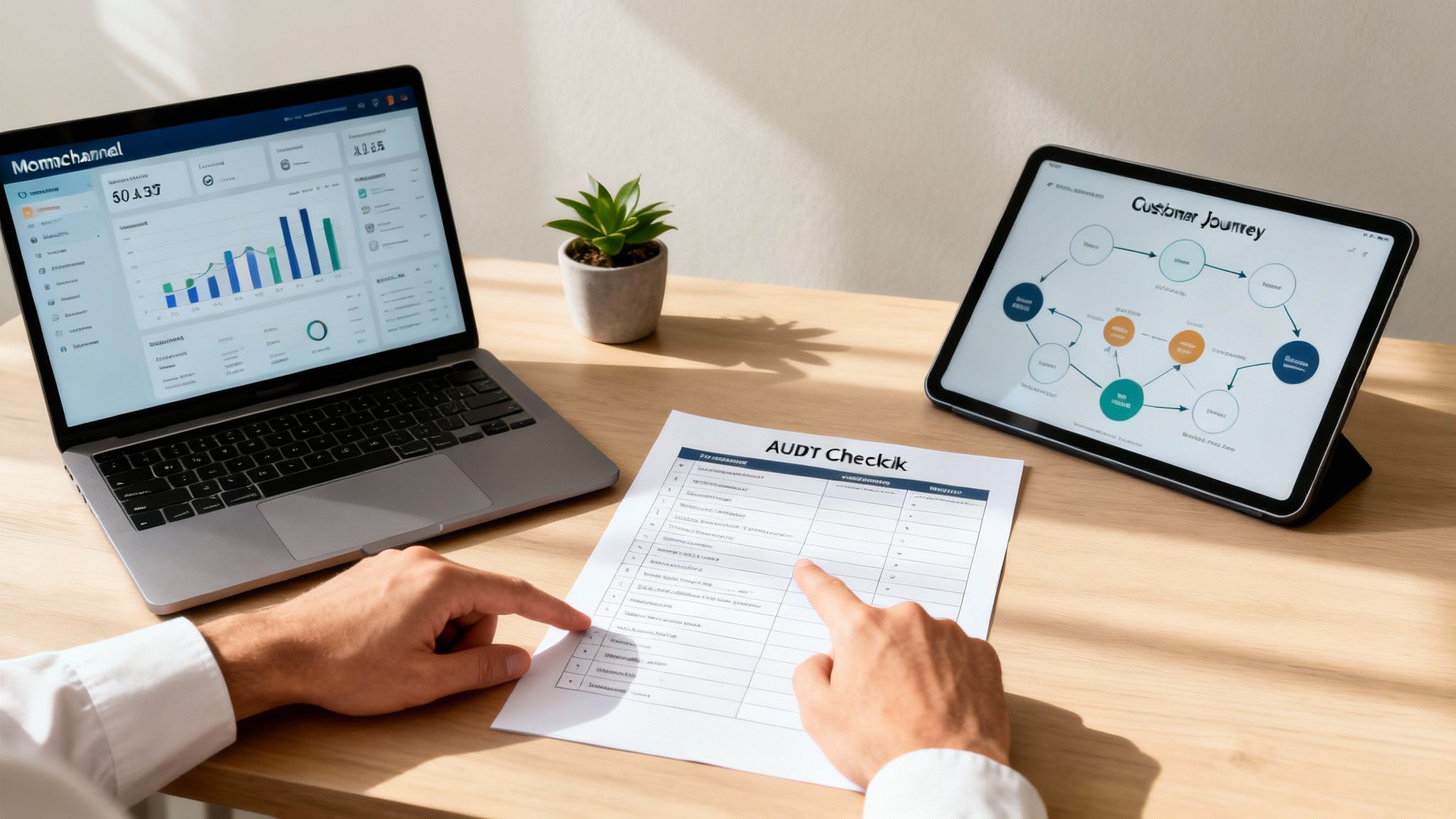
The process kicks off with a comprehensive omnichannel audit. We're not talking about surface-level metrics here. You need to dig deep, map the entire customer journey, and understand how people interact with your brand online versus their actual in-store experience. Where are the friction points causing them to abandon a purchase?
To answer these questions, you need a single, unified view of your business—a core principle of any successful omnichannel retail strategy.
First, get into your data. A deep dive is non-negotiable. You need to analyze sales performance, customer behavior, and operational efficiency across every channel. This diagnostic phase isn't a one-time task; it's an ongoing discipline that keeps your strategy grounded in reality.
Here are the key areas to investigate:
This visual guide breaks down the essential steps for building that strong foundation: Diagnose, Strategize, and Align.
It’s a clear process flow that shows growth is a structured journey, not just a collection of random tactics. You move from deep analysis to getting your entire team on the same page.
To help you get started, this table outlines the core pillars of a healthy retail foundation. Think of these as the must-haves before you move on to more advanced tactics.
| Pillar | Key Objective | Example Metric to Track |
|---|---|---|
| Sales Performance | Understand what's selling, where, and why. | Category sales by channel (online vs. in-store) |
| Customer Journey | Identify how customers interact with your brand across touchpoints. | Cart abandonment rate |
| Operational Efficiency | Ensure back-end processes support a seamless customer experience. | Inventory stock-out rate |
| Digital Presence | Evaluate the effectiveness of your online storefront and marketing. | Website conversion rate |
| In-Store Experience | Assess the physical retail environment and staff performance. | In-store conversion rate or foot traffic |
Getting these pillars right creates the stability you need to build a truly scalable retail operation.
Once you have a clear diagnosis, you can set realistic growth targets and build a plan that makes sense. Your roadmap should directly connect your findings to concrete actions.
For instance, if your audit uncovers poor online conversion rates, your strategy should focus on optimizing your product detail pages before you pour more money into paid ads. It's a simple, logical progression.
A goal without a plan is just a wish. Your diagnostic audit provides the data-driven insights needed to turn growth aspirations into an actionable, step-by-step strategy that aligns your entire team.
The opportunity is massive. The global retail market is projected to hit $31.3 trillion in 2025. Here in the U.S., sales are expected to reach $7.45 trillion, with the average American consumer spending over $21,000 each year. This underscores just how critical a sharp omnichannel approach is to claim your piece of the market.
To lay the groundwork for boosting revenue and keeping customers coming back, it's worth exploring these proven strategies for building customer loyalty and growing your business.
With a solid data foundation, it’s time to refine every customer touchpoint. This is the Optimization phase, where we use data-informed insights to improve both your digital and physical shelves. The goal is to create a shopping experience that is seamless, compelling, and consistent.
This is about ensuring your products are presented perfectly, priced correctly, and placed exactly where your customers expect to find them.
Whether someone is scrolling on their phone or walking down a store aisle, this is the moment you win or lose the sale. Seemingly small optimizations here compound over time, turning casual browsers into buyers and one-time purchasers into loyal advocates.
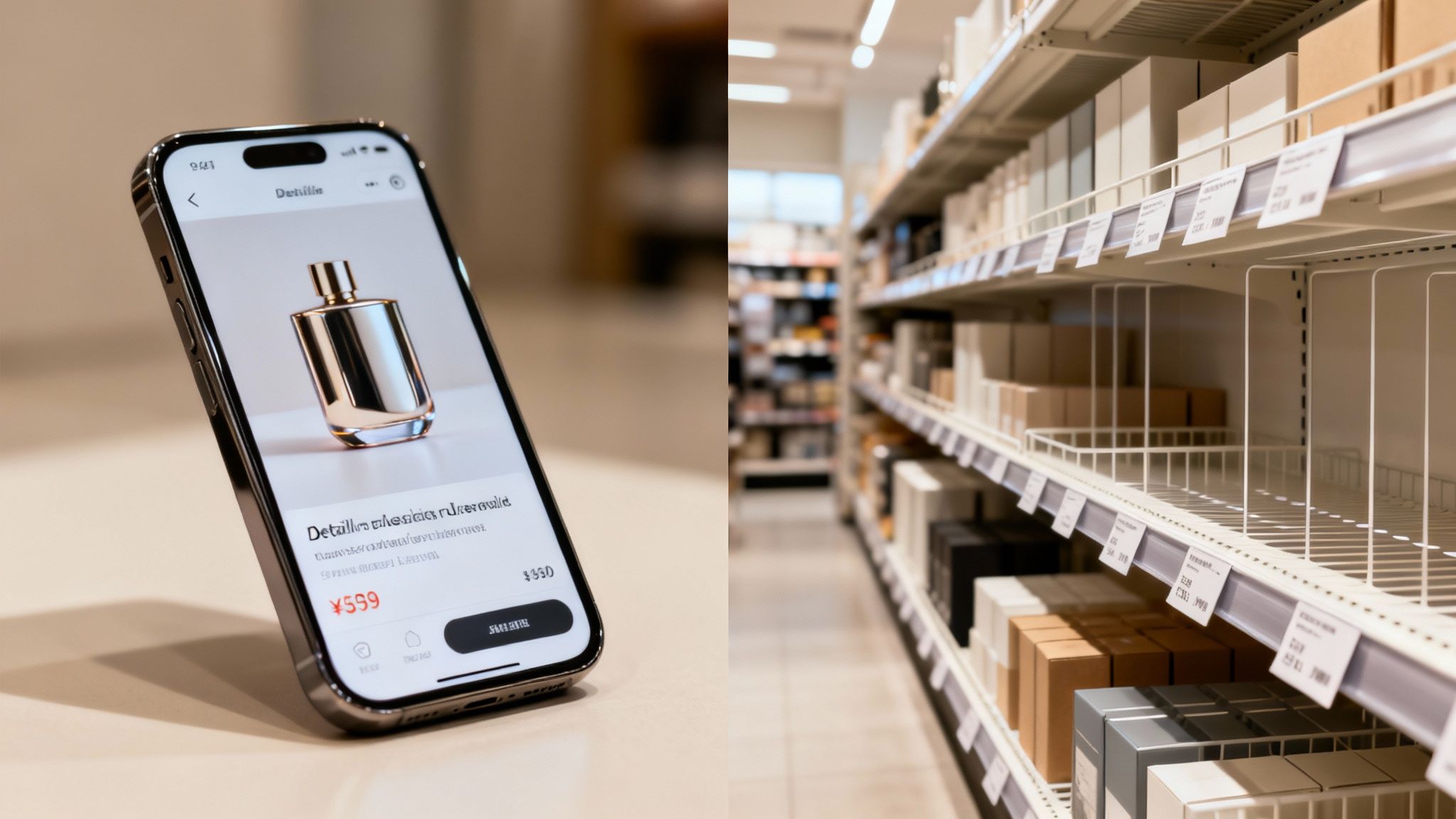
Think of your product detail pages (PDPs) as your 24/7 online salespeople. A bland, uninspired PDP is the digital equivalent of a disengaged employee on the sales floor—and it’s costing you sales. To grow retail sales in an omnichannel world, your digital shelf needs to be as meticulously managed as your physical one.
The numbers are staggering. Global online retail sales are on track to hit $7.4 trillion in 2025, making up nearly a quarter of all retail spending. With over 2.77 billion people expected to shop online, a weak digital presence is no longer an option.
Here’s how to transform your PDPs from basic listings into powerful conversion engines:
Your digital shelf is where modern merchandising comes alive. It’s a dynamic space where data on customer behavior, conversion rates, and on-page engagement should inform every decision you make about product presentation.
Understanding the role of merchandising in ecommerce is key. It's about using the digital space to guide customer discovery and drive purchases, just as a well-designed planogram does in a brick-and-mortar store.
While digital is critical, the in-store experience is still a massive driver of sales and brand loyalty. Effective visual merchandising isn’t just about making your store look pretty; it's a science designed to influence how customers move, increase basket size, and shine a spotlight on your most profitable products.
Imagine the path a customer takes through your store. Is it logical? Are your best-sellers or high-margin items placed in high-traffic zones? This is where planograms—detailed diagrams of product placement—become invaluable.
To get the most out of your physical space, you need to implement essential visual merchandising guidelines to boost sales. This covers everything from window displays that stop people in their tracks to in-store signage that clearly communicates promotions and guides shoppers.
The final piece of optimization is ensuring you have the right products at the right price, consistently across every channel. Nothing erodes trust faster than a disjointed strategy where prices or promotions differ wildly between your website and your store. It just creates confusion and frustration.
Here's how to get your assortment and pricing aligned:
By systematically optimizing these elements, you create an environment where shopping is easier and more enjoyable for your customers, which translates directly to measurable, sustainable growth.
You've built a solid foundation and your digital shelves are primed for conversion. Now it's time to drive high-intent traffic. This is the Amplification pillar, where we strategically use paid ads and the powerhouse of retail media networks (RMNs) to put your products in front of the right shoppers at the exact moment they’re ready to buy.
This is about precision. The goal isn't just to generate awareness; it's to drive profitable sales. A smart media strategy blends platforms like Google and Meta with the booming ecosystem of RMNs, creating a powerful feedback loop that lifts sales across every channel.
This approach ensures every ad dollar works as hard as possible to grow your retail sales, delivering a return you can actually measure.
For years, Google and Meta (Facebook/Instagram) have been the titans of digital advertising for good reason. Their reach and targeting capabilities are incredible. But the sharpest strategies today don't treat them as separate channels; they weave them into a larger omnichannel plan.
Here’s how to think about their roles:
The magic happens when you connect these dots. A customer might see your brand in an Instagram story, search for it later on Google, and finally buy it from a retail partner. Understanding that entire journey is the key to spending your budget wisely.
Retail Media Networks (RMNs) represent one of the biggest shifts in digital advertising in the last decade. Platforms like Amazon Ads, Walmart Connect, and Target's Roundel let you advertise directly on retailer sites and apps, reaching shoppers at the digital point of sale.
This isn’t just another channel—it’s a game-changer. These platforms provide access to invaluable first-party shopper data. You're no longer guessing what people might want; you're targeting them based on what they actually buy.
Retail media turns a retailer's digital real estate into a high-margin revenue stream and gives brands an unparalleled opportunity to influence purchasing decisions on the digital shelf. It’s a win-win that has reshaped the path to purchase.
Tapping into retail media has become essential for growth. In 2024, Amazon's ad business generated $56.2 billion, making it more profitable than its core e-commerce operations. This signals how monetizing shelf space and shopper data drives revenue, creating a blueprint for other retailers.
Choosing the right RMN depends on your product, customer, and goals. Each network has unique strengths and excels in different areas.
| Retail Media Network | Primary Audience | Key Strength | Best For |
|---|---|---|---|
| Amazon Ads | High-intent shoppers ready to buy | Unmatched first-party purchase data & scale | Brands seeking high conversion rates and market share dominance |
| Walmart Connect | Value-conscious, omnichannel shoppers | Massive in-store and online customer base | CPG brands and products appealing to a broad, family-oriented demographic |
| Target (Roundel) | Brand-loyal, trend-conscious shoppers (millennials) | Strong brand affinity and guest loyalty data | Brands in home goods, apparel, and beauty targeting a specific lifestyle |
| Instacart Ads | Convenience-focused grocery shoppers | Point-of-purchase influence for CPG items | Food, beverage, and household brands looking to win the weekly shop |
This is just a starting point. The best approach is often a diversified one, allocating budget based on performance and your specific campaign objectives. Test and learn which networks deliver the best results for your brand.
A winning amplification strategy makes these channels work together. For instance, you can use insights from your Amazon Ads campaigns to sharpen your Google keyword strategy. If a certain search term is converting well on Amazon, it's likely worth doubling down on in your Google Ads.
Our guide on Amazon advertising management provides a deeper look into mastering that ecosystem for maximum return.
Your budget shouldn't be set in stone. Be fluid. A data-first mindset means you shift money to the channels and campaigns delivering the best Return on Ad Spend (ROAS). If a Meta campaign is driving significant traffic to a new product, increase its budget to capitalize on the momentum.
Finally, remember that creative is king. All the fancy targeting in the world won’t save a boring ad. Your creative needs to fit the platform—a slick video for YouTube, a thumb-stopping image for Instagram, and a clean, product-focused asset for a sponsored ad on Walmart. Test everything relentlessly: visuals, headlines, calls-to-action. This constant cycle of testing and learning separates a good ad strategy from a great one.
With your channels optimized, it’s time to give customers a compelling reason to buy now. This is where smart promotions come in. Think of them as the accelerator for your growth engine.
Promotions aren't just about slashing prices. They are precise tools designed to influence specific behaviors—whether that’s clearing out old inventory, driving traffic during a slow month, or generating excitement for a new launch. The goal is to create urgency without destroying your margins. It’s a delicate balance, but when done right, promotions drive incremental sales you wouldn’t have captured otherwise.
A poorly planned promotion can do more harm than good, attracting one-time bargain hunters or training loyal customers to always wait for a discount. To grow retail sales sustainably, your promotional strategy must be thoughtful and data-driven.
Every campaign needs a clear objective. Are you trying to increase your average order value (AOV)? Or do you need to boost a new product launch? The goal dictates the promotion.
Here are a few proven promotional mechanics and when they work best:
Smart promotions are less about the discount itself and more about the customer behavior you’re trying to encourage. Align the mechanic with a specific business goal to ensure your campaign adds to your bottom line instead of just giving away margin.
Always use your past sales data to plan ahead. If sales dipped last September, it makes strategic sense to plan a "back-to-school" or "end-of-summer" event. This data-first approach transforms promotions from a reactive tactic into a proactive growth strategy.
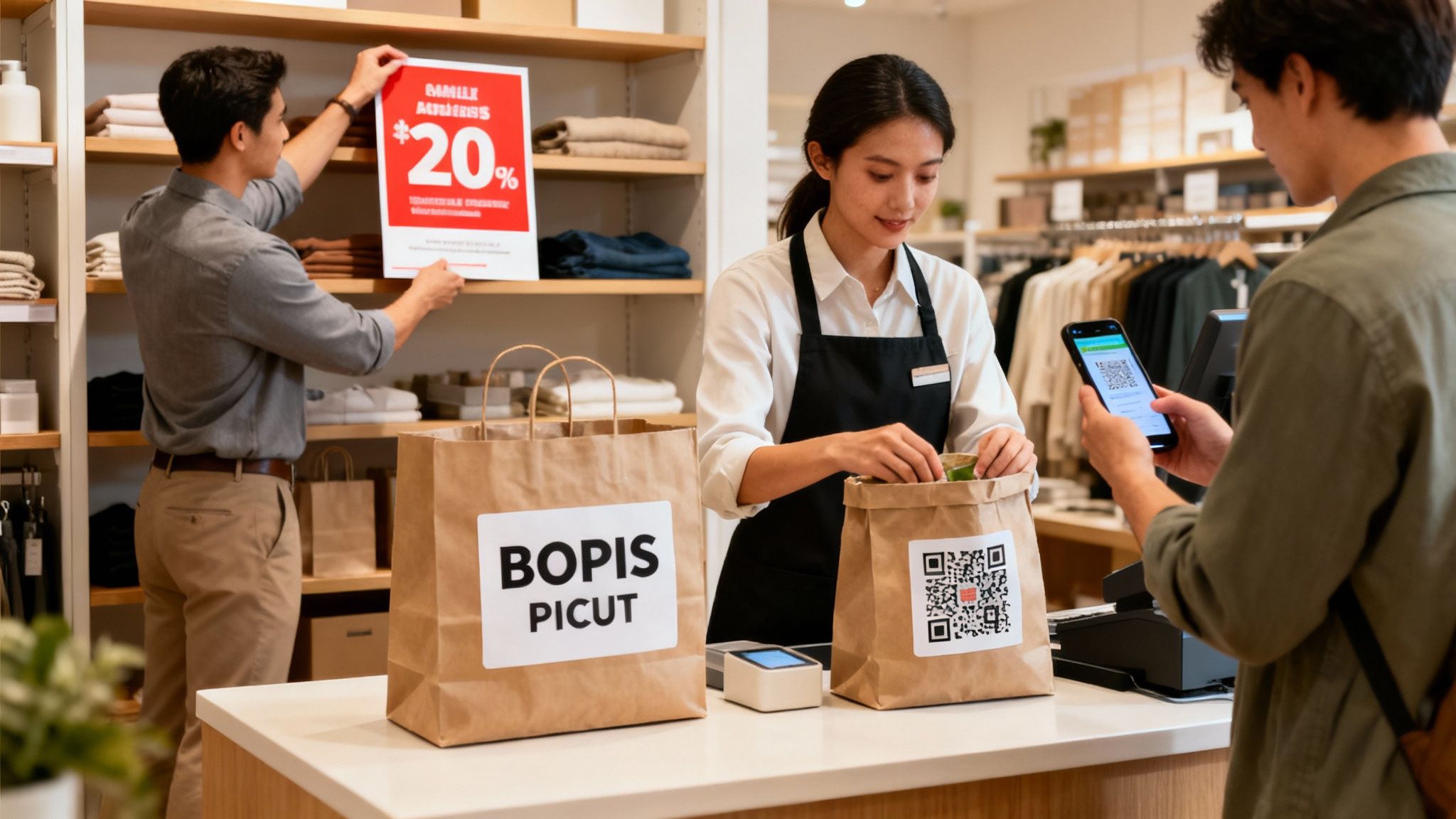
A brilliant digital promotion falls apart if the in-store experience is a mess. This is where your omnichannel strategy meets the real world, and flawless execution is non-negotiable, especially for services like BOPIS (Buy Online, Pick-up In-Store).
When a customer buys online and heads to your store for pickup, that experience has to be seamless. If they encounter confused staff, long waits, or discover their item isn't actually in stock, you've likely lost them for good.
Getting the tactical details right is just as important as the promotion's design. Use this checklist to bridge the gap between your online campaigns and on-the-ground reality:
By connecting your promotional strategy directly to your operational execution, you create a reliable, positive experience that builds trust and turns one-time promotional buyers into long-term, loyal fans.
You’ve built your foundation, optimized your shelves, and amplified your reach. Now comes the part that ties it all together: measurement. Without a smart way to track what’s working, growth is just guesswork. You can’t grow what you don’t measure.
This final stage creates a self-sustaining loop of continuous improvement. The insights you gather here feed directly back into your strategy, making your entire operation smarter with every sale. It’s how you turn data into your most valuable asset.
The goal is to move past surface-level numbers and focus on the metrics that truly signal the health of your retail business.
It’s easy to get distracted by numbers that look impressive but don't actually tell you much. Big follower counts or high website traffic are nice, but they don't pay the bills. To truly grow retail sales, you need to track Key Performance Indicators (KPIs) that connect directly to profitability and customer value.
These are the metrics that provide real intelligence, telling you not just what happened, but why. They reveal the true performance of your omnichannel strategy.
Here are a few non-negotiable KPIs that should be on every retailer's dashboard:
Shifting your focus from vanity metrics like 'likes' to business-critical KPIs like CLV is the difference between running a social media account and running a profitable retail operation. One feels good, the other fuels growth.
The most successful retailers are relentless learners. They treat their business like a laboratory, constantly running experiments to find what works best. This culture of testing and iteration is what separates the brands that thrive from those that just get by.
Testing isn't just for your website; it's a mindset that applies to every channel. The idea is to make small, controlled changes, measure the results, and then double down on what works.
This process removes ego and guesswork from decision-making. The data tells you what to do next.
A structured testing plan prevents you from making random, ineffective changes. It ensures you’re learning something valuable from every experiment, win or lose.
Here's a simple framework to get you started:
This continuous loop of measuring, testing, and refining closes the loop on our growth framework. The insights you gain here become the foundation for your next round of optimizations, ensuring your strategy is always evolving and improving. This is how you build a resilient retail business that’s always learning and growing.
Navigating omnichannel growth often brings up similar questions for brands. Let's tackle some of the most common ones we hear with straightforward, practical answers.
Think of this as a quick reference for applying the Foundation, Optimization, and Amplification principles to your business.
The most critical first step is a full omnichannel audit to build your Foundation. Before spending a dime on new marketing or technology, you have to get an honest assessment of where you stand right now, across every channel.
This means digging into your sales data, mapping how a customer moves between your website and stores, and identifying the operational friction points holding you back. This foundational work prevents you from wasting money on the wrong problems and ensures every dollar you spend is aimed at a real opportunity.
For example, you might think you have a traffic problem, but an audit reveals your online cart abandonment rate is sky-high because of a clunky checkout process. No amount of advertising can fix that; only a foundational diagnosis will.
This is the central challenge of omnichannel: connecting digital clicks to in-store purchases. The solution is to look at the entire customer journey instead of getting stuck on channel-specific metrics.
A few proven strategies that work:
True omnichannel measurement requires integrated data systems. The payoff is a complete picture of your marketing ROI where you can see exactly how a Facebook ad or Google search led to an in-store sale.
Not anymore. While large brands are spending heavily, retail media networks (RMNs) like Amazon Ads and Walmart Connect have become much more accessible for small and mid-sized businesses. Most offer self-service platforms with flexible, pay-as-you-go pricing.
The key for smaller brands is to be strategic. Instead of competing on broad, expensive keywords, you can win by targeting niche product categories and long-tail keywords where competition is lower. A laser focus on profitability and a solid Return on Ad Spend (ROAS) can turn retail media into a powerful growth engine, regardless of your size.
At RedDog Group, we specialize in building integrated growth systems that connect every part of your business. We move beyond generic advice to build data-driven strategies that deliver measurable results.
Ready to stop guessing and start growing? Let’s Talk Growth.
Leave a comment: