
Published: March 2020 | Last Updated:April 2026
© Copyright 2026, Reddog Consulting Group.

TL;DR:
- Proper assessment and strategic planning are essential before scaling marketplace channels.
- Choosing the right channel strategy depends on operational readiness and revenue milestones.
- Continuous data integration and iterative troubleshooting are key to sustained marketplace growth.
Brands in the $500K to $20M revenue range sit in a uniquely powerful position: big enough to compete, small enough to move fast. The challenge is that scaling a marketplace business without a structured plan often leads to margin erosion, fulfillment chaos, and wasted ad spend before any real traction appears. Done right, though, the payoff is significant. Data-driven collaboration between CPG brands and retail partners can generate 45% higher promotional ROI and a 10% lift in sales through smarter use of point-of-sale data. This guide walks you through every critical step, from readiness assessment to funding to continuous iteration, so you can scale with confidence and protect your margins along the way.
| Point | Details |
|---|---|
| Set structured goals | Use revenue and operational benchmarks to guide your marketplace scaling plan. |
| Pick the right channel mix | Choosing between single, hybrid, or multi-channel approaches defines risk and opportunity. |
| Integrate data for growth | Real-time data sharing drives higher promo ROI and sales, reducing scaling friction. |
| Secure smart funding | Right-size your capital strategy for each growth milestone to avoid dilution or stalls. |
| Continually measure and adapt | Ongoing troubleshooting and data-driven iteration fuel long-term marketplace acceleration. |
Scaling without a readiness check is like adding lanes to a highway that already has a broken bridge. Before you expand to new third-party marketplaces for CPG, you need an honest look at where your operation actually stands today.
Start with three core benchmarks: revenue stability, operational capacity, and fulfillment readiness. Revenue stability means you have at least 6 months of consistent sales data, not just a few strong months. Operational capacity means your team can absorb a 2x to 3x order volume increase without collapsing. Fulfillment readiness means your 3PL relationships, inventory lead times, and reorder cycles are documented and reliable.
| Readiness factor | Early stage (not ready) | Growth stage (ready to scale) |
|---|---|---|
| Monthly revenue | Under $40K | $80K+ consistently |
| Inventory accuracy | Manual, spreadsheet-based | System-synced, 95%+ accuracy |
| Fulfillment lead time | 5+ days to ship | 1 to 2 days to ship |
| Channel data visibility | Fragmented or delayed | Real-time or near real-time |
| Working capital buffer | Less than 30 days | 60 to 90 days on hand |
Once you know where you stand, set milestones that are specific and time-bound. Vague goals like “grow on Amazon” don’t work. Instead, define targets like “reach $150K monthly Amazon revenue by Q3 with a contribution margin above 28%.” That kind of specificity lets you measure progress and spot drift early.
Gaps in operations, tech, or product mix show up fast when you apply this framework. A brand might have strong revenue but no inventory sync between their 3PL and Amazon Seller Central. Another might have great fulfillment but zero clarity on which SKUs are actually profitable after fees. Both are scaling risks. Scaling with technology is not just about adding software. It means identifying the specific operational gaps that technology can close before you try to grow through them.
On the capital side, growth equity options become relevant once you have DTC traction. Growth equity typically targets brands in the $5M to $50M range, while revenue-based financing (RBF) suits brands generating $100K or more per month and want to avoid equity dilution, with RBF typically available in the $500K to $5M range.
Key gaps to surface before scaling:
Pro Tip: Run a one-week “scale simulation” by manually projecting what happens to your operation if orders double next month. Where does it break? That’s your first constraint to fix.
With clear goals set, the next key decision is choosing the optimal channel strategy for your brand’s scale journey. This choice shapes everything from your tech stack to your team structure to your cash flow timing.
The three main approaches each carry distinct trade-offs:
| Strategy | Best for | Key advantage | Key risk |
|---|---|---|---|
| Single marketplace (e.g., Amazon) | Early-stage brands under $2M | Deep focus, lower complexity | Platform dependency |
| Hybrid (DTC + one marketplace) | Brands at $1M to $5M | Customer data ownership + reach | Dual fulfillment complexity |
| Multi-channel (Amazon, Walmart, DTC, wholesale) | Brands above $5M | Diversified revenue, broader reach | High operational overhead |
The single marketplace approach is underrated for brands that haven’t yet mastered one channel. Going deep on Amazon before adding Walmart or a DTC store often produces better margins and faster learning. The temptation to be everywhere at once is real, but spreading thin across channels before you have operational and data infrastructure in place is one of the most common scaling mistakes we see.
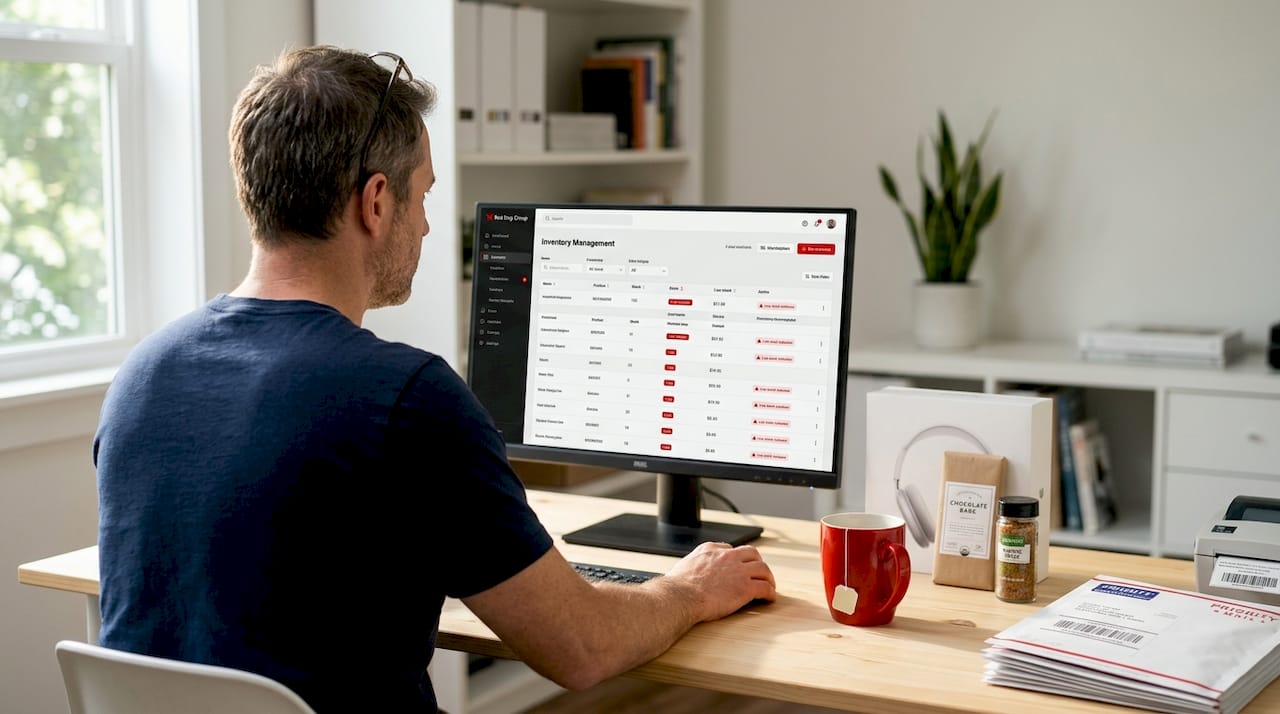
The hybrid model works well when you have a loyal customer base and want to own the relationship. DTC gives you first-party data and higher margins on select SKUs. Pairing it with one strong marketplace gives you discovery and volume. The key is making sure your pricing strategy is consistent across channels. Price gaps between Amazon and your own site create arbitrage problems and erode brand trust.
Multi-channel is the right move once you have the systems to support it. Marketplace expansion strategies that work at scale require synchronized inventory, consistent content, and clear channel-specific margin targets. Without those, multi-channel just multiplies your problems.
Multi-vendor marketplace development is a real infrastructure investment. Don’t underestimate the technical and operational lift of adding a new channel, especially if your current stack isn’t built for it.
Pro Tip: Before adding Walmart to your channel mix, verify that your Amazon listings are fully optimized and profitable. Walmart WFS margins are tighter, and the operational demands are similar. If Amazon isn’t working well, Walmart won’t fix it.
Once your channel path is chosen, operational scalability relies on robust data and technology. This is where a lot of growth-stage CPG brands hit a wall they didn’t see coming.
The core problem is fragmentation. Inventory data lives in one system. Order data lives in another. Ad performance data is in a spreadsheet. Promo results are buried in a retailer portal you check once a month. None of these systems talk to each other in real time, so decisions get made on stale data or gut instinct.
“Brands that share granular POS data with retail partners see 45% higher promo ROI and a 10% lift in sales. The difference is real-time visibility, not just more data.”
The role of data in marketplace growth is not abstract. It shows up in concrete decisions: which SKUs to promote, when to reorder, where to cut ad spend, and how to negotiate with retail partners. Without clean, connected data, those decisions are guesses.
Essential tech stack components for scaling CPG marketplace operations:
Brittle ETL (extract-transform-load) integrations are a specific and underappreciated risk. These are the custom-built data pipelines that connect your systems, and they break constantly. A software update on one platform can silently corrupt your inventory counts or delay order routing for days before anyone notices. Digital scalability strategies for operators at this stage increasingly favor modern data sharing approaches like Delta Sharing, which allow real-time data access without fragile point-to-point integrations.
The practical fix is to audit your current integrations quarterly. Ask: what breaks when one of our platforms updates? What data is more than 24 hours old? Where are we making decisions without real-time visibility? Each answer points to a specific tech investment that pays for itself in avoided errors and faster decisions.
With operational foundation set, securing capital becomes the next lever for rapid but controlled growth. The mistake most founders make is waiting too long to think about funding, then scrambling for capital at the worst possible moment, usually when inventory is low and growth is stalling.
The right funding approach depends entirely on where you are in the revenue curve. Here’s a practical sequence:
“The brands that secure capital on the best terms are the ones that don’t need it urgently. Build your data room before you need funding, not after.”
What investors and financiers want to see:
Warning signs of under-capitalization are easy to miss until they’re urgent. If you’re regularly stocking out of top-selling SKUs, declining purchase orders because you can’t fund the inventory, or running promotions you can’t fulfill, those are signals that working capital is the binding constraint on your growth. Address it before it becomes a crisis.
Pro Tip: Build a 13-week cash flow forecast and update it every week. This single habit gives you 90 days of early warning on capital gaps and makes you dramatically more credible to any funding source.
Scaling doesn’t end at launch. Here’s how to make sure your marketplace business keeps accelerating and never stalls.
The most effective measurement cadence combines weekly operational metrics with monthly strategic reviews. Weekly, you’re watching inventory levels, order fill rates, ad spend efficiency, and listing health scores. Monthly, you’re reviewing contribution margin by channel, promo performance against targets, and progress toward your revenue milestones.
| Metric | Review frequency | Warning threshold |
|---|---|---|
| Inventory days on hand | Weekly | Below 21 days |
| Order fill rate | Weekly | Below 95% |
| Contribution margin by channel | Monthly | Below 25% |
| Promo ROI vs. target | Monthly | Below 30% of target |
| Listing health score (Amazon) | Weekly | Any suppressed listings |
| Ad spend ROAS by SKU | Weekly | Below channel floor |
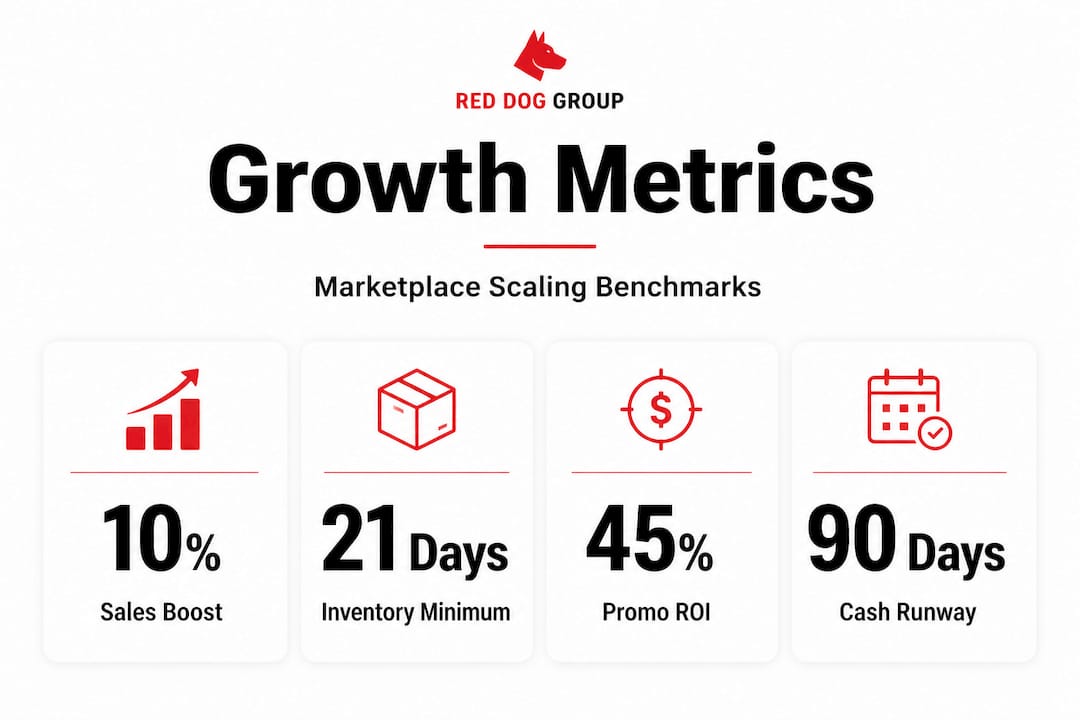
Promo underperformance is one of the most common scale issues, and it’s almost always a data problem. Brands run promotions without a clear baseline, then can’t tell if the lift was real or just demand timing. Granular POS data sharing with retail partners is what separates a 45% promo ROI from a promotion that breaks even at best.
Common bottlenecks and how to address them:
The iteration mindset is what separates brands that sustain growth from those that plateau after one good quarter. Build a 30-day test-and-learn cycle into your operations. Every month, run one structured experiment: a new promo format, a pricing test, a content update on a key listing. Document the result and apply the learning. Over 12 months, that’s 12 data-backed improvements compounding on each other.
Here’s what most scaling guides won’t tell you: even well-structured brands with clean data, solid funding, and a clear channel strategy hit unexpected walls. The wall is rarely where you expect it.
We’ve seen brands with excellent Amazon operations collapse under the weight of a Walmart WFS expansion they weren’t operationally ready for. We’ve seen DTC-first brands with strong margins discover that their cost structure completely falls apart when Amazon fees are factored in at scale. We’ve seen well-funded brands run out of working capital because their inventory forecasting was built on optimistic assumptions rather than real velocity data.
The standard playbook says: follow the steps, build the systems, secure the capital, and scale. The reality is messier. Marketplace management for CPG at the growth stage is a continuous problem-solving exercise, not a linear execution of a fixed plan. The brands that win are the ones that treat every quarter as a new set of variables to understand, not a plan to execute unchanged.
The iteration mindset is not just a nice-to-have. It’s the actual mechanism of sustained growth. Rigid adherence to a plan that isn’t working is how brands stall. The willingness to call a channel experiment a failure, pull back, and redirect resources is what keeps margin intact and momentum building. Speed of learning matters more than perfection of planning.
Scaling a CPG marketplace business is genuinely hard work, and the steps in this guide give you a structured foundation to build on. But knowing the steps and executing them profitably across Amazon, Walmart, DTC, and wholesale are two very different things.
RedDog Group works directly with CPG founders and operators in the $500K to $20M revenue range who need more than a generic growth plan. We focus on contribution margin, operational clarity, and marketplace economics because top-line growth without margin discipline is just expensive noise. If you’re ready to move from scattered marketplace activity to a structured, profitable scale plan, explore our CPG retail growth support to see exactly how we work and what structured partnership looks like in practice.
Brands typically need at least $500,000 in annual revenue to begin structured marketplace scaling, with stronger multi-channel potential emerging above $1 million where capital options and operational capacity expand meaningfully.
Brands that share granular POS data with retail partners can see up to a 10% sales boost and 45% higher promotional ROI compared to brands operating without real-time data sharing.
Growth equity suits brands in the $5M to $50M range, while revenue-based financing is the better fit for brands generating $100K or more monthly, since it avoids equity dilution and aligns repayment with actual sales.
Build real-time data integration across channels from the start and maintain a structured monthly review cycle so operational and margin issues surface before they become costly problems.
Leave a comment: