
Published: March 2020 | Last Updated:March 2026
© Copyright 2026, Reddog Consulting Group.

Multi-channel sellers earn 190% more revenue than single-channel retailers, yet most CPG brands in the $500K–$20M range still treat each sales channel as a separate business. The result is predictable: pricing conflicts, inventory chaos, margin erosion, and a growth ceiling that feels impossible to break through. This guide gives you a structured, margin-first framework for building a multichannel retail operation that actually scales, covering channel selection, infrastructure, execution, and the KPIs that tell you whether it’s working.
| Point | Details |
|---|---|
| Multichannel multiplies revenue | Brands selling on 3+ channels see over double the revenue per customer compared to single-channel. |
| Integration is non-negotiable | Siloed multichannel quickly leads to chaos; unified tech and processes are vital for growth. |
| DTC and marketplaces balance growth | Direct-to-consumer maximizes margin and data, while Amazon and Walmart drive volume but require careful strategy. |
| Guardrails prevent profit loss | MAP, inventory sync, and unified attribution protect profit and prevent channel conflict. |
| KPIs should guide expansion | Track channel revenue, margin, and LTV to measure progress and inform scaling decisions. |
Consumer behavior has shifted permanently. 73% of consumers shop across 3+ channels, and Amazon alone captures 38% of all U.S. ecommerce sales. If your brand is not showing up where your buyers are already shopping, a competitor is. This is not a future trend. It’s the current baseline.
The benefits for CPG brands go well beyond top-line revenue. Multichannel presence reduces dependency on any single platform, smooths out demand volatility, and creates multiple touchpoints that compound brand recognition over time. A buyer who discovers you on Amazon and then finds you at a regional retailer is far more likely to become a loyal, high-LTV customer.
Here’s what’s at stake if you stay siloed:
“The brands winning in CPG right now are not the ones with the best product alone. They’re the ones showing up consistently across every channel their customer uses.”
The marketplace giants offer scale you cannot replicate independently. But DTC gives you data, margin, and control. The goal is not to choose one. It’s to build a system where each channel plays a defined role.
Not every channel deserves equal investment at every stage of growth. The mistake most founders make is adding channels reactively, chasing revenue without a clear role defined for each platform. Channel prioritization means assigning DTC for owned data, Amazon and Walmart for scale, and wholesale for volume with trade-offs.

Here’s a quick comparison to anchor your thinking:
| Channel | Margin profile | Data ownership | Reach | Control |
|---|---|---|---|---|
| DTC | High (60–75% gross) | Full | Limited | Maximum |
| Amazon | Medium (after FBA fees) | Minimal | Massive | Low |
| Walmart WFS | Medium-low | Minimal | Large | Low |
| Wholesale | Low (volume trade-off) | None | Regional/national | Minimal |
DTC gross margins of 60–75% with a healthy LTV:CAC ratio of 3:1 make it the most profitable channel per unit, but it requires marketing investment and audience building. Wholesale trades margin for volume and retail shelf presence, which matters for brand credibility and regional distribution.
How to decide which channel to prioritize:
Pro Tip: Before adding a new channel, ask one question: “Can I execute this channel at 80% quality without degrading my existing channels?” If the answer is no, wait. A poorly run channel hurts your brand more than no presence at all.
Know when to drop a channel too. If a wholesale account requires deep discounting that destroys your MAP pricing integrity, it is costing you more than it contributes. Revenue is not the metric. Contribution margin is.
The biggest operational failure we see in growth-stage CPG brands is adding channels without building the infrastructure to support them. You end up with oversells, inconsistent product data, pricing conflicts, and zero visibility into what’s actually driving profit. Unified OMS, MAP pricing parity, and AI forecasting are the non-negotiables for scaling without chaos.
Here are the four infrastructure layers every multichannel CPG brand needs:
| Infrastructure layer | What it solves | Priority |
|---|---|---|
| OMS | Inventory sync, oversell prevention | Critical |
| PIM | Listing consistency, SEO alignment | High |
| MAP tools | Price integrity, margin protection | High |
| Unified attribution | Performance visibility, budget allocation | Essential |
Pro Tip: You do not need enterprise software to start. Many brands in the $1M–$5M range use seamless omnichannel tech that integrates with Shopify, Amazon Seller Central, and Walmart Seller Center without a six-figure implementation budget.
The channel integration checklist we use with clients starts with inventory unification before anything else. Get that right first, and every other layer becomes easier to build.
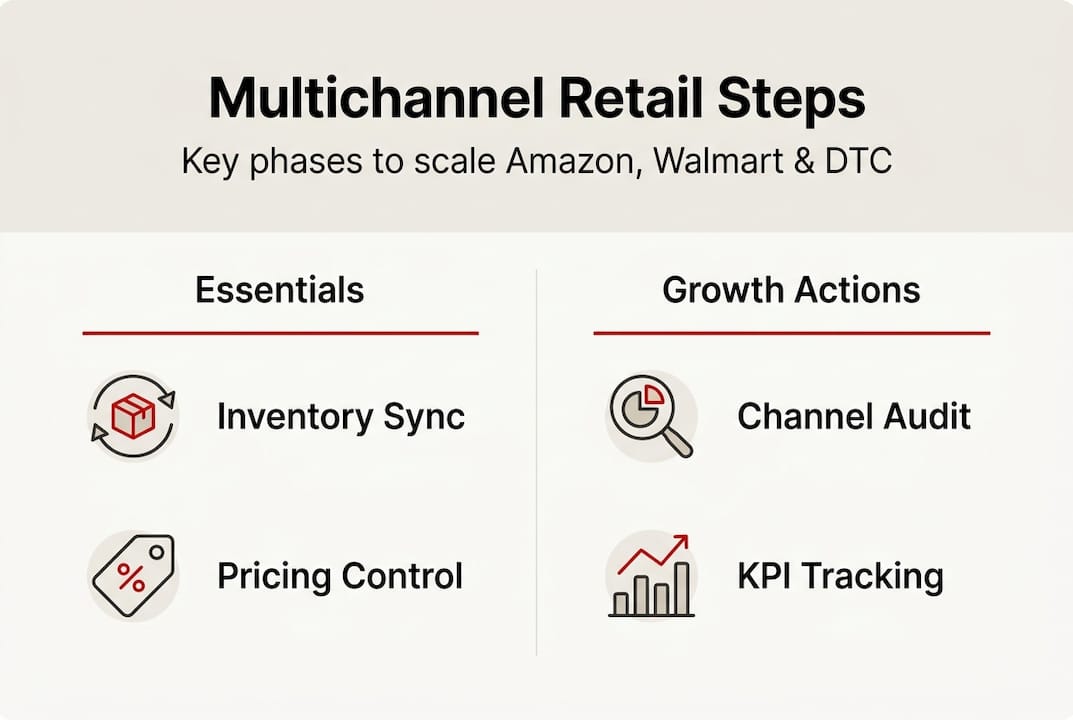
Strategy without execution is just a slide deck. Here is the order of operations that consistently works for CPG brands moving from single-channel to full multichannel.
Before you add any new channel, confirm:
The rollout sequence:
Multichannel presence alone leads to chaos without true integration. We have seen brands add four channels in twelve months and end up less profitable than when they started, because each channel was managed in isolation.
The detailed step-by-step guide we recommend walks through each phase with specific tool recommendations and decision checkpoints. Pair it with a solid omnichannel marketing integration plan to make sure your advertising and promotions reinforce each channel rather than competing with them.
Pro Tip: Run a “channel audit” every quarter. Score each channel on revenue, margin, operational complexity, and strategic value. Channels that score low on margin and high on complexity are candidates for restructuring or exit.
Even well-planned multichannel operations run into problems. The key is catching them early, before they compound into margin disasters. Pricing conflicts, stockouts, and channel cannibalization are the three most common failure modes, and all three are preventable with the right guardrails.
Here’s what to watch for:
“The brands that scale without chaos are not the ones that avoid problems. They’re the ones that build systems to catch problems before they become expensive.”
For a deeper breakdown of how to troubleshoot channel integration issues specific to CPG, the framework we use covers both the diagnostic and the fix for each scenario.
Revenue growth is a lagging indicator. By the time it shows up in your numbers, the decisions that drove it were made months ago. The brands that scale well track leading indicators by channel, so they can course-correct before problems compound.
Omnichannel integration yields 15–25% higher customer LTV compared to siloed multichannel. That gap is the financial case for doing this right.
Primary KPIs every multichannel CPG brand should track:
| Revenue stage | Key focus | Success benchmark |
|---|---|---|
| $1M run rate | Channel margin clarity | 2+ channels profitable on contribution basis |
| $5M–$10M run rate | LTV and CAC optimization | LTV:CAC above 3:1 on DTC; inventory turns above 8x |
| $10M–$20M run rate | Omnichannel integration | 15–25% LTV lift vs. siloed baseline; stockout rate below 2% |
As you approach the $10M–$20M range, consider expanding internationally as a next-phase growth lever. Cross-border ecommerce adds complexity, but for brands with tight domestic operations, it can be a high-upside move.
Building a profitable multichannel operation is not a one-time project. It’s an ongoing system of channel strategy, infrastructure management, margin monitoring, and execution discipline. Most CPG founders in the $500K–$20M range have the ambition but not the bandwidth to do all of it well simultaneously.
At RedDog Group, we work directly with CPG brands to build and optimize multichannel retail operations that are margin-first, not just revenue-first. From Amazon and Walmart marketplace strategy to DTC optimization and wholesale expansion, our omnichannel growth services are built around your specific channel mix and growth stage. If you’re ready to stop guessing and start scaling with a structured plan, explore our consulting services and connect with our team for a channel assessment. We’ll show you exactly where your margin is leaking and what to do about it.
Multichannel retailing sells on multiple platforms independently, while omnichannel integrates those channels so the customer experience and backend operations work as one unified system. Omnichannel integration yields higher LTV than siloed multichannel because it compounds customer value across every touchpoint.
Use MAP enforcement tools and a coordinated promotional calendar to keep pricing consistent across all channels. MAP and pricing parity are the primary guardrails that prevent third-party sellers and channel overlap from destroying your margin.
Add a new channel only after your existing channels have unified inventory, consistent listings, and clear margin visibility. Start with inventory unification before expanding, or you risk compounding operational chaos across every platform you touch.
Track contribution margin by channel, LTV:CAC ratio, inventory turns, and stockout rate as your primary indicators. Omnichannel integration lifts customer value by 15–25% over siloed approaches, so LTV growth is the clearest signal that your integration is working.
Leave a comment: