
Published: March 2020 | Last Updated:May 2026
© Copyright 2026, Reddog Consulting Group.

TL;DR:
- Marketplace compliance influences listing eligibility, operational costs, and seller account stability more than mere regulatory box-checking.
- Implementing continuous verification, jurisdiction-specific controls, and proactive workflows transforms compliance into a competitive advantage and risk mitigation tool.
Marketplace compliance gets treated like a legal formality by most sellers. File what you need to file, verify what you’re asked to verify, and move on. That framing is expensive. The real role of marketplace compliance goes much further than checking regulatory boxes. It directly affects whether your listings stay live, whether your seller account stays eligible, how fast you can onboard new channels, and what your operational costs look like at scale. Get it right, and compliance becomes a competitive advantage. Get it wrong, and a single regulatory gap can suspend your sales mid-quarter.
| Point | Details |
|---|---|
| Compliance protects listing eligibility | Incomplete seller verification can trigger listing suspension under DAC7, DSA, and the INFORM Act. |
| Treat it as a system, not a checklist | Continuous verification workflows catch problems that annual reviews miss every time. |
| Cross-border costs are rising fast | Compliance costs for EU-serving platforms surged 147% in 2026, making proactive planning non-negotiable. |
| Onboarding speed depends on compliance quality | Better KYC and seller data processes reduce friction and accelerate time to first revenue. |
| Jurisdiction-specific controls matter | Building controls per local law, not generic templates, is what separates audit-ready sellers from vulnerable ones. |
The phrase “marketplace compliance” covers a broad range of regulatory obligations, but the industry term you’ll encounter in policy documents is platform due diligence. It refers to the structured process by which marketplace operators collect, verify, and report seller information to satisfy legal and tax authority requirements across jurisdictions. Understanding both terms matters because regulators and platforms use them interchangeably, and confusing one for the other can leave sellers unaware of their specific obligations.
Three frameworks dominate the current regulatory environment for anyone selling on or operating digital marketplaces.
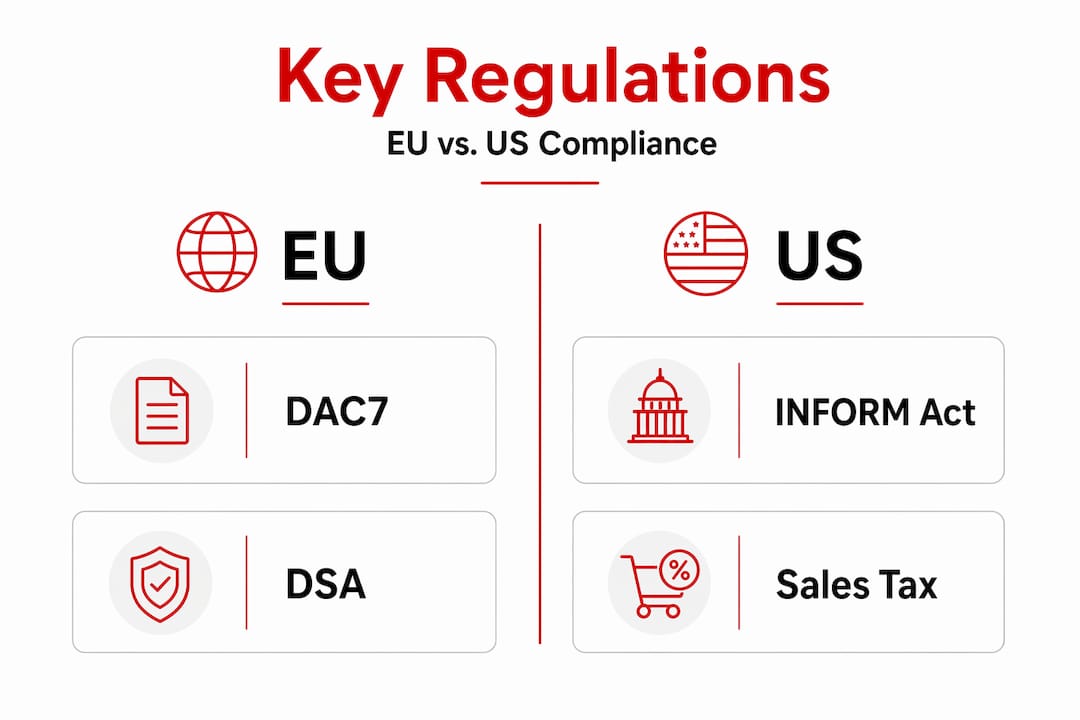
DAC7 (the EU Directive on Administrative Cooperation) requires platform operators to collect and verify seller info and submit annual reports by January 31 each year. Coverage includes the sale of goods, rental of property, personal services, and transport rental. Critically, non-EU platforms must register and report through a single EU member state if they have EU-based sellers or customers. There is no exemption for geography if the transaction touches Europe.
The US INFORM Consumers Act targets high-volume third-party sellers, defined as those completing at least 200 transactions and $5,000 in annual revenue. Marketplaces must verify these sellers within 10 days and suspend accounts that fail to comply. Annual recertification is mandatory. The practical implication for marketplace sellers: if you cross those thresholds, your listing continuity depends entirely on whether your verification data is current and accurate.
The EU Digital Services Act (DSA) goes further than tax reporting. It mandates six mandatory trader data points before any listing goes live. Marketplaces must run plausibility checks, re-verify data when updates occur, and maintain audit logs of all actions. The first DSA fine landed in December 2025, a €120M penalty that signaled enforcement is no longer theoretical. Fines can reach 6% of worldwide turnover.
| Regulation | Scope | Key seller obligation | Enforcement risk |
|---|---|---|---|
| DAC7 | EU (plus non-EU platforms with EU activity) | Annual seller data reporting by Jan 31 | Tax authority audits, reporting penalties |
| INFORM Act | United States | Verification within 10 days for high-volume sellers | Listing suspension, FTC enforcement |
| DSA | EU marketplaces | Six data points verified pre-listing, audit logs maintained | Fines up to 6% of global revenue |
The jurisdictional overlap is where most sellers get into trouble. A US-based CPG brand selling on Amazon’s European stores is simultaneously subject to DAC7 reporting through Amazon, DSA data verification requirements, and potentially INFORM Act obligations back in the US. Each framework has its own timeline, data format, and enforcement pathway.
Here is where the marketplace compliance importance becomes concrete for day-to-day operations.
Listing eligibility is gated by verification status. Under the DSA, incomplete data triggers suspension of your listing until rectified. This is not a warning. It is an automatic hold. If your business address, VAT number, or contact information is flagged as implausible during a re-verification cycle, your products go dark with no prior notice.
Onboarding speed reflects your compliance readiness. Improved compliance tooling has been shown to reduce onboarding friction and accelerate time to first revenue. Brands that have clean, pre-verified seller data move through new marketplace onboarding in days. Brands scrambling to locate formation documents and tax IDs take weeks, sometimes missing seasonal launch windows entirely.
Transaction approval rates are tied to seller data quality. Marketplaces are increasingly using compliance data as a proxy for seller trustworthiness. A verified, complete seller profile moves through automated approval queues faster. Gaps in the record create manual review flags that slow payment processing.
Audit readiness is now an operational, not legal, function. Legal teams increasingly expect credible documentation and operational traceability, which means compliance has shifted from policy document to proactive daily control. Your evidence stack needs to be retrievable on short notice, not reconstructed at year-end.
Pro Tip: Set a calendar trigger 90 days before your DAC7 annual report deadline. Use that window to reconcile payout records, re-verify any updated seller data, and confirm your reporting entity in the EU is still valid. Doing this in October is infinitely less painful than doing it in January.
The practical reality is that treating due diligence as continuous operations rather than an annual cleanup changes everything about how marketplace compliance functions. Sellers who run quarterly data audits catch mismatches before regulators do. Sellers who wait for an annual review often discover problems they can no longer fix retroactively.
Selling across borders has always carried operational complexity, but 2026 has made the financial weight of marketplace regulations and compliance much harder to ignore.

After the EU’s regulatory framework fully took effect, compliance costs surged 147%. Platforms serving European customers now spend an average of $2.3M annually on compliance, up from $930K in 2025. Verification approval times tripled, rising from 3 days to 11 days on average. Transaction fees increased by €0.45 to €1.20 per order. These are not abstract platform costs. They flow through to sellers in the form of slower approvals, higher fees, and tighter margin structures.
The compliance challenges in e-commerce compound across dimensions when you operate multi-jurisdiction:
For CPG brands in the $500K to $20M revenue range, the cost question is real. The brands that treat cross-border compliance as a growth investment, building the infrastructure before expanding rather than retrofitting it after, consistently land faster, with fewer disruptions and better margin outcomes.
The core insight driving effective compliance is this: compliance is a system design problem, not a legal checkbox. Designing around that principle means your operational controls are specific to each jurisdiction you operate in, not templated off a generic checklist.
Here is what that looks like in practice:
Pro Tip: Build your compliance stack as a channel-specific control system rather than a single universal policy. Amazon’s compliance requirements and the DSA’s trader verification requirements overlap but do not map perfectly. Treating them as one system creates gaps in both.
The brands and operators who get this right do not necessarily spend more. They spend more deliberately, with controls that are audit-ready from day one rather than scrambled together under regulatory pressure.
I have watched a lot of CPG brands treat marketplace compliance as the thing they deal with after growth. The logic sounds reasonable: get sales going first, sort out the regulatory infrastructure later. In practice, this approach costs more in both time and money than building it correctly from the start.
What I have seen consistently is that the brands who treat compliance as an operational design priority from the moment they expand channels are the ones with faster onboarding, fewer listing disruptions, and better margin stability. The brands who bolt it on reactively spend months correcting data gaps, resubmitting verification documents, and, in some cases, rebuilding seller reputation scores after unnecessary suspensions.
The other thing worth saying plainly: the impact of compliance in marketplaces is no longer limited to legal risk. It has a direct line to revenue. A listing suspension during a peak sales window costs real margin dollars. Delayed verification on a new marketplace channel means missed launch timing. These are P&L events, not legal events.
Most operators also underestimate the technical lift involved in true compliance integration. It is not just about having the right documents. It is about having systems that surface the right data, at the right time, in the right format for each jurisdiction. That requires planning, not just intention.
My advice is to scope your compliance infrastructure the same way you would scope your inventory system. Define what each jurisdiction requires, map those requirements to your operational workflows, and build in review cycles that catch problems before they become penalties.
— Reddog

Marketplace compliance is one piece of a larger operational picture. At Reddog, we work with CPG brands in the $500K to $20M range who need more than advice. They need a practical, margin-focused plan that accounts for channel economics, compliance overhead, inventory velocity, and retail expansion readiness across Amazon, Walmart, DTC, and wholesale. We help you understand what each channel actually contributes to profit, and where the leaks are hiding before they compound.
If you want a clearer picture of your channel margin and compliance exposure, book a free 30-minute strategy call with the Reddog team. We will review your current channel setup, identify the compliance gaps most likely to affect your sales continuity, and give you a concrete starting point for building a more resilient marketplace operation.
Marketplace compliance covers the regulatory obligations sellers must meet to maintain listing eligibility, complete seller verification, and satisfy tax reporting requirements across jurisdictions. It directly affects sales continuity, onboarding speed, and financial risk exposure.
Cross-border sellers face overlapping frameworks including DAC7, the DSA, and the INFORM Act, each with different data requirements and timelines. Compliance costs for EU-serving platforms surged 147% in 2026, making proactive infrastructure a financial necessity rather than an optional investment.
Under the DSA, marketplaces must collect and verify six mandatory data points before a listing goes live. Incomplete or implausible data automatically triggers a listing suspension until the seller resolves the issue, with no prior warning.
Treating compliance as an annual cleanup rather than a continuous workflow is the most common failure. Unverified data and unreconciled transaction records discovered at year-end are often impossible to correct retroactively, which leads to failed audits and penalties.
The INFORM Act requires marketplaces to verify sellers who reach 200 transactions and $5,000 in revenue within 12 months. Verification must be completed within 10 days, and non-compliant sellers face suspension of their selling privileges.
Leave a comment: