
Published: March 2020 | Last Updated:May 2026
© Copyright 2026, Reddog Consulting Group.

TL;DR:
- Choosing the right ecommerce platform depends on your team’s operational capacity, growth stage, and complexity needs. Hosted SaaS platforms offer speed and ease for early-stage brands, while open-source and composable architectures provide control and scalability for larger or more complex businesses. Prioritizing operational fit and long-term migration considerations is essential for sustainable growth and profitability.
Picking the wrong ecommerce platform costs you more than you think. It costs time rebuilding your store, money migrating data, and margin when fees and technical debt pile up silently in the background. Yet most articles on types of ecommerce platforms spend their energy listing features without answering the real question: which delivery model fits how your business actually operates? This guide cuts through that noise. You will learn the three core platform architectures, what each one demands from your team, and how to match the right choice to your sales strategy and growth stage.
| Point | Details |
|---|---|
| Three core delivery models | Hosted SaaS, open-source/self-hosted, and composable/headless cover nearly every ecommerce use case. |
| Operational burden matters most | Your internal technical capacity should drive your platform choice as much as features or price. |
| SaaS wins on speed | Hosted platforms get you selling faster with less IT overhead, but customization has a ceiling. |
| Open-source trades time for control | Self-hosted platforms give you full flexibility, but disciplined maintenance processes are non-negotiable. |
| Composable is not for everyone | Headless and composable architectures serve complex use cases and require strong engineering governance. |
The clearest way to map ecommerce platform options is by delivery model: hosted SaaS, open-source/self-hosted, and composable/headless. Each model makes a fundamentally different deal with you about who owns what. Hosted SaaS bundles hosting, security, and updates into a monthly subscription. Open-source hands you the full software stack and says “your server, your rules.” Composable commerce lets you assemble a custom stack of best-of-breed services connected via APIs.
Most entrepreneurs hit trouble not because they chose the wrong features but because they chose the wrong delivery model for their team’s capacity. A two-person brand does not need a headless architecture. A rapidly scaling enterprise with three regional storefronts and custom B2B workflows probably cannot afford the limitations of a locked-down SaaS product. The structure of the platform shapes every operational decision that follows.
Before comparing specific tools, get clear on these evaluation criteria:
Pro Tip: Do not evaluate platforms on features alone. Build a short list of your non-negotiable operational requirements and eliminate any platform that cannot meet them before you ever book a demo.
Hosted SaaS platforms are the most common entry point for growing brands, and for good reason. The provider handles hosting, security patches, and software updates. You log in, build your store, and sell. Shopify, BigCommerce, and Wix are the most widely used examples in the US market.
The core advantages are speed and simplicity. A founder with no engineering background can launch a functional store in days. The app ecosystems on platforms like Shopify are extensive, covering everything from subscription billing to loyalty programs to advanced reporting. For brands focused on DTC growth or omnichannel expansion, hosted SaaS removes infrastructure complexity from the equation.
The trade-offs are real, though. Shopify’s transaction fees add up if you are not using their native payment processor. Deep customization of checkout logic or backend workflows often requires expensive developer work or custom app builds. And when a platform changes its pricing structure or deprecates a feature, you have limited leverage as a tenant on their infrastructure.
Hosted SaaS works best for:
Pro Tip: Check the platform’s ecommerce SEO capabilities before committing. Some hosted platforms limit URL structures, canonical tag control, and page speed optimization in ways that compound into serious organic traffic losses over time.
Open-source platforms give you the full software stack to deploy on your own hosting infrastructure. WooCommerce runs on WordPress and powers a massive share of independent online stores globally. Magento, now Adobe Commerce, serves mid-market and enterprise brands with complex catalog and B2B requirements. PrestaShop is another widely used option, particularly in international markets.

The appeal is total control. You choose your hosting provider, your payment processors, your plugins, and your custom development roadmap. Nothing is off-limits if you have the engineering resources to build it. For brands with custom ecommerce solutions requirements tied to unusual catalog logic, tiered pricing for wholesale, or deep integrations with ERP systems, open-source often wins.
The operational weight is significant, though. WooCommerce requires you to manage updates, hosting performance, security hardening, and plugin compatibility. Missing a security patch or running conflicting plugins can take your store offline or expose customer data. The failure modes for self-hosted platforms are almost always operational, not architectural: outdated plugins, misconfigured servers, and neglected performance tuning.
Open-source self-hosted platforms suit:
Pro Tip: Budget for ongoing maintenance from day one. The software is free or low-cost, but reliable patching, backups, and performance tuning processes require either dedicated staff time or a managed hosting plan. That cost is real and predictable. Ignoring it is not.
Composable commerce represents a fundamentally different architectural philosophy. Instead of buying one platform that does everything, you assemble a stack of specialized services, each one best-in-class for its function, connected via APIs. Your commerce engine, CMS, search, payments, and personalization layer all talk to each other through structured API contracts. Headless commerce is a specific pattern within this model where the frontend presentation layer is decoupled from the backend commerce logic.
The practical benefit is modularity. You can swap out your search provider without rebuilding your checkout. You can run multiple storefronts for different regions or customer segments from a single backend. Composable commerce enables B2B, DTC, marketplace, and point-of-sale use cases from one unified architecture. Medusa, an open-source composable platform, has built significant developer community traction for exactly these kinds of complex commerce applications.
The challenge is governance. Every API integration is a potential point of failure. Teams must define API contracts clearly, monitor for failures actively, and plan migrations carefully when swapping services. Integration complexity is the most common reason composable commerce projects blow past budget and timeline. This is not a model you adopt because it sounds modern. It is a model you adopt because your business requirements genuinely exceed what unified platforms can deliver.
Composable and headless architectures work best for:
Pro Tip: If you are considering a composable stack, map your integration risks before selecting vendors. Know which services are core to your revenue flow and build redundancy or fallback logic around them from the start.
When you put the three major categories next to each other, the decision criteria become easier to see. Here is a quick reference comparison across the factors that actually affect your day-to-day operations and long-term costs.
| Factor | Hosted SaaS | Open-source/self-hosted | Composable/headless |
|---|---|---|---|
| Time-to-launch | Fast (days to weeks) | Moderate (weeks to months) | Slow (months) |
| Technical complexity | Low | Medium to high | Very high |
| Customization ceiling | Medium | High | Unlimited |
| Operational burden | Low | High | Very high |
| Monthly cost visibility | High (predictable) | Medium (variable) | Low (unpredictable) |
| Best for scale stage | Startup to growth | Growth to enterprise | Mid-market to enterprise |
| B2B ecommerce fit | Limited | Strong | Strongest |
The platform decision ultimately comes down to a trade-off between time-to-launch and ease of use on one side versus long-term engineering and maintenance load on the other. Enterprise platforms like Adobe Commerce and Salesforce Commerce Cloud offer internationalization, B2B functionality, and catalog complexity that SMB-focused platforms simply do not match. But they come with total cost of ownership figures that are a poor fit for brands under $5M in revenue.
A few quick alignment rules worth keeping in mind:
I have watched brands at every growth stage make the same mistake: they evaluate platforms by feature list rather than by operational fit. A founder who reads that headless commerce is the future and then commits to a composable architecture without a development team in place is setting up an 18-month distraction that bleeds cash.
In my experience, the best ecommerce solutions for most growing brands are boring. A well-configured hosted SaaS setup with clean integrations and disciplined catalog management outperforms a half-finished headless architecture every time. The brands I have seen win with open-source did so because they had a reliable development partner, a documented maintenance process, and clear requirements before writing a single line of code.
What I have learned watching brands replatform is that the pain usually comes 18 to 24 months after the initial launch, when the business has grown past the original platform’s limits and the team has to migrate under pressure. The right question at the start is not “what platform can we afford today” but “what platform will we have to migrate off of in two years if we hit our growth targets.” That single shift in framing saves a lot of expensive rebuilds.
And if you are weighing composable options, take governance seriously from day one. Managing API contracts and failure monitoring is not an afterthought. It is the work. Teams that skip this end up with brittle architectures that are harder to maintain than the monolithic platform they left.
— Reddog
Platform selection is not just a technology decision. It is a margin decision. The wrong platform adds hidden costs through developer hours, transaction fees, plugin subscriptions, and operational complexity that rarely shows up in the initial comparison. Reddog works with CPG brands in the $500K to $20M revenue range to map channel economics, evaluate technology stacks, and build growth plans grounded in contribution margin rather than top-line optimism.
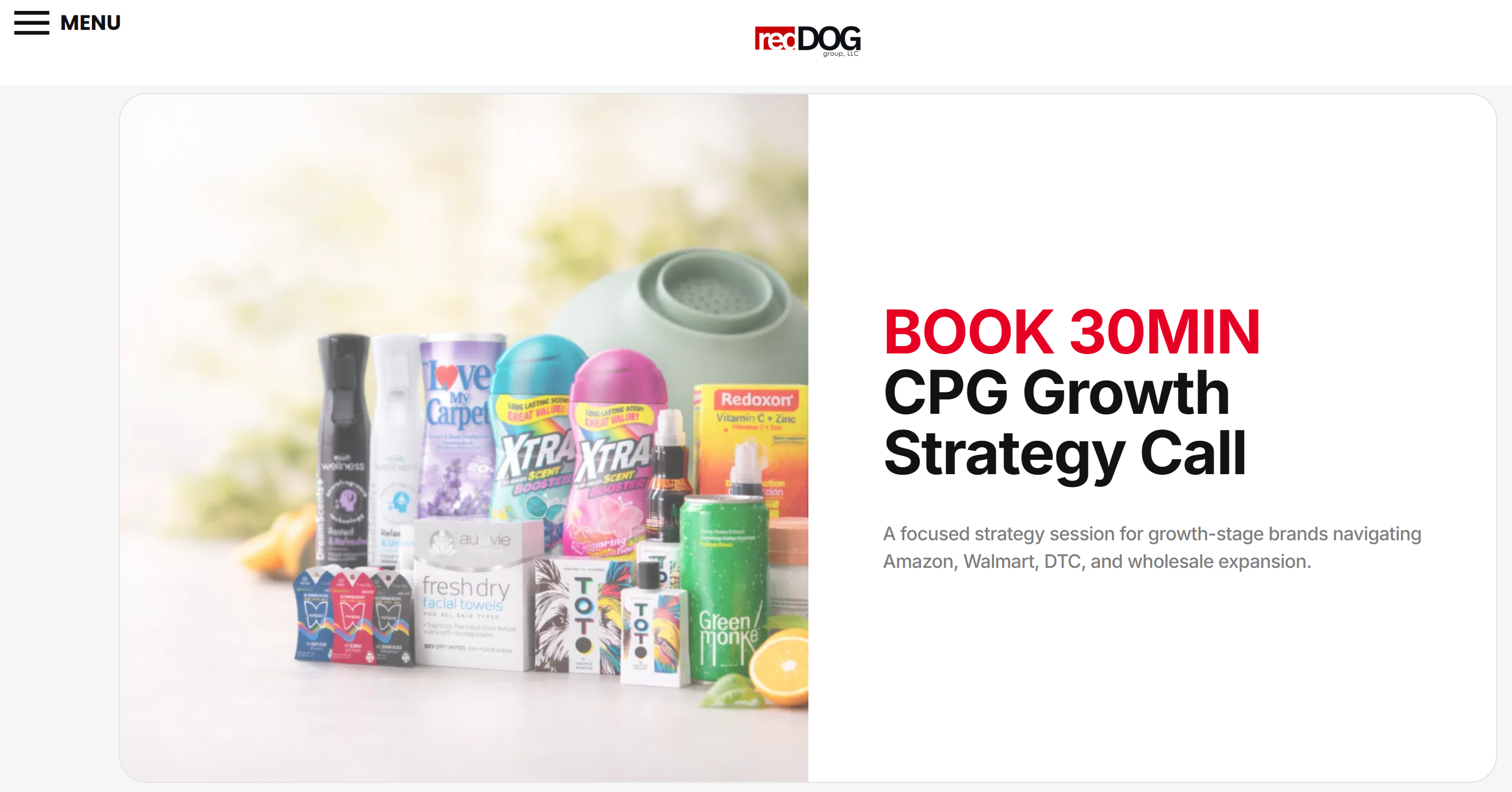
If you are still sorting through ecommerce platform options or wondering whether your current setup is actually serving your growth goals, a free 30-minute strategy call with the Reddog team is a practical place to start. We will review your current channel mix, identify where margin is leaking, and give you a clearer picture of whether your platform infrastructure is helping or hurting your path to profitable scale.
The three core types are hosted SaaS platforms (like Shopify and BigCommerce), open-source/self-hosted platforms (like WooCommerce and Magento), and composable/headless platforms. Each differs in who manages hosting, security, and customization.
Hosted SaaS platforms are generally the best fit for small businesses because they reduce technical overhead, launch quickly, and require no server management. Most early-stage brands can meet their needs within a well-configured SaaS environment.
Composable commerce is the broader approach of assembling a modular tech stack via APIs. Headless commerce is a specific pattern within composable architecture where the frontend is decoupled from the backend commerce engine.
B2B ecommerce platforms require tiered pricing, account-based ordering, and custom workflow support. Open-source platforms like Magento and composable platforms like Medusa handle B2B complexity better than most hosted SaaS options.
Total cost of ownership includes subscription or licensing fees, hosting costs, developer time, plugin or app subscriptions, transaction fees, and ongoing maintenance hours. Hosted SaaS platforms have more predictable costs; self-hosted and composable platforms carry higher variable costs tied to engineering needs.
Leave a comment: