
Published: March 2020 | Last Updated:March 2026
© Copyright 2026, Reddog Consulting Group.

Most Texas CPG brands pour cash into Amazon ads but watch margins evaporate while organic sales stagnate. The path to sustainable growth lies in optimizing your listings, pricing strategically, and managing inventory with precision. This guide delivers a margin-focused roadmap to boost organic sales without bleeding profit.
| Point | Details |
|---|---|
| Listing optimization drives discovery | Optimized titles, keywords, and images boost organic clicks and conversions significantly. |
| Strategic pricing protects margins | Calculate all Amazon fees before setting prices to avoid margin leakage. |
| Inventory health sustains rankings | Stockouts damage organic visibility and sales velocity permanently. |
| Seller metrics impact visibility | Maintaining Order Defect Rate below 1% increases organic sales potential by 10-15%. |
| Results require patience | Expect measurable organic growth after 60-90 days of consistent optimization. |
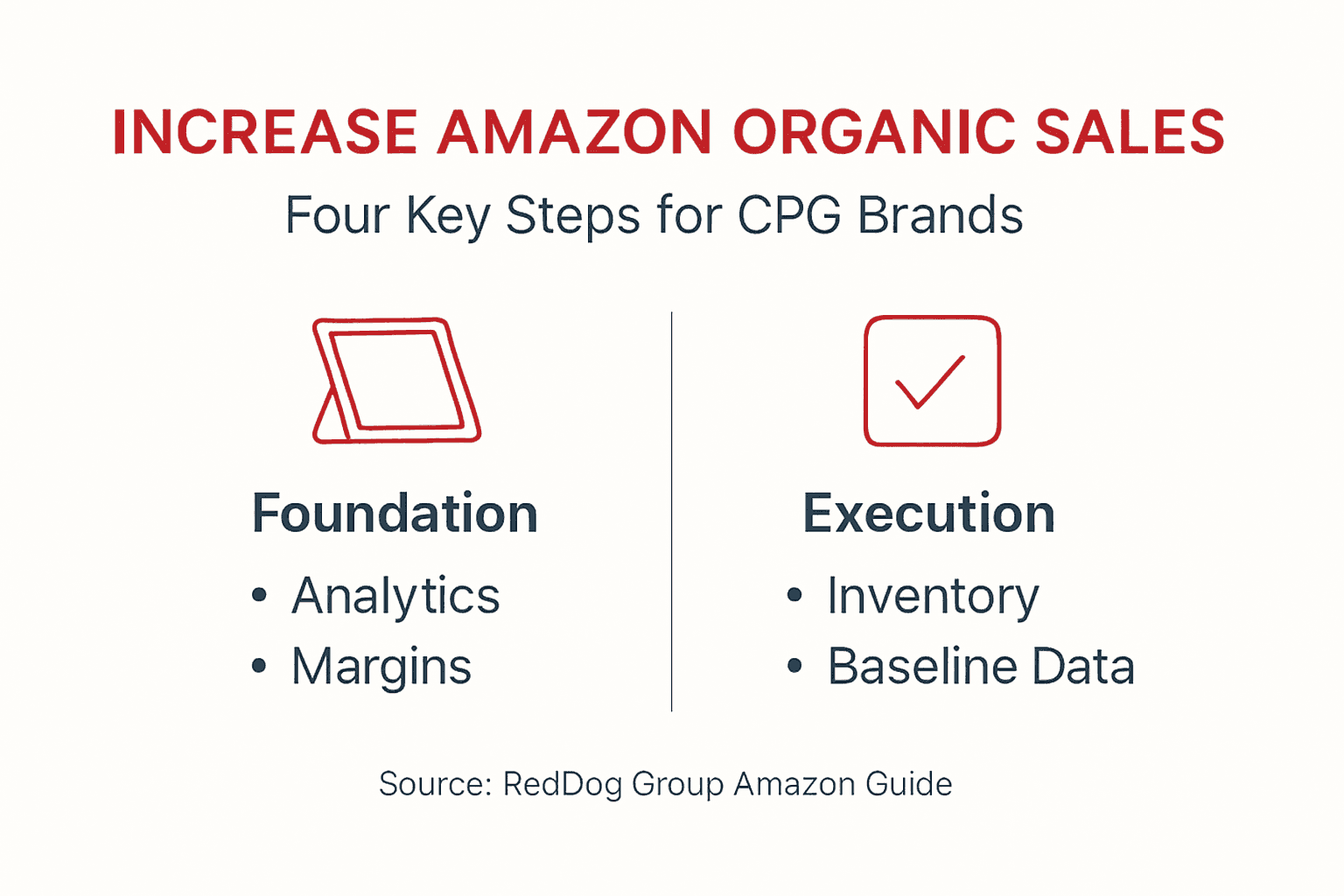
Before you optimize anything, you need the right foundation. Too many brands jump into tactics without baseline data or tools, then wonder why results disappoint.
First, secure full access to Amazon Seller Central analytics. You need visibility into search term performance, conversion rates, and traffic sources. Without this data, you’re flying blind.
Second, understand your complete margin picture. Amazon FBA fees, storage costs, referral fees, and fulfillment charges add up fast. Calculate your true contribution margin per unit before making any pricing decisions.
Third, establish reliable inventory management. Whether you use a 3PL or manage stock internally, you need real-time visibility into inventory levels across all channels. Stockouts kill organic rankings faster than any competitor.
Fourth, gather at least 30 days of baseline performance data. Track current organic sales, conversion rates, click-through rates, and keyword rankings. You need a benchmark to measure improvement against.
Pro Tip: Use tools to track Amazon product rankings weekly so you catch ranking drops before they crater sales.
Key prerequisites checklist:
Your listing is your storefront. If it doesn’t match search intent and convert browsers into buyers, no amount of traffic helps.
Start with titles. Pack your primary keyword near the front, then add modifiers shoppers actually search for. Skip brand fluff and focus on what people type into the search bar.
Bullet points should answer objections and highlight benefits, not features. Think about what makes someone hesitate before clicking Add to Cart. Address those concerns directly.
Backend keywords capture search variations your visible content misses. Use all available character space for synonyms, misspellings, and alternative phrases relevant to your product.
Images make or break conversions. Show your product from multiple angles, demonstrate use cases, and include lifestyle shots that help shoppers visualize ownership. Enhanced Brand Content adds credibility and educates buyers without cluttering bullet points.
Implementing A/B testing on product images and titles can improve organic click-through rates by 20% or more. Test one element at a time so you know what actually moves the needle.
Pro Tip: Customer questions reveal gaps in your listing. If the same question appears repeatedly, add that information to your bullets or A+ content.
Listing optimization priorities:
Learn more tactics to optimize Amazon product listings for maximum organic visibility.
Cheap prices attract browsers. Smart pricing attracts profit. The difference determines whether you build a business or subsidize Amazon’s warehouse.
Calculate your floor price by adding every fee Amazon charges. FBA fulfillment, referral percentage, storage, long-term storage penalties, return processing. If your price doesn’t cover these plus product cost and target margin, you’re losing money on every sale.
Competitor pricing matters, but don’t race to the bottom. Analyze where competitors sit, then decide if you compete on price or differentiate on value. Often, a 10% price premium with better images and copy outperforms discounting.
Price elasticity varies by category. Test small price increases to find your sweet spot where conversion rate drops don’t offset margin gains. Sometimes raising prices 8% only reduces volume 3%, netting significant profit improvement.
Use promotions strategically, not desperately. Lightning Deals and coupons can boost velocity during ranking-critical periods, but chronic discounting trains customers to wait for sales and damages brand perception.
Pro Tip: Review your Amazon pricing strategies quarterly as fee structures and competitor landscapes shift constantly.
| Pricing Approach | Margin Impact | Volume Impact | Best For |
|---|---|---|---|
| Premium positioning | +20-30% | -5-15% | Differentiated products with strong value props |
| Competitive parity | Neutral | Neutral | Commodity categories with limited differentiation |
| Discount strategy | -15-25% | +10-20% | High inventory levels or clearance scenarios |
| Dynamic pricing | Variable | Variable | Categories with frequent competitor price changes |
Run out of stock and watch your organic ranking collapse. Amazon’s algorithm interprets stockouts as poor seller reliability and demotes your listings accordingly.
Inventory velocity signals product health to Amazon. Consistent sales cadence tells the algorithm your product deserves visibility. Erratic availability creates erratic rankings.
Implement these inventory practices to protect organic sales:
Multi-channel fulfillment through Amazon FBA and backup 3PLs prevents total stockouts if one channel fails. A fulfillment strategy for CPG brands should balance cost efficiency with supply reliability.
Inventory turnover affects storage fees. Products sitting over 365 days incur long-term storage charges that destroy margins. Sell through or remove aged inventory before penalties kick in.

Amazon rewards sellers who deliver excellent customer experiences with better organic placement. Your backend metrics directly impact frontend visibility.
Order Defect Rate (ODR) below 1% improves Amazon’s organic ranking algorithm favorably, increasing organic sales potential by 10-15%. ODR combines negative feedback rate, A-to-z Guarantee claims, and credit card chargebacks.
Customer feedback shapes your seller rating and informs product improvements. Monitor reviews weekly for recurring complaints that signal listing inaccuracies or product issues. Respond professionally to negative reviews and use insights to refine your offering.
Return rate matters more than most brands realize. High returns suggest listing mismatches or quality problems. Amazon penalizes products with excessive return rates by reducing organic visibility.
Shipping performance affects Prime eligibility and customer satisfaction scores. Late shipments, pre-fulfillment cancellations, and tracking problems all damage your account health.
Pro Tip: Monitor Amazon ranking metrics alongside seller performance to catch correlation between operational issues and ranking drops.
Critical metrics to maintain:
Check Amazon Seller Central metrics documentation regularly for threshold updates and policy changes.
Even experienced sellers sabotage organic growth through fixable errors. Recognize these patterns to avoid them.
Neglecting backend keywords leaves search visibility on the table. Brands optimize titles and bullets but ignore the 250-byte backend field where synonyms and alternative phrases capture incremental traffic.
Ignoring customer reviews costs conversions and insights. Reviews tell you what confuses buyers, what delights them, and what your listing fails to communicate. Brands that don’t mine review data for optimization opportunities leave money on the table.
Margin leakage from unaccounted fees is epidemic. You think you’re profitable at $24.99 until you calculate FBA fees, referral percentage, storage, and return processing. Suddenly your 40% margin becomes 12%.
Allowing stockouts damages rankings that take months to rebuild. A two-week stockout can cost you three months of suppressed organic visibility even after inventory returns.
Over-reliance on price cuts trains customers to wait for deals and conditions the market to expect discounts. Your baseline price becomes irrelevant, and you compete purely on promotion depth.
Pro Tip: Audit your listings quarterly to fix common listing mistakes before they compound into ranking losses.
Organic growth requires patience. Algorithm changes propagate slowly, and customer behavior shifts take time to materialize in sales data.
Most brands see initial improvements in organic traffic within 30 days of listing optimization, but conversion increases and ranking gains typically require 60-90 days of consistent execution. Amazon needs time to assess your changes and adjust placements accordingly.
Listing optimizations that improve relevance and conversion can boost overall sales by up to 35% within three months. The impact varies by category competitiveness and baseline listing quality.
Pricing adjustments improve profitability faster than volume. Expect margin improvements of 15-25% within 30 days of strategic repricing, though volume may dip slightly as price-sensitive shoppers filter out.
Maintaining operational excellence compounds over time. Keeping ODR below 1% consistently can increase organic sales potential by 10-15% as Amazon rewards reliable sellers with better placement.
Reducing stockouts stabilizes sales velocity and protects rankings. Consistent availability signals product health to the algorithm and maintains upward ranking momentum.
| Optimization Area | Timeline to Results | Expected Impact |
|---|---|---|
| Listing optimization | 60-90 days | +20-35% conversion rate |
| Strategic pricing | 30-45 days | +15-25% margin improvement |
| Inventory consistency | Immediate protection | Prevents 20-40% ranking drops |
| Operational metrics | 90+ days | +10-15% organic visibility |
Growing profitable organic sales on Amazon requires marketplace expertise and margin discipline most brands lack internally. You need partners who understand both the algorithm and the economics.
RedDog Group specializes in helping Texas CPG brands scale Amazon sales without sacrificing margins. We combine listing optimization, strategic pricing frameworks, and inventory planning to drive sustainable organic growth. Our approach prioritizes contribution margin, not vanity metrics.
We help you implement the exact strategies in this guide, customized for your category, competition, and growth stage. Our CPG conversion rate optimization guide and proven ways to increase ecommerce sales for CPG brands deliver measurable results.
Ready to grow Amazon sales profitably? Explore our CPG retail growth offer designed specifically for emerging brands in the $500K to $20M revenue range.
Most brands see measurable gains in organic sales after 60 to 90 days of consistent optimization. Listing improvements, pricing adjustments, and operational excellence compound over time as Amazon’s algorithm recognizes sustained performance.
Order Defect Rate below 1% is critical for ranking favorability and can boost organic sales potential by 10 to 15%. Customer feedback scores, return rates, shipping performance, and response times also heavily influence your organic visibility.
Account for all Amazon fees including FBA fulfillment, referral percentages, storage costs, and return processing when setting prices. Avoid excessive discounts that erode both margin and brand perception in the marketplace.
Ignoring backend keyword optimization and customer review insights limits visibility and conversion improvements. Allowing stockouts and over-relying on price cuts also damage long-term growth potential and margin health.
Leave a comment: