
Published: March 2020 | Last Updated:May 2026
© Copyright 2026, Reddog Consulting Group.

TL;DR:
- Most influencer marketing efforts are undervalued because last-click attribution misses up to 21% of sales driven by creators. Brands that build content-to-commerce systems and connect influencer content with channel profitability achieve sustained growth and higher margins. Accurate measurement through sales lift studies and proper content rights management are essential for maximizing influencer ROI in CPG.
Standard influencer marketing measurement is quietly misleading CPG executives. Up to 21% of influencer-driven sales go unattributed under last-click models, meaning your team may be undervaluing campaigns that are genuinely moving product. For brands in the $500K to $20M revenue range navigating Amazon, Walmart, DTC, and wholesale simultaneously, this blind spot directly affects budget decisions, channel priorities, and ultimately, profitability. This guide cuts through the noise to clarify what influencer marketing actually does for CPG growth, how to measure it honestly, and how to connect it to the margins that matter.
| Point | Details |
|---|---|
| Measurement must go beyond clicks | To understand influencer ROI, prioritize incrementality and sales lift over just clicks or impressions. |
| Attribution gaps distort ROI | Standard tracking can undercount as much as 21% of sales, so CPG leaders need smarter measurement. |
| Content reuse boosts profits | Securing content rights and integrating influencer assets across all channels multiplies returns. |
| Compliance is critical | Clear, prominent disclosure for all influencer partnerships is non-negotiable to avoid fines and trust loss. |
| Systems outperform campaigns | Modern CPGs win by building layered, commerce-linked influencer ecosystems—not just one-off promos. |
The conversation around influencer marketing has changed. Two years ago, most CPG founders treated creator campaigns as an awareness play: get eyes on the product, hope for downstream conversions. That model is outdated. Today, the most competitive CPG operators are building what you might call content-to-commerce systems, where creator output feeds paid media, on-shelf storytelling, and Amazon listings simultaneously.
This matters because awareness is no longer a competitive advantage on its own. Shelf space is crowded, digital ads are expensive, and consumers are skeptical of brand-direct messaging. What actually moves the needle is trusted voices creating commerce-ready content that can be repurposed, amplified, and measured across every channel.
The shift is real. Modern CPG operating models now treat influencer content as a supply chain asset, not a marketing luxury. Brands that get this right are building content libraries that fuel six to twelve months of paid creative, email sequences, and product page imagery from a single well-briefed campaign.
Here is what separates the brands winning with influencer marketing in 2026:
“The strategic role of influencer marketing in CPG is shifting from awareness-only to content-to-commerce systems: creator briefs, commerce-ready assets, usage rights, and measurement that supports budget scaling.”
The brands that still approach influencer marketing as a reach play are paying creator fees without capturing compounding value. Every piece of content that cannot be reused, amplified, or connected to a channel-specific outcome is a wasted asset. Proper channel integration for CPG starts with making sure influencer content is built to travel across every touchpoint, not sit inside one campaign.
Most CPG teams fail at influencer marketing measurement before a single post goes live. The problem is not the creator or the content. It is the absence of clearly defined funnel roles and business-tied KPIs assigned to each campaign phase.
Here is how to structure it:
For CPG brands, influencer marketing KPIs must tie to business outcomes like CAC, ROAS, and contribution margin, not vanity metrics. This is non-negotiable if you want to defend your influencer budget in a board meeting or quarterly review.
| Metric type | Example KPIs | Business relevance |
|---|---|---|
| Vanity metrics | Likes, followers, impressions | Low: no direct revenue connection |
| Leading indicators | CTR, saves, add-to-cart rate | Medium: signals intent and content quality |
| Profit outcomes | ROAS, CAC, contribution margin | High: directly ties to profitability |
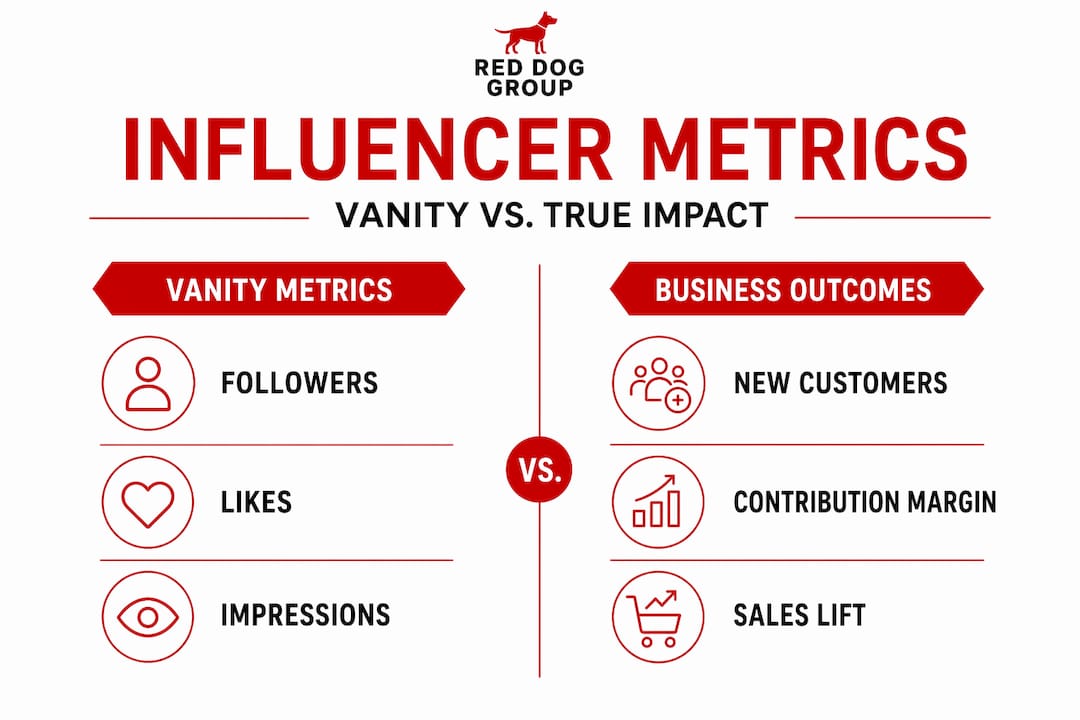
Pro Tip: Separate your leading indicators from your lagging profit outcomes in every campaign report. Leading indicators tell you whether the creative is working early. Lagging profit outcomes tell you whether the channel is worth scaling. Mixing them creates confusion and bad budget decisions.
Connecting influencer data to contribution margin calculation is what separates a CPG operator from a brand marketer. You need to know whether the customers your creators bring in are actually profitable after COGS, fulfillment, and acquisition cost, or if you are buying revenue at a loss. That is a foundational question, and measuring ROI in CPG marketing must include influencer campaigns to give you a complete picture. For brands optimizing across Amazon, DTC, and wholesale, conversion optimization in CPG must also account for where creator-driven traffic actually lands and converts.
Here is the uncomfortable truth: your influencer campaigns are probably performing better than your data suggests. The reason is attribution. Last-click attribution assigns credit to the final touchpoint before purchase, which is almost never the influencer post that introduced a customer to your product three days earlier.
Up to 21% of influencer-attributed sales can go unrecorded under standard models. For a brand running $200,000 in annual influencer spend, that gap could represent tens of thousands of dollars in real revenue that is being written off as unproductive marketing. That directly harms future budget allocation.
The practical solution is to layer your measurement approach:
Sales lift and incrementality testing is a more reliable KPI than attributed sales when you need to prove causal impact. This is particularly important for CPG brands selling through retail and wholesale, where there is no direct tracking pixel on a store shelf.
| Attribution method | What it captures | Risk of undercounting |
|---|---|---|
| Last-click | Final touchpoint only | Very high |
| Promo codes / UTMs | Direct influencer-driven clicks | High (delayed purchases missed) |
| Sales lift / incrementality | Causal sales increase | Low (most accurate measure) |
| Multi-touch modeling | Distributed credit across journey | Medium |
Pro Tip: Run a simple geo-based sales lift test alongside your next influencer campaign. Target creator content in specific DMAs or zip codes, then compare sell-through velocity against comparable non-targeted markets. This gives you a controlled read on true incremental lift without needing expensive attribution software.
Monitoring sell-through rate tracking during and after influencer campaign windows is one of the clearest signals available for CPG brands with retail placement. A velocity spike in the two weeks following a major creator push is measurable evidence of real impact. Connecting that to your ROI measurement best practices framework ensures nothing falls through the cracks. For more on solving attribution challenges across channels, there are structured approaches that CPG operators can implement without massive technology investment.
One of the most overlooked leverage points in influencer marketing is content reuse. Most brands pay a creator, get one post, and move on. The operators who are winning in 2026 are extracting ten to fifteen times more value from each creator relationship by securing rights upfront and deploying that content across every revenue channel.

The numbers support this. Over 77% of brands repurpose influencer content for paid ads, and 67% now contract for content reuse rights before outreach even begins. This is not a bonus strategy. It is table stakes for any CPG brand trying to maximize return on creator spend.
Here is a practical integration sequence for a $1 million to $5 million CPG brand:
“Creator content reuse and tighter integration with paid media and commerce is central to influencer marketing’s role in multichannel CPG growth for 2026.”
Your integrated channel strategy should have influencer content as a primary input, not an afterthought. Pairing creator assets with a strong cross-channel email strategy creates a pull-through effect that compounds over time.
FTC compliance is not a legal technicality. It is a brand trust issue. As influencer marketing has scaled, regulatory scrutiny has intensified, and the consequences of non-compliance now include fines, public enforcement actions, and lasting damage to consumer trust.
FTC disclosure requirements are clear: any material connection between a brand and a creator requires a disclosure that is both clear and conspicuous. This applies to paid partnerships, gifted products, discounts, affiliate commissions, and even family or personal relationships that might color an endorsement.
Here is what your disclosure checklist should include:
Pro Tip: Build a two-sentence disclosure template into every creator contract and brief. Make it easy for creators to copy and paste the exact language you require. Creators who have clear guidance on disclosure comply far more consistently than those left to interpret requirements on their own.
Skipping disclosure to avoid “interrupting the content” is a false economy. The reputational and legal risk far exceeds any marginal engagement gain from a less disrupted post. Strong building brand authority depends on transparency, and consumers increasingly reward brands that are upfront about their creator relationships.
Here is the honest take most consultants and agencies will not give you: the biggest mistake CPG founders make with influencer marketing is treating it like a media buy. You pay, you get posts, you measure clicks. Done.
That model does not capture how influencer content actually compounds value over time. A single well-produced creator video, properly licensed and amplified, can serve as your highest-converting paid social creative for six months, your best product page asset, and your most authentic email content simultaneously. That is not a media buy. That is infrastructure.
The brands that have shifted to a content-to-commerce infrastructure model consistently outperform brands chasing easy reach metrics. They spend more time on creator briefs and rights agreements upfront, but they recoup that investment many times over in content reuse and conversion improvement downstream.
There is also a measurement patience problem. According to the Influencer Marketing Benchmark Report, separating leading indicators from lagging profit outcomes is a critical discipline because teams that only look at short attribution windows will kill viable campaigns before the pipeline matures. A creator post that generates strong save rates and branded search lift in week one may not produce measurable conversion until week three or four. If you cut the campaign budget at week two, you will never see the return.
This is particularly true for CPG brands in regional distribution networks and brick-and-mortar channels, where a consumer might see a creator post on Tuesday, find the product at a Houston-area retailer on Saturday, and never appear in your digital attribution model at all. Looking at actual CPG brand repositioning case studies, the brands that scaled successfully built measurement windows and patience into their influencer investment thesis from the start.
The uncomfortable truth is that most CPG brands are under-investing in influencer marketing precisely because they are measuring it wrong. Fix the measurement, fix the investment thesis, fix the growth trajectory.
Influencer marketing only delivers real profit impact when it is connected to clear funnel roles, honest attribution, commerce-ready content rights, and a multichannel integration plan. Getting any one of those pieces wrong is expensive. Getting all of them right creates a compounding growth engine that supports Amazon performance, DTC conversion, and wholesale velocity simultaneously.
At RedDog Group, we work with CPG brands in the $500K to $20M revenue range to build exactly this kind of structured growth infrastructure. From contribution-margin-first planning to influencer strategy that connects to real channel profitability, we help founders move from campaign-by-campaign guessing to a system that scales. If you are ready to connect your influencer investment to actual margin outcomes, explore our CPG growth strategy resources and reach out to start the conversation.
Use incrementality and sales lift studies rather than attributable clicks to measure the true causal impact of your campaigns on revenue.
Over-relying on last-click attribution causes brands to systematically undercount influencer impact, since up to 21% of sales driven by creators are missed by standard models.
Secure usage and amplification rights in writing before the campaign launches so you can repurpose creator content across paid social, email, DTC, and marketplace listings.
Any material connection, whether paid, gifted, discounted, or personal, must be clearly and conspicuously disclosed on every piece of influencer content across every platform where it appears.
Leave a comment: